

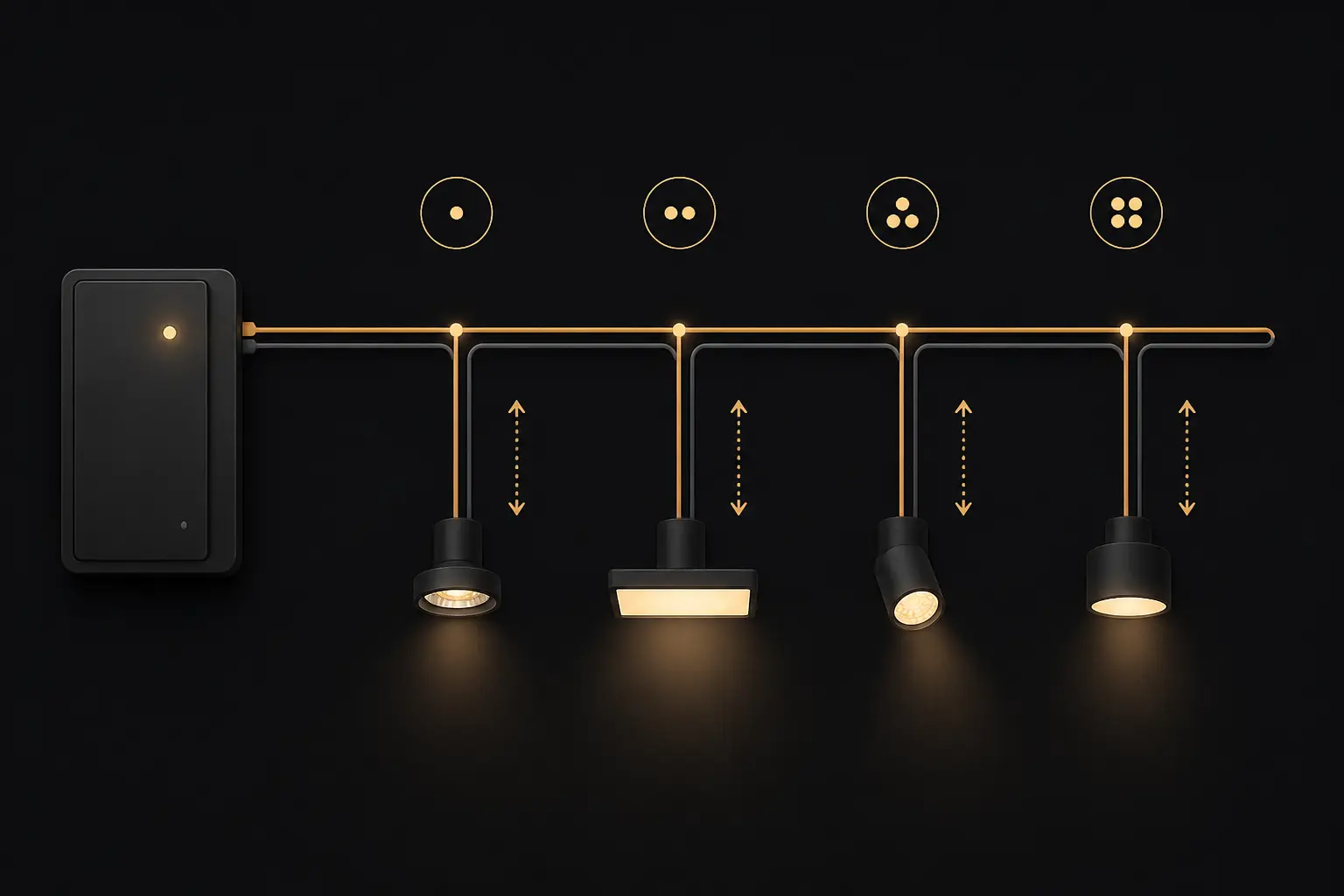
DALI (Digital Addressable Lighting Interface) is an open, digital protocol for controlling lighting, where each light fixture gets its own address and can be controlled individually over a simple two-wire cable. Unlike older analog dimming, DALI is two-way — fixtures report back their status and faults — and lets you group lights, set scenes, and adjust them precisely, all in software rather than rewiring. A single DALI line can control up to 64 devices individually. It's the standard behind most professional lighting control in offices, hotels, and increasingly premium homes.
If you've looked into serious lighting control, you've likely come across "DALI" — often mentioned alongside KNX or as a spec on quality LED drivers. But what actually is it, and why does it matter? This guide explains DALI in plain terms: how it works, its benefits, and where it's used.
Who Is This Guide For?
Homeowners and clients planning premium lighting who keep seeing "DALI" and want to understand it. Architects and interior designers specifying lighting control for residential or commercial projects. And anyone comparing lighting control options — DALI, KNX, Zigbee, or standard dimming — who wants to know where DALI fits.
What Does DALI Mean?
DALI stands for Digital Addressable Lighting Interface. Breaking that down explains exactly what it does:
- Digital — it sends digital data (not just an analog voltage level), so control is precise and reliable.
- Addressable — every fixture has its own unique address, so each can be controlled individually.
- Lighting Interface — it's a communication language specifically for lighting.
It is an open communication protocol defined by the IEC 62386 standard, developed as a digital successor to analog 0-10V dimming. The protocol is owned by the Digital Illumination Interface Alliance (DiiA), now commonly referred to as the DALI Alliance — a consortium of lighting manufacturers that keeps it an open, cross-brand standard.
How Does DALI Work?
At its simplest, DALI connects your light fixtures to a controller over a two-wire cable, and each fixture listens for its own address.
Here's the flow: a controller (or gateway) sends a digital command down the DALI line — say, "fixture 12, dim to 40%." Only fixture 12 responds. Because it's two-way communication, that fixture can also report back — its current level, or whether the lamp has failed. This is achieved through two-way communication, where each device can both send and receive signals.
A few technical basics worth knowing:
- A single DALI bus supports up to 64 individually addressable control gear devices (LED drivers, ballasts), and fixtures can be organised into groups and scenes.
- The wiring is simple — power and control lines can be laid together and no shielding is required, and the topology is flexible.
- For bigger buildings, multiple DALI lines are linked through gateways into one system.
The key idea: once wired, everything is controlled in software. Want to regroup lights, change a scene, or reassign a switch? You reconfigure it digitally — no rewiring.
DALI vs Analog Dimming (0-10V)
The easiest way to understand DALI's value is to compare it with the older analog method it replaced.
| Feature | Analog (0-10V) | DALI (Digital) |
|---|---|---|
| Control | One voltage for a whole group | Each fixture individually addressable |
| Communication | One-way | Two-way (reports status & faults) |
| Regrouping / scenes | Needs rewiring | Done in software |
| Wiring | More complex | Simple two-wire, no shielding |
| Fault reporting | No | Yes — flags failed lamps |
| Best for | Basic dimming | Precise, flexible, scalable control |
With 0-10V, a single control signal dims an entire group together, and changing the layout means rewiring. With DALI, every fixture is independent, the system talks back, and changes happen in software. That flexibility is why DALI became the professional standard.
What Is DALI-2?
You'll often see "DALI-2" — it's worth clarifying. Whilst DALI generally refers to the technology behind the protocol, DALI-2 is the certification program which is based on the latest version of the protocol.
The practical benefit is interoperability. DALI-2 (IEC 62386 Edition 2) adds mandatory third-party certification testing, standardized control device types (sensors, push buttons, gateways), multi-master support, and improved interoperability. In plain terms: DALI-2-certified products from different brands are guaranteed to work together, so you're not locked into one manufacturer. DALI-2 also standardised support for features like colour and tunable-white control.
When choosing DALI products, looking for DALI-2 certification is the simplest way to ensure cross-brand compatibility.
The Benefits of DALI Lighting
Individual fixture control. Every light can be dimmed and controlled on its own — no more lighting a whole zone the same way.
Flexible grouping and scenes. Group and regroup fixtures, and set scenes, all in software. As a space's use changes, the lighting adapts without rewiring.
Two-way feedback. The system knows each fixture's status and can flag a failed lamp — invaluable for maintenance in larger buildings.
Simpler wiring. A two-wire bus, no shielding needed, laid alongside power — cleaner than complex analog setups.
Open standard. Being brand-neutral means you can mix vendors and aren't trapped in one ecosystem, especially with DALI-2 certification.
Integration. Through gateways, DALI connects to wider systems like KNX and building management — lighting becomes part of the whole smart building, not an island. Our guide on the ABB DALI gateway shows exactly this — DALI lighting bridged into a KNX home.
Where Is DALI Used?
Commercial buildings are DALI's heartland — offices, hotels, retail, hospitals, and airports, where precise control, scenes, energy efficiency, and fault reporting across many fixtures matter. It pairs naturally with commercial lighting automation.
Premium homes increasingly use DALI for sophisticated lighting control — especially where there are many fixtures, tunable white, or a desire for precise, reconfigurable scenes integrated with the wider smart home.
Anywhere with lots of fixtures and a need for flexible, individual control benefits from DALI over basic dimming.
For homes, DALI is often one layer within a broader control system like KNX — our KNX vs Zigbee comparison explains how these platforms relate.
DALI vs KNX vs DMX — Quick Clarity
These often get confused:
- DALI — a protocol specifically for lighting control (dimming, scenes, per-fixture).
- KNX — a broader building automation standard (lighting, blinds, HVAC, security). DALI lighting often sits within a KNX system via a gateway.
- DMX — designed for entertainment/stage and dynamic colour lighting, fast and effect-driven. Our DMX lighting guide covers that.
Simply: DALI for architectural lighting control, DMX for shows and colour effects, KNX for the whole building.
Expert Recommendation from Brightmatic
For projects where lighting control needs to be precise and flexible — many fixtures, scenes, tunable white, or commercial-grade requirements — we frequently specify DALI, ideally DALI-2 certified, integrated into the wider system via a gateway.
The insight worth passing on: clients sometimes ask why not just use simple dimmers. For a few lights, basic dimming is fine. But the moment you have many fixtures, want reconfigurable scenes, or need the lighting to talk to the rest of the building, DALI's addressability and two-way feedback change everything. The wiring is simpler, the control is granular, and years later you can rework the entire lighting logic in software without opening a wall. It's an investment in flexibility that pays off over the life of the space.
That's why DALI features in our architectural lighting approach for the right projects — lighting control that's Designed Around Experience, and built to adapt.
Planning Sophisticated Lighting Control?
DALI is the quiet standard behind professional lighting — the reason a building's lights can be controlled individually, grouped into scenes, and reconfigured in software years later. For the right project, it's the foundation of flexible, future-proof lighting.
Wondering if DALI is right for your project? Get a free consultation.
Planning a home or project in Noida or Delhi NCR? Contact Brightmatic for a personalised lighting control consultation.
FAQ's
What is DALI lighting in simple terms?
DALI (Digital Addressable Lighting Interface) is a digital protocol where each light fixture has its own address and can be controlled individually over a two-wire cable. Unlike basic dimming, it's two-way — fixtures report their status — and lets you group lights and set scenes in software rather than by rewiring.What does DALI stand for?
DALI stands for Digital Addressable Lighting Interface. "Digital" means it sends digital data for precise control, "addressable" means each fixture has a unique address for individual control, and it's an interface (communication language) specifically for lighting.What is the difference between DALI and 0-10V dimming?
0-10V is analog and one-way — a single voltage dims a whole group together, and changes need rewiring. DALI is digital and two-way — each fixture is individually addressable, reports its status and faults, and can be regrouped or rescened in software. DALI is far more flexible and scalable.What is DALI-2?
DALI-2 is the certification program based on the latest version of the DALI protocol (IEC 62386). Its main benefit is guaranteed interoperability — DALI-2-certified products from different manufacturers are tested to work together, so you aren't locked into one brand. It also standardised features like colour and tunable-white control.How many lights can DALI control?
A single DALI bus (line) supports up to 64 individually addressable control gear devices, such as LED drivers, organised into groups and scenes. For larger buildings, multiple DALI lines are linked together through gateways into one coordinated system.Is DALI better than KNX?
They do different jobs. DALI is a protocol specifically for lighting control, while KNX is a broader building-automation standard covering lighting, blinds, HVAC, and more. They're often used together — DALI handles the lighting and connects into a KNX system via a gateway, rather than one replacing the other.Is DALI good for homes?
Yes, especially premium homes with many fixtures, tunable white, or a desire for precise, reconfigurable lighting scenes. For very simple setups, basic dimming may suffice, but DALI's individual control and flexibility suit sophisticated home lighting, usually as part of a wider system like KNX.
Comments
No Comments