

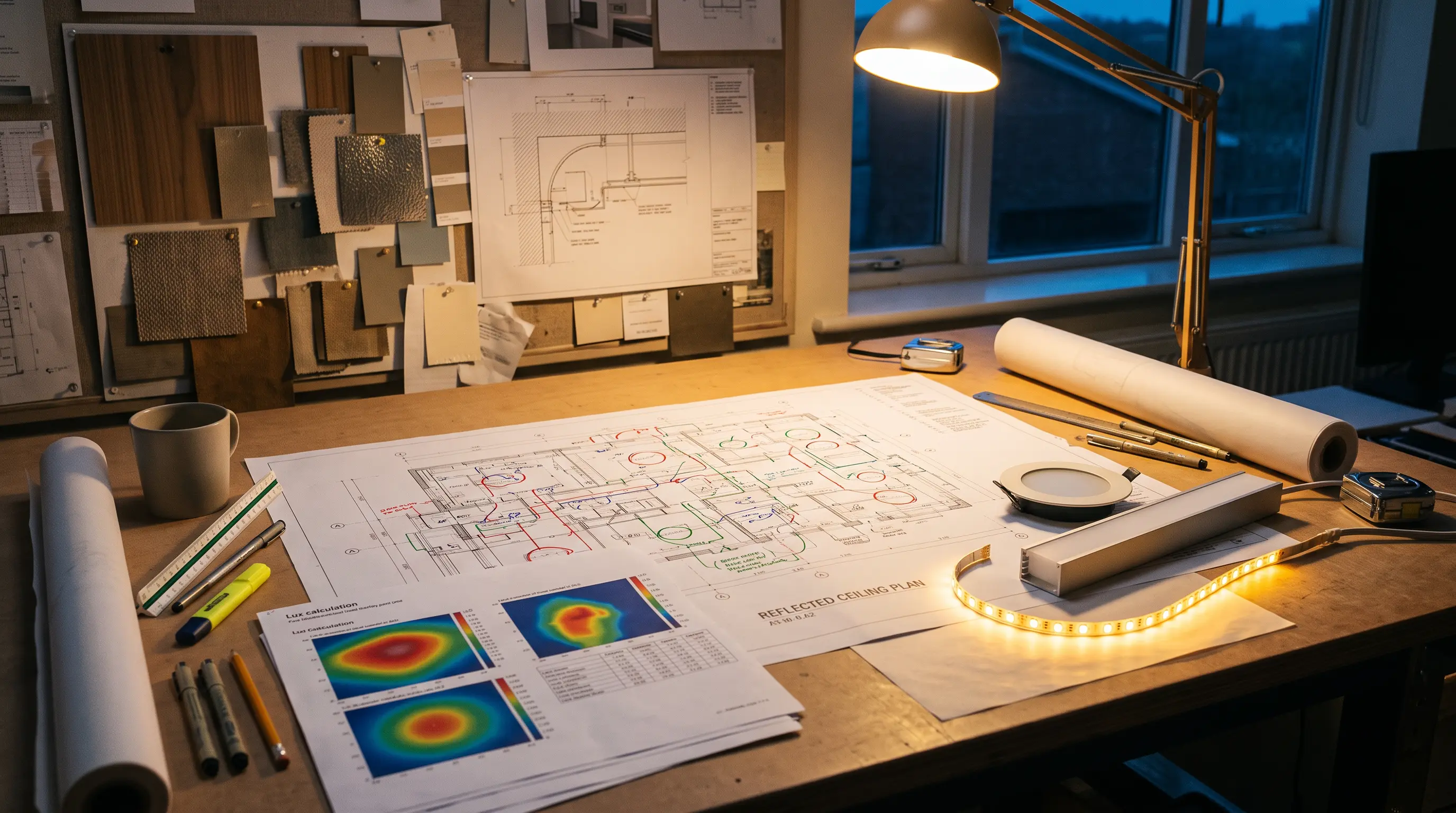
Architects and designers in India need a lighting partner who covers the whole chain: lighting concept, lux calculations, fixture specification, BOQ, sampling, lighting controls, site coordination and after-sales. The best partners also check LED quality (test reports, CRI and driver warranty) so the finished space looks like the render.
Most lighting failures on site start with a good design. The layout was right and the mood board was right. Then the fixtures were bought from three vendors, the drivers didn't match the dimmers, and the "warm white" in the bedroom came from a different batch than the living room.
Those gaps sit between the architect, the supplier, the electrician and the ceiling contractor, and a lighting partner's job is to close them. This guide sets out what that partner should deliver, what to check before you specify, and where projects usually go wrong.
Who is this guide for?
- Architects who want lighting to match the design intent on site
- Interior designers who need layouts, BOQs and samples for client approval
- MEP and electrical consultants coordinating circuits and controls
- Developers standardising lighting across projects
What lighting solutions do architects need from a lighting partner?
A lighting partner turns the architect's intent into a buildable lighting scheme, from concept and calculation through procurement, controls and handover.
| Service | What you should get |
|---|---|
| Lighting concept | Layers of ambient, task and accent light mapped to the design |
| Lux calculations | Light levels checked per room, often in DIALux or Relux |
| Specification | Fixture schedule with wattage, lumens, CCT, CRI, beam angle and driver |
| BOQ and estimate | Quantities and a costed BOQ for client approval |
| Sampling and mock-ups | Real fittings tested in the real space before bulk ordering |
| Lighting controls | Dimming and scenes through DALI, 1-10 V, phase-cut or KNX |
| Site coordination | Ceiling cut-outs, cove profiles, driver access and circuit checks |
| After-sales | Spares, driver replacements and warranty support |
Many suppliers stop after the BOQ. Sampling, controls, site coordination and after-sales decide whether the finished space matches the drawings.
What should a lighting partner deliver at each project stage?
Each stage needs a specific output, and the partner should hand it over before the next stage begins.
| Stage | Partner's output |
|---|---|
| Concept | Lighting concept and mood references |
| Design development | Lighting layout on the RCP, lux calculation, draft schedule |
| Tender or BOQ | Final schedule, BOQ, approved alternatives |
| Pre-execution | Samples or mock-up, driver and control check |
| Execution | Site visits, ceiling and cove coordination, testing |
| Handover | Scene programming, as-built schedule, warranty documents |
Which drawings and documents should you expect?
At minimum: a lighting layout on the reflected ceiling plan (RCP), a switching or circuit layout, a lighting schedule and a lux calculation for the main rooms.
The lighting schedule matters most. It should list the driver type for every circuit, because the driver decides whether a light can be dimmed and by which system. A schedule without driver details is how dimmable coves turn up with non-dimmable drivers.
For light levels, Indian projects usually refer to IS 3646 and the National Lighting Code of India from the Bureau of Indian Standards. Ask your partner which targets they used for each space. Our guide to reading a lighting specification sheet explains how to check what's on a schedule.
How do you check lighting quality before specifying?
Ask for test data, check colour consistency and approve a physical sample before the order is placed.
- LM-79 report: measured lumens, wattage and colour of the complete fitting, not just the LED chip.
- LM-80 data: how the LED chip holds its brightness over time, which supports lifetime claims.
- CRI and R9: CRI 90+ for living spaces, and an R9 value that renders reds, skin tones and wood properly.
- Colour binning (SDCM): 3-step or tighter, so fittings from the same batch look the same.
- Driver brand and warranty: the driver usually fails before the LED does.
- Sample approval: the bulk order should match the approved sample, batch for batch.
The cheapest fitting on paper often costs more on site, once mismatched batches and failed drivers start coming back.
Want fittings sampled in your actual space? Talk to our lighting team →
How do lighting controls fit into the design?
Controls should be decided with the lighting design, because the control system decides which drivers, circuits and keypads the project needs.
| Control type | Best for |
|---|---|
| Phase-cut dimming | Simple dimming in homes and small spaces |
| 1-10 V dimming | Linear and office fittings |
| DALI | Individual fitting control, tunable white, commercial and hospitality |
| KNX | Whole-building control of lighting, curtains and HVAC from one system |
If KNX is planned, actuators sit in the distribution board and need DIN-rail space. Our KNX actuators guide for architects covers what to plan. For a full setup, see our lighting control service.
What goes wrong when lighting is sourced separately?
Most site problems come from gaps between the designer, the supplier, the electrician and the false ceiling contractor.
- Cove profiles cut too shallow, so the LED strip shows dots instead of a smooth line
- Mixed colour temperatures, because fittings came from different vendors or batches
- Drivers buried in the ceiling with no access panel for replacement
- Dimmers that flicker, because nobody matched them to the drivers
- Beam angles changed on site, turning a wall wash into scallops
At Brightmatic, we check cove sections, driver positions and dimming compatibility with the ceiling and electrical teams before installation begins, because each of these is cheap to fix on paper and expensive to fix in a finished ceiling.
Is a single lighting partner worth it?
- Does it cost more? Often not, once wrong orders, re-work and extra site visits are counted.
- Will it limit design freedom? It shouldn't. A good partner sources to your specification across brands.
- What can go wrong? A partner who only sells fittings and walks away after delivery. Ask who handles sampling, controls and after-sales.
What mistakes should you avoid?
- Approving fittings from a catalogue photo instead of a sample
- Leaving driver types off the lighting schedule
- Choosing controls after the ceiling is closed
- Mixing colour temperatures within one visual zone
- Ignoring driver access for maintenance
- Comparing BOQs with different fitting specifications
A common myth: a higher wattage means a better light. Light output depends on lumens, optics and beam angle, and a well-designed 7W fitting can outperform a careless 12W one.
Expert recommendation from Brightmatic
Bring the lighting partner in at concept stage and insist on a lighting schedule with driver types. Approve physical samples before bulk orders, and decide controls with the layout. Check test data and driver warranties as carefully as the look of the fitting. Our guides to layered lighting and choosing a lighting designer go deeper.
Brightmatic provides architectural lighting design, supply, controls and installation for architects, interior designers and developers.
Working on a project now? Send us your drawings. We'll return a lighting layout and BOQ, free.
Work with Brightmatic on your next project
Brightmatic designs, supplies and installs architectural lighting and lighting controls for architects, interior designers and developers in Noida, Delhi NCR & across India.
FAQ's
What does a lighting consultant do for architects?
They plan the lighting concept, calculate light levels, specify fittings and drivers, prepare the BOQ and coordinate on site until handover.
Do lighting partners provide free layouts?
Many supply partners offer layouts and BOQs as part of the project, especially when they also supply the fittings.
What is a lighting BOQ?
A bill of quantities listing every fitting, driver and control item with quantities and costs, used for client approval and tendering.
What lux levels should I design for?
It depends on the space. Indian projects usually refer to IS 3646 and the National Lighting Code for room-by-room targets.
Can lighting controls be added after design?
Sometimes, but it often means changing drivers and wiring. It's cheaper to plan controls with the layout.
How do I check LED quality before specifying?
Ask for LM-79 and LM-80 data, check CRI and R9, confirm colour binning and driver warranty, and approve a physical sample.
Comments
No Comments