

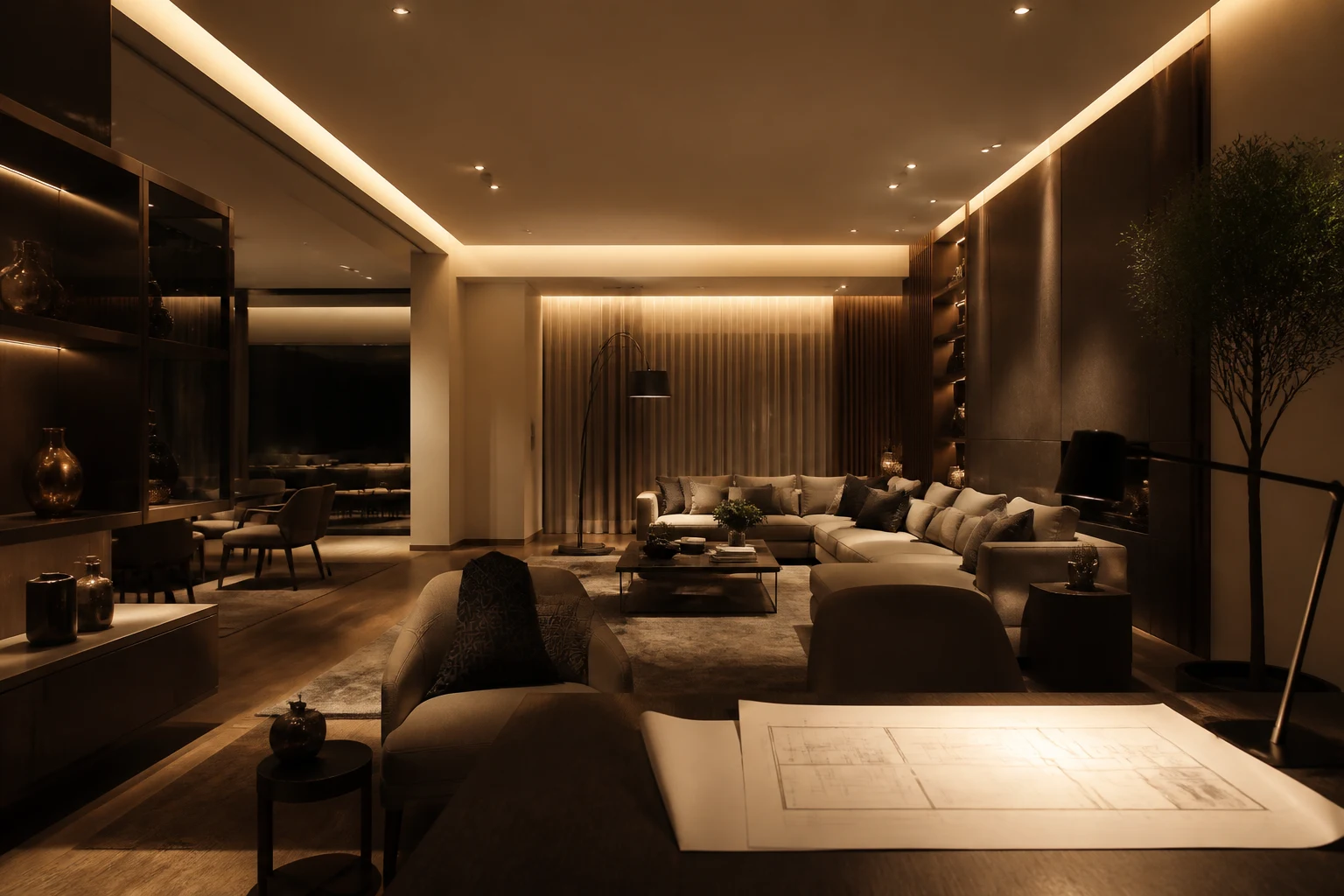
A lighting designer plans how light works in a space — the layers, fixtures, placement, colour temperature, and controls — so it looks beautiful, functions well, and feels right, rather than just being bright. Choosing a good one in Delhi NCR comes down to their design capability and portfolio, whether they plan lighting properly (a reflected ceiling plan, layered scheme, and controls), their understanding of both aesthetics and technical detail, and whether they design around how you live rather than selling fixtures. The best lighting designer is involved early — at the drawing stage — and coordinates with your architect and interior designer. This guide explains what a lighting designer does, when you need one, and how to choose the right one.
Most homes are lit by whoever installs the electricals — resulting in a grid of downlights and little else. A lighting designer transforms a space entirely. This guide helps you understand and choose one in Delhi NCR.
Who Is This Guide For?
Homeowners building or renovating a home, villa, or apartment in Noida, Greater Noida, Gurgaon, Faridabad, Ghaziabad, or Delhi, who want their lighting done properly. Architects and interior designers looking for a lighting design partner. And anyone who's seen the difference good lighting makes and wants to find the right professional.
What Does a Lighting Designer Actually Do?
A lighting designer is a specialist who plans a space's lighting as a designed system — quite different from an electrician who installs fixtures, or a showroom that sells them.
Their work includes designing the layers of light (ambient, task, accent) for each space, choosing and placing fixtures for the right effect, specifying colour temperature and quality (CRI) to suit each room, planning controls and scenes (dimming, automation), and producing a lighting plan (a reflected ceiling plan) that shows every light, switch, and circuit before construction.
In short, they think about how light will work in your space — how it looks, functions, and feels through the day — rather than just ensuring there's enough of it. This is the difference between a home that's merely lit and one that's beautifully lit. Our guide on what architectural lighting is explains the discipline in more depth.
When Do You Need a Lighting Designer?
When building or renovating. The ideal time — lighting designed before construction means conduits, circuits, and ceiling geometry are right from the start. Decisions made after plastering cost far more.
For a premium or design-led home. If you're investing in good architecture and interiors, lighting deserves the same care — it's what brings the whole design to life after dark.
When you want more than downlights. If you want layered, atmospheric, controllable lighting — not a flat grid — you need someone who designs it.
For complex or large spaces. Villas, multi-level homes, and homes with special features benefit most from professional design.
When integrating automation. If lighting ties into a smart home, a designer ensures it's planned coherently.
For a simple flat where basic lighting suffices, you may not need one. But for any home where lighting matters, a designer is what makes the difference.
How to Choose a Lighting Designer in Delhi NCR
Here's what actually matters.
1. Their Portfolio & Design Sense
The clearest signal. Look at their completed work — does the lighting look considered, layered, and beautiful? Does it show range and a genuine design sensibility, or just competent installation? Ask to see projects similar to yours.
2. Do They Actually Design (Not Just Supply)?
A true lighting designer produces a lighting plan — a reflected ceiling plan showing every fixture, switch, and circuit, with layers and controls thought through. If someone just hands you a fixture list or quotes per point without a design, they're supplying, not designing.
3. Aesthetics and Technical Knowledge
Good lighting design balances art and engineering. Your designer should understand the look (mood, layers, drama) and the technical (colour temperature, CRI, beam angles, lumens, controls). Both matter — beauty without technical grounding disappoints, and vice versa.
4. They Design Around How You Live
The best designers ask how you use each space — where you read, cook, relax, entertain — and design for that, rather than applying a template. Lighting should serve your life, not a formula.
5. Early Involvement & Coordination
A good lighting designer wants to be involved early, at the drawing stage, and coordinates with your architect and interior designer. If they're happy to be brought in at the end, that's a limitation.
6. Understanding of Controls & Automation
Modern lighting design includes dimming, scenes, and often smart control. Your designer should be fluent in how lighting is controlled, not just how it's placed.
Questions to Ask a Lighting Designer
- Can I see your portfolio of completed projects?
- Will you produce a proper lighting plan (reflected ceiling plan)?
- How do you approach layering light in a room?
- How do you decide colour temperature and CRI for each space?
- Do you plan the controls, dimming, and scenes too?
- Will you coordinate with my architect and interior designer?
- When in the project do you like to get involved?
A serious lighting designer answers these with depth and shows their thinking. Vague answers or a jump straight to a fixture quote are a warning sign.
Lighting Designer vs Electrician vs Showroom
These get confused, so to be clear:
- An electrician installs and wires fixtures safely — essential, but doesn't design the scheme.
- A lighting showroom sells fixtures — useful for buying, but not for designing how your space is lit.
- A lighting designer plans the whole lighting scheme — layers, placement, colour, controls — as a designed system.
For a beautifully lit home, you want a designer directing the scheme, with the electrician executing it and fixtures chosen to fit the design. If you're comparing full-service providers, our guide on choosing a lighting company in Noida and Delhi NCR covers that angle, and how to evaluate any lighting or automation company goes further.
Why Local (Delhi NCR) Matters
A lighting designer serving Delhi NCR can visit your site, understand the space firsthand, coordinate with your other consultants during the build, and be present through installation and commissioning. Lighting design isn't done from a distance — it needs someone who sees the space, understands the light through the day, and is there to get the result right. A local designer across Noida, Gurgaon, Faridabad, Ghaziabad, and Delhi can do that.
Expert Recommendation from Brightmatic
For the homes we design across Delhi NCR, our view on choosing a lighting designer is simple: judge them on their design thinking, not their fixture catalogue. Ask to see how they'd plan your home — the layers, the reasoning, the controls — before anything else.
The insight worth passing on: the biggest mistake we see is treating lighting as a shopping exercise — picking fixtures from a showroom and asking an electrician to fit them. That produces a lit home, not a designed one. A real lighting designer starts not with products but with your space and your life — how each room is used, how light should move through the day, where drama and calm belong — and then specifies the fixtures to achieve it. The fixtures are the last step, not the first. When you choose a designer who thinks that way, the result is a home that feels considered in every corner, where the lighting does something you can feel but can't quite name.
That's the approach behind our own architectural lighting work — lighting that's Crafting Brighter Lives, designed around how you live.
Planning Lighting for Your Home?
The right lighting designer transforms a space — turning a functional grid of lights into a considered, layered, atmospheric scheme that brings your whole home to life. The key is choosing someone who designs around your space and life, not someone who sells fixtures.
Want your home lit beautifully? Get a free consultation.
Planning a home in Noida or Delhi NCR? Contact Brightmatic for a personalised lighting design consultation.
FAQ's
What does a lighting designer do?
A lighting designer plans a space's lighting as a designed system — the layers (ambient, task, accent), fixture selection and placement, colour temperature and quality, and controls and scenes — and produces a lighting plan showing every light and circuit. They focus on how light looks, functions, and feels in a space, rather than just providing enough brightness, which distinguishes them from an electrician or fixture showroom.When should I hire a lighting designer?
Ideally when building or renovating, at the drawing stage, so lighting is planned before conduits and ceilings are fixed. You especially need one for a premium or design-led home, when you want layered atmospheric lighting rather than a flat grid of downlights, for complex or large spaces, and when integrating lighting with a smart home. For a simple space with basic needs, you may not require one.How do I choose a good lighting designer in Delhi NCR?
Look at their portfolio and design sense, confirm they actually design (producing a proper lighting plan, not just a fixture list), check they balance aesthetics with technical knowledge, and ensure they design around how you live and get involved early. Ask to see completed projects and how they'd approach your home before deciding. A local Delhi NCR designer can visit your site and coordinate through the build.What is the difference between a lighting designer and an electrician?
An electrician installs and wires fixtures safely but doesn't design the lighting scheme. A lighting designer plans the whole scheme — the layers, placement, colour temperature, and controls — as a designed system, then the electrician executes it. For a beautifully lit home, you want a designer directing the design and an electrician carrying out the installation.Is hiring a lighting designer worth it?
For any home where lighting matters, yes. The difference between a professionally designed lighting scheme and a default grid of downlights is dramatic — designed lighting brings architecture and interiors to life, creates atmosphere, and functions better for how you live. The investment in design pays back in a home that feels considered and beautiful, especially when planned early to avoid costly changes later.
Comments
No Comments