

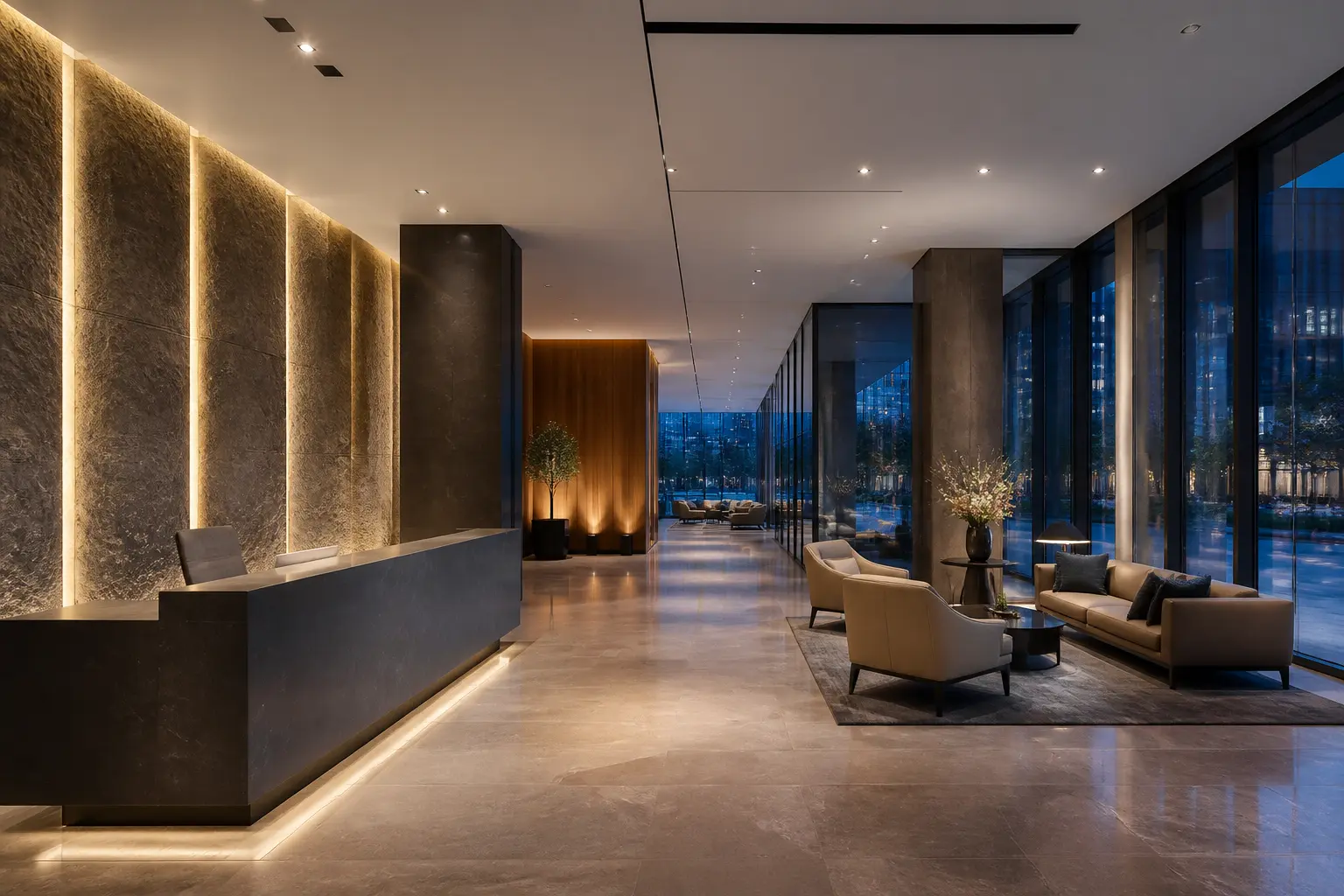
Architectural lighting for commercial spaces uses light as a designed element — shaping how a space looks, functions, and makes people feel — rather than just providing brightness. In offices, retail, hotels, restaurants, and corporate environments, it combines ambient, task, and accent layers to support the work done there, reinforce the brand, guide people through the space, and create the right atmosphere. Good commercial lighting improves productivity and wellbeing, drives sales in retail, elevates guest experience in hospitality, and manages energy costs across long operating hours. It's a strategic investment, not a utility — one that directly affects how a commercial space performs.
In a commercial space, lighting does far more than let people see. It affects how staff perform, how customers behave, how a brand is perceived, and how much energy the building consumes. This guide covers architectural lighting design for commercial spaces across India.
Who Is This Guide For?
Business owners, developers, and facility managers designing or upgrading a commercial space — office, retail, hotel, restaurant, or corporate building — in Noida, Greater Noida, Gurgaon, Delhi NCR, or across India. Architects and interior designers specifying lighting for commercial projects. And anyone wanting to understand how lighting shapes a commercial space's success.
Why Commercial Lighting Is Strategic
Unlike a home, where lighting serves comfort, commercial lighting serves business outcomes. Each type of space has a job for its lighting to do:
- An office needs light that supports focus, reduces fatigue, and creates a professional environment.
- A shop needs light that makes products irresistible and guides customers to buy.
- A hotel needs light that welcomes guests and elevates the sense of luxury.
- A restaurant needs light that sets the mood and flatters food and faces.
In every case, lighting is a tool that directly affects the space's commercial performance. That's why it deserves professional design, not an afterthought.
The Layers of Commercial Lighting
Good commercial lighting, like all architectural lighting, works in layers — combined and balanced for each space.
Ambient lighting provides the base level of illumination that lets people move and work comfortably. In commercial spaces this must be efficient, even, and appropriate to the task.
Task lighting delivers focused light where specific work happens — desks in an office, counters in a shop, prep areas in a kitchen. Correct task lighting is essential for productivity and safety.
Accent lighting highlights what matters — products in retail, architecture in a lobby, features in a restaurant — creating focus, depth, and visual interest.
The art is balancing these layers for each space's purpose. An office leans on even, glare-free ambient and task light; a boutique leans heavily on accent; a restaurant blends soft ambient with warm accents. Getting the balance right for the space is what defines good commercial lighting.
Lighting by Commercial Space Type
Different commercial spaces have very different lighting needs.
Offices & workplaces. The priority is comfortable, glare-free, productive light that supports focus and wellbeing over long hours, with energy efficiency across large floors. Our office lighting design guide covers this in depth.
Retail & showrooms. Here lighting sells — accent-heavy schemes, high colour accuracy, and contrast that makes products stand out. Our retail and showroom lighting guide goes deeper.
Hotels & hospitality. Lighting creates atmosphere and luxury — warm, layered, scene-based schemes in lobbies, rooms, and restaurants that shape the guest experience.
Restaurants & cafés. Mood is everything — warm, flattering light that makes diners comfortable and food appealing, with flexibility between day and evening.
Corporate & reception areas. Lighting makes a first impression and reinforces brand identity, balancing impressive design with function.
Healthcare, education & institutional. Function-first lighting — bright, even, accurate — that supports specific activities and wellbeing.
Each demands a different approach, which is why commercial lighting is designed space by space, not applied as a template.
Colour Temperature & CRI in Commercial Spaces
Two technical factors strongly shape commercial lighting.
Colour temperature sets the mood. Warmer light (2700–3000K) suits hospitality, restaurants, and premium retail where comfort and intimacy matter. Neutral to cool light (4000K) suits offices, supermarkets, and clinical spaces where alertness and precision matter. Matching colour temperature to the space's purpose is fundamental.
CRI (Colour Rendering Index) measures how accurately light shows colours. In retail, hospitality, and anywhere appearance matters, high CRI (90+) is essential — it's the difference between products and food looking appealing or dull. In offices, good CRI supports comfort and accuracy.
Getting these right for each commercial space is a hallmark of professional lighting design.
The Benefits of Good Commercial Lighting
Productivity & wellbeing. In workplaces, well-designed lighting reduces fatigue and eye strain and supports focus — directly affecting output and staff satisfaction.
Sales & customer behaviour. In retail and hospitality, lighting draws people in, guides them, highlights what matters, and encourages them to stay and spend.
Brand & impression. Lighting shapes how a commercial space feels the moment someone walks in, reinforcing the brand's positioning and quality.
Energy efficiency. Commercial spaces run long hours, so efficient LED lighting and controls significantly cut running costs — often a major operating expense. This pairs naturally with commercial lighting automation.
Flexibility. Scene-based and controllable lighting lets a space adapt — a restaurant from bright lunch to intimate dinner, an office from focused work to a presentation.
Compliance & safety. Proper lighting levels meet standards and ensure safe, well-lit environments.
What to Consider for Commercial Lighting
Design for the space's purpose. The lighting must serve what the space is for — selling, working, dining, hosting. Purpose drives the design.
Plan for efficiency and control. Given long operating hours, energy-efficient fixtures and automation (occupancy sensing, scheduling, daylight harvesting) deliver major savings and flexibility.
Prioritise quality and CRI where it matters. Especially in retail and hospitality, quality fixtures and high CRI are worth the investment.
Plan early. Commercial lighting is far more effective and economical when designed into the space from the start, coordinated with architecture and interiors.
Think long-term. Durable, quality lighting with good controls costs less over a commercial space's life through lower energy and maintenance.
Expert Recommendation from Brightmatic
For the commercial spaces we light across Delhi NCR — offices, retail, and hospitality — our approach starts with a question that has nothing to do with fixtures: what does this space need to achieve, and how should people feel and behave in it? From there we design the layers, colour temperature, CRI, and controls to serve that goal.
The insight worth passing on: commercial lighting is too often treated as a utility — enough fixtures to hit a brightness level, chosen on price. But lighting is one of the most powerful, and most underused, tools a commercial space has. The same office lit thoughtfully versus generically produces measurably different focus and morale. The same shop lit to sell versus merely lit produces different sales. The lighting isn't a cost to minimise; it's a lever that affects how the whole space performs. Spend on it wisely, design it around the space's real purpose, and it pays back in productivity, sales, and impression.
That's the thinking behind our architectural lighting work for commercial spaces — lighting that's Crafting Brighter Lives, and helping businesses perform.
Planning Lighting for a Commercial Space?
Commercial lighting is a strategic investment that shapes how your space performs — how staff work, how customers behave, how your brand is perceived, and what you spend on energy. Designed around the space's real purpose, it delivers returns a generic install never can.
Planning an office, retail, or hospitality project? Get a consultation.
Designing a commercial space in Noida or Delhi NCR? Contact Brightmatic for a personalised commercial lighting consultation.
FAQ's
What is architectural lighting for commercial spaces?
Architectural lighting for commercial spaces uses light as a designed element that shapes how a space looks, functions, and feels — not just providing brightness. It combines ambient, task, and accent layers tailored to each space type (office, retail, hotel, restaurant) to support its purpose, reinforce the brand, and manage energy, making it a strategic business investment.Why is lighting important in commercial spaces?
Lighting directly affects business outcomes — it influences staff productivity and wellbeing in offices, customer behaviour and sales in retail, guest experience in hospitality, and brand impression everywhere. It also manages energy costs across long operating hours. Well-designed commercial lighting is a tool that measurably affects how a space performs, not just a utility.What is the best lighting for commercial spaces?
The best commercial lighting uses layered ambient, task, and accent light balanced for the specific space, with colour temperature and CRI matched to its purpose — warm high-CRI light for hospitality and premium retail, neutral-to-cool light for offices and clinical spaces. Energy-efficient LEDs with automation suit the long operating hours. There's no single answer; it's designed per space.How does lighting affect employee productivity?
Well-designed office lighting reduces eye strain and fatigue, supports focus, and improves mood and wellbeing — all of which affect productivity and satisfaction. Glare-free, appropriately bright, good-CRI lighting, ideally with some daylight and tunable control, creates an environment where people work better and feel better over long hours.How can commercial lighting reduce energy costs?
Commercial spaces run long hours, so energy-efficient LED lighting combined with controls — occupancy sensors, scheduling, and daylight harvesting — ensures light is used only where and when needed. Across a whole space operating daily, this cuts a major operating expense substantially, making efficient lighting and automation a strong financial decision.
Comments
No Comments