

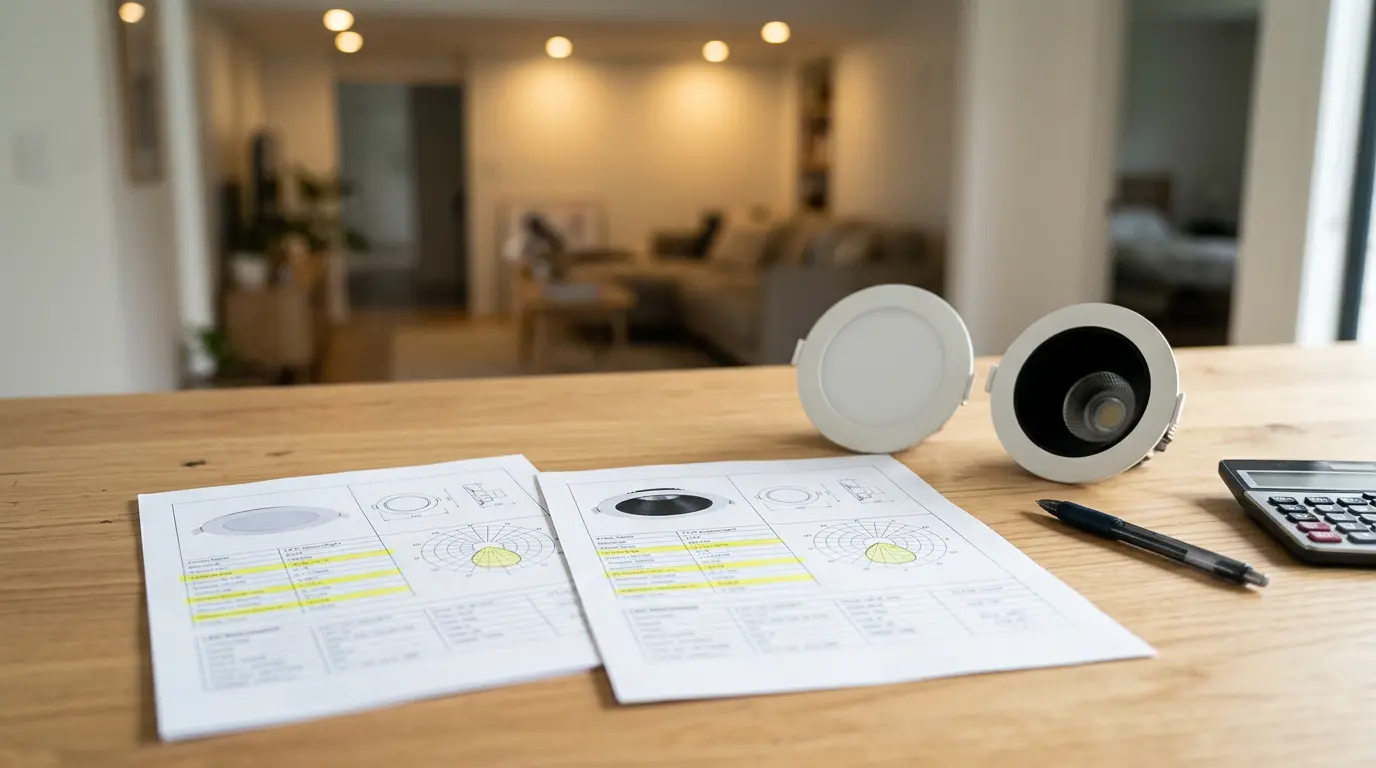
A lighting specification sheet lists the technical details of a light fitting. For homes, check lumens and efficacy for brightness, CCT for warmth, CRI 90+ for natural colour, beam angle, UGR for glare, IP rating for wet areas, driver and flicker quality, dimming type, L70 lifespan and warranty. These explain most price differences between similar-looking lights.
You have two quotes on the table. Both list “12W LED downlight, warm white”. One is Rs 900 a piece. The other is Rs 3,200.
The fittings look almost the same in the photos. So you choose the cheaper one, and a year later the light has turned slightly green, the bedroom has a faint flicker on camera, and two units have already died.
The difference was there all along, on the specification sheet. This guide explains every line on it in plain language, so you can compare quotes with confidence and know exactly what you are paying for.
Who is this guide for?
- Homeowners comparing lighting quotes for a new home or renovation
- Villa and apartment owners choosing between brands and price points
- Interior designers explaining fitting choices to clients
- Anyone who has bought LEDs that looked fine in the shop but disappointing at home
What is a lighting specification sheet?
A lighting specification sheet, or spec sheet, is a technical document that lists a fitting’s light output, colour, beam, glare, protection, electrical and lifespan details.
Good manufacturers publish complete, tested data. Vague or missing values on a spec sheet are often the first warning sign of a low-quality product.
What does each line on a spec sheet mean?
Ten values explain most of what matters for homes.
| Spec line | What it means | What good looks like for homes |
|---|---|---|
| Lumens (lm) | Total light output | Compare lumens, not watts |
| Efficacy (lm/W) | Light per watt of power | Higher is more efficient |
| CCT (K) | Colour temperature, warm to cool | 2700K–3000K for living spaces |
| CRI (Ra) | How naturally colours look | 90 or above |
| Beam angle | How wide the light spreads | Narrow for accents, wider for general light |
| UGR | Glare rating | Lower is more comfortable, ideally below 19 |
| IP rating | Protection from dust and water | IP44+ near showers, IP65+ outdoors |
| Driver and flicker | Quality of the power supply | Branded driver, low or no flicker |
| Dimming | How the light can be dimmed | Phase, 0-10V, DALI or smart, matched to your system |
| Lifespan (L70) and warranty | Hours until output drops to 70%, and cover | Long L70 rating with a multi-year warranty |
Which specs matter most for comfort and appearance?
CRI, colour temperature, glare and flicker decide how a room actually feels.
CRI is the line that most often separates cheap and premium LEDs. Low-CRI light makes skin look dull, wood look flat and white walls look slightly green. Our guide to CRI in lighting explains why 90+ matters.
Colour temperature sets the mood. Warm white suits bedrooms and living rooms, while neutral white suits kitchens and study areas. See our comparison of 3000K vs 4000K vs 5000K.
UGR tells you how much glare a fitting creates. Deep-set, well-shielded downlights feel calmer to sit under. Read more in our UGR and anti-glare lighting guide.
Flicker is often invisible but can cause eye strain. Cheap drivers are the usual cause. A simple phone camera test can sometimes reveal it as rolling lines on screen.
Which specs matter for performance and safety?
Efficacy, IP rating, driver quality and lifespan decide how well a light performs over the years.
- Lumens and efficacy: two 12W fittings can produce very different amounts of light. Always compare lumens.
- IP rating: bathrooms, balconies and gardens need fittings rated for moisture and dust.
- Driver: the driver is the heart of an LED. Branded, well-rated drivers last longer and dim smoothly.
- Power factor: a value above 0.9 indicates an efficient, better-designed driver.
- L70 lifespan: a long L70 rating means the light stays bright for longer before fading noticeably.
- Warranty: a longer warranty usually reflects the manufacturer’s confidence in the product.
At Brightmatic, we typically check CRI, driver brand, UGR and dimming compatibility first when reviewing a client’s quote. Those four lines explain most of the price differences we see.
How do specs change the price?
Better specs cost more, but they decide how a light looks, feels and lasts.
Indicative estimates only, not actual quotes.
| Downlight grade | Typical specs | Indicative price per fitting |
|---|---|---|
| Basic | CRI around 80, unbranded driver, no glare control, short warranty | Rs 500 – 1,200 |
| Mid-range | CRI 90+, branded driver, better optics | Rs 1,500 – 3,000 |
| Premium | CRI 90+, deep anti-glare optics, low flicker, dimmable | Rs 3,000 – 6,000 |
| Architectural | High CRI, UGR below 16, DALI or tunable white, long warranty | Rs 6,000 – 15,000+ |
For a sense of how many fittings each room needs, see how many downlights a room needs.
Comparing lighting quotes for a home in Noida or Delhi NCR? Send us both spec sheets, and we’ll explain the differences line by line.
Not sure what you’re comparing? Share your quotes →
How do you compare two quotes using spec sheets?
Compare like for like, line by line, before comparing price.
- Check that lumens, not just watts, are similar.
- Compare CRI and colour temperature.
- Check beam angle and UGR for the same purpose.
- Confirm IP ratings for wet or outdoor areas.
- Compare driver brand, flicker and dimming type.
- Compare L70 lifespan and warranty terms.
If one quote is missing several values, ask for the full spec sheet. A supplier who can’t provide one is telling you something.
Is reading spec sheets worth the effort?
- Is it complicated? Not once you know the ten key lines. Most decisions come down to four or five of them.
- Is a better spec more expensive? Upfront, yes. But it usually costs less than replacing failed or uncomfortable lights later.
- What can go wrong? Choosing on wattage and price alone, ignoring CRI and drivers, and mixing fittings with different colour temperatures.
What mistakes should you avoid?
- Comparing watts instead of lumens
- Ignoring CRI because the shop lighting looked fine
- Choosing fittings with no stated UGR for living spaces
- Using non-IP-rated fittings in bathrooms or balconies
- Buying dimmable fittings that don’t match your dimming system
- Accepting quotes without full spec sheets
A common myth: an LED is an LED, so the cheapest one with the right wattage is fine. In reality, the chip, optics and driver make the biggest difference in colour, comfort and lifespan.
Expert recommendation from Brightmatic
For most homes, we recommend fittings with CRI 90+, 2700K–3000K in living spaces, low-glare optics, branded low-flicker drivers, the right IP rating for each area, dimming that matches your control system, and a multi-year warranty. For dimming choices, our DALI vs 0-10V guide explains the options. The Bureau of Energy Efficiency also publishes guidance on efficient lighting products.
Brightmatic designs and specifies architectural lighting for homes, villas and premium interiors, and helps clients compare fittings before they buy.
Still comparing quotes? Talk to our lighting expert. We’ll review your spec sheets, free.
Choose the right lights with Brightmatic
Brightmatic helps homeowners specify and install the right lighting for homes and villas in Noida, Delhi NCR & across India.
Comments
No Comments