

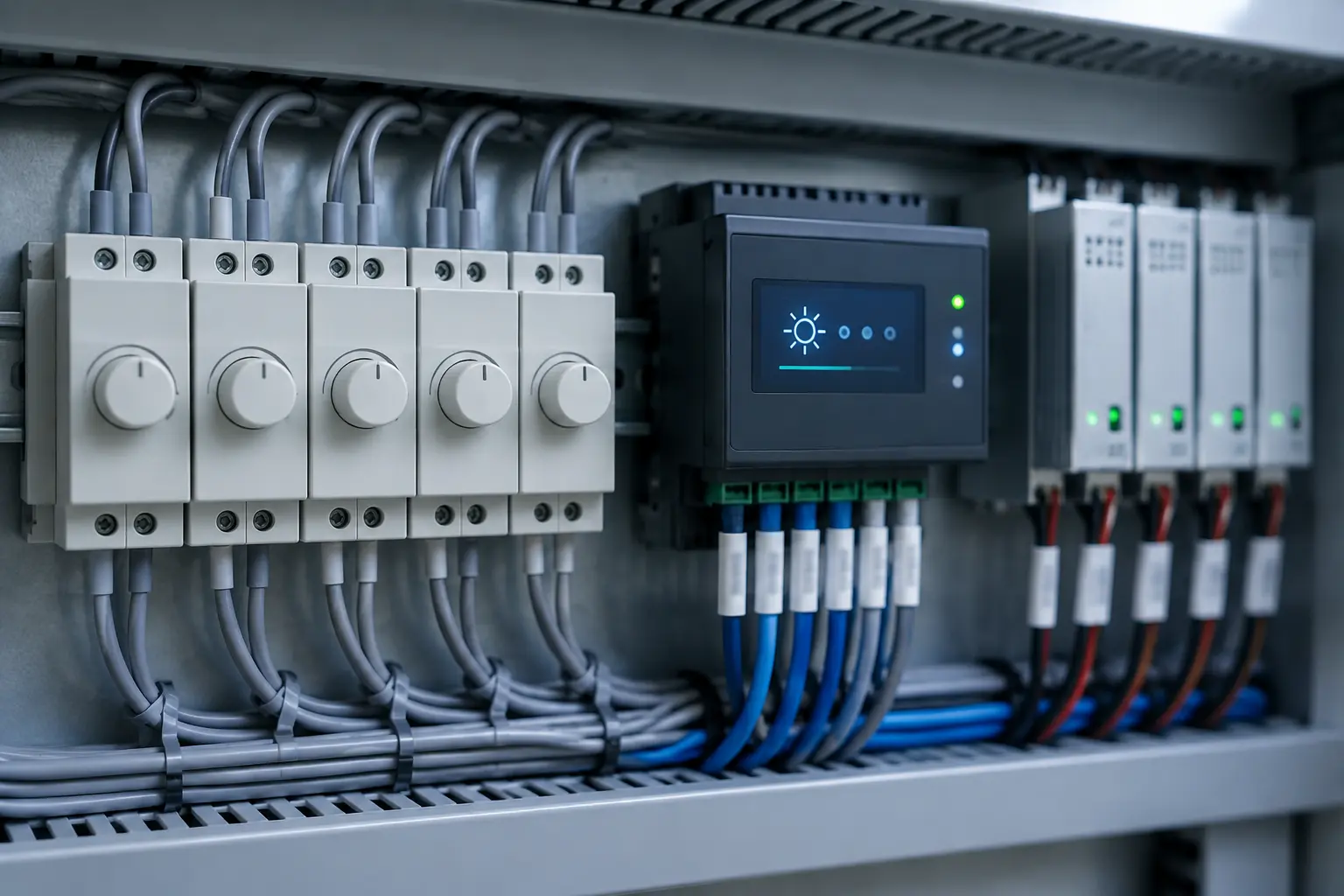
0-10V is a simple analog dimming method that controls groups of lights with a varying voltage signal. DALI is a digital protocol that addresses each light individually, supports scenes and groups, and reports faults back to the system. 0-10V is cheaper and suits basic zone dimming. DALI costs more but offers far greater control and flexibility.
An office floor is wired and dimming works. Six months later, the team moves desks and wants the lights regrouped. With one system, that’s a few clicks in software. With the other, it means an electrician, new wiring and a ceiling opened up again.
That’s the real difference between DALI and 0-10V. Both dim LED lights well. Only one stays flexible after installation. This guide explains how each works, what they cost and which suits your project.
Who is this guide for?
- Office, hotel and retail owners planning dimmable lighting
- Architects and MEP consultants specifying lighting control
- Villa and luxury home owners choosing between dimming systems
- Facility managers upgrading existing commercial lighting
What is 0-10V dimming?
0-10V is an analog control method where a low-voltage DC signal between 0 and 10 volts tells the LED driver how bright the light should be.
At 10V the light runs at full output, and as the voltage drops, the light dims. It needs two extra control wires alongside the power wires, and every driver connected to the same control wires dims together as one zone.
A closely related version, 1-10V, is common in IEC markets including India. It works the same way, with 1V as minimum brightness. In both, switching the light fully off usually needs a separate relay, because the minimum signal dims rather than switches off.
What is DALI?
DALI (Digital Addressable Lighting Interface) is an international digital lighting control standard that gives every driver its own address, so each light can be controlled individually.
Defined under IEC 62386 and maintained by the DALI Alliance, DALI uses a two-wire control bus. A single DALI line typically supports up to 64 drivers, which can be organised into up to 16 groups and up to 16 scenes per device. Crucially, DALI is two-way: drivers can report their status and faults back to the system.
DALI-2, the newer version, adds certified interoperability between brands and standardises input devices like sensors and push buttons. Read our DALI lighting guide for a deeper explanation.
What are the key differences between DALI and 0-10V?
The biggest differences are individual addressing, two-way communication and how easily lighting can be regrouped after installation.
| Feature | 0-10V / 1-10V | DALI |
|---|---|---|
| Signal type | Analog DC voltage | Digital protocol |
| Control level | Zone or group only | Each light individually |
| Regrouping lights | Needs rewiring | Done in software |
| Feedback | None | Status and fault reporting |
| Scenes | Needs an external controller | Built into the system |
| Switching off | Usually needs a separate relay | Handled digitally |
| Dimming curve | Mostly linear | Logarithmic, smooth at low levels |
| Long cable runs | Voltage drop can cause mismatch | Digital signal stays consistent |
| Installation | Simple | Needs addressing and programming |
| Cost | Lower | Higher |
How much do DALI and 0-10V systems cost?
0-10V is cheaper upfront because drivers and controllers are simpler, while DALI costs more because of digital drivers, bus power supplies, gateways and programming.
Indicative estimates only, not actual quotes.
| Item | 0-10V / 1-10V | DALI |
|---|---|---|
| Dimmable LED driver | Rs 800 – 3,000 | Rs 1,500 – 5,000 |
| Zone controller or dimmer | Rs 2,000 – 8,000 per zone | Not needed per zone |
| DALI bus power and gateway | Not needed | Rs 40,000 – 1.2 lakh per system |
| Programming and commissioning | Minimal | Often 10–20% of hardware cost |
For a small project with a few zones, 0-10V is usually more economical. On larger projects with many zones, sensors and frequent layout changes, DALI often costs less over its lifetime, because changes don’t need rewiring. For full system pricing, see our lighting control system cost guide.
When should you choose 0-10V?
Choose 0-10V when you need simple, reliable zone dimming on a limited budget.
- Small offices, shops and restaurants with a few lighting zones
- Projects where the layout is unlikely to change
- Retrofits where existing drivers are already 0-10V or 1-10V
- Spaces that only need basic dimming, without scenes or monitoring
When should you choose DALI?
Choose DALI when you need individual control, scenes, sensors, monitoring or the freedom to change layouts later.
- Offices with flexible seating and daylight-linked dimming
- Hotels, where lobbies, corridors and rooms need different scenes
- Retail and showrooms that change displays frequently
- Luxury villas wanting precise, flicker-free dimming
- Buildings where lighting must integrate with KNX or a building management system
DALI also integrates with KNX through gateways, so one keypad can control DALI lights alongside curtains and climate. See our ABB DALI gateway guide.
At Brightmatic, we often recommend DALI for commercial projects above a few thousand square feet, because the flexibility pays for itself the first time the layout changes.
Not sure which suits your project? Share your drawings for a recommendation →
Is DALI worth the extra cost?
- Is it expensive? Per driver, yes. Over a building’s life, often not, because changes are made in software instead of with new wiring.
- Is it complicated? Installation needs addressing and programming, but day-to-day use is simple.
- What can go wrong? Mixing non-certified devices, poor addressing records and no handover documentation.
What mistakes should you avoid?
- Mixing DALI and 0-10V drivers on the same circuit without a plan
- Forgetting the relay needed to switch 0-10V lights fully off
- Ignoring voltage drop on long 0-10V control runs
- Choosing cheap drivers that flicker at low dimming levels
- Skipping DALI addressing documentation at handover
- Choosing 0-10V for spaces that will clearly be reconfigured
A common myth: DALI is only for huge commercial buildings. In reality, it is increasingly used in luxury homes and boutique hotels where smooth, precise dimming matters.
Expert recommendation from Brightmatic
For small, fixed-layout spaces, 0-10V or 1-10V dimming is a sensible, economical choice. For offices, hotels, retail and luxury residences, we recommend DALI-2 certified drivers, combined with presence and daylight sensors, and integrated with KNX where whole-building control is needed.
Whichever you choose, decide before wiring begins. Control wiring is the hardest thing to change later.
Brightmatic designs and installs DALI, 0-10V and KNX lighting control systems, with components from brands like ABB.
Plan your lighting control with Brightmatic
Brightmatic designs and installs lighting control for offices, hotels, retail spaces and luxury homes in Noida, Delhi NCR & across India.
FAQ's
What is the main difference between DALI and 0-10V?
0-10V dims groups of lights using an analog voltage signal, while DALI is digital and controls each light individually with two-way feedback.Is DALI better than 0-10V?
DALI is more flexible and feature-rich, while 0-10V is simpler and cheaper. The better choice depends on project size, budget and how often the layout will change.Is 1-10V the same as 0-10V?
They work the same way. 1-10V, common in India, uses 1V as minimum brightness, while 0-10V is the North American convention.Can DALI and 0-10V be used together?
Yes, through controllers or gateways, but each needs compatible drivers. Planning is essential to avoid mismatched dimming.How many lights can one DALI line control?
A single DALI line typically supports up to 64 drivers, organised into up to 16 groups.Does DALI work with KNX?
Yes. DALI gateways connect DALI lighting to KNX, so lights can be controlled alongside curtains, climate and scenes.Still deciding? Talk to our lighting control expert. We’ll recommend the right system for your project, free.
Comments
No Comments