

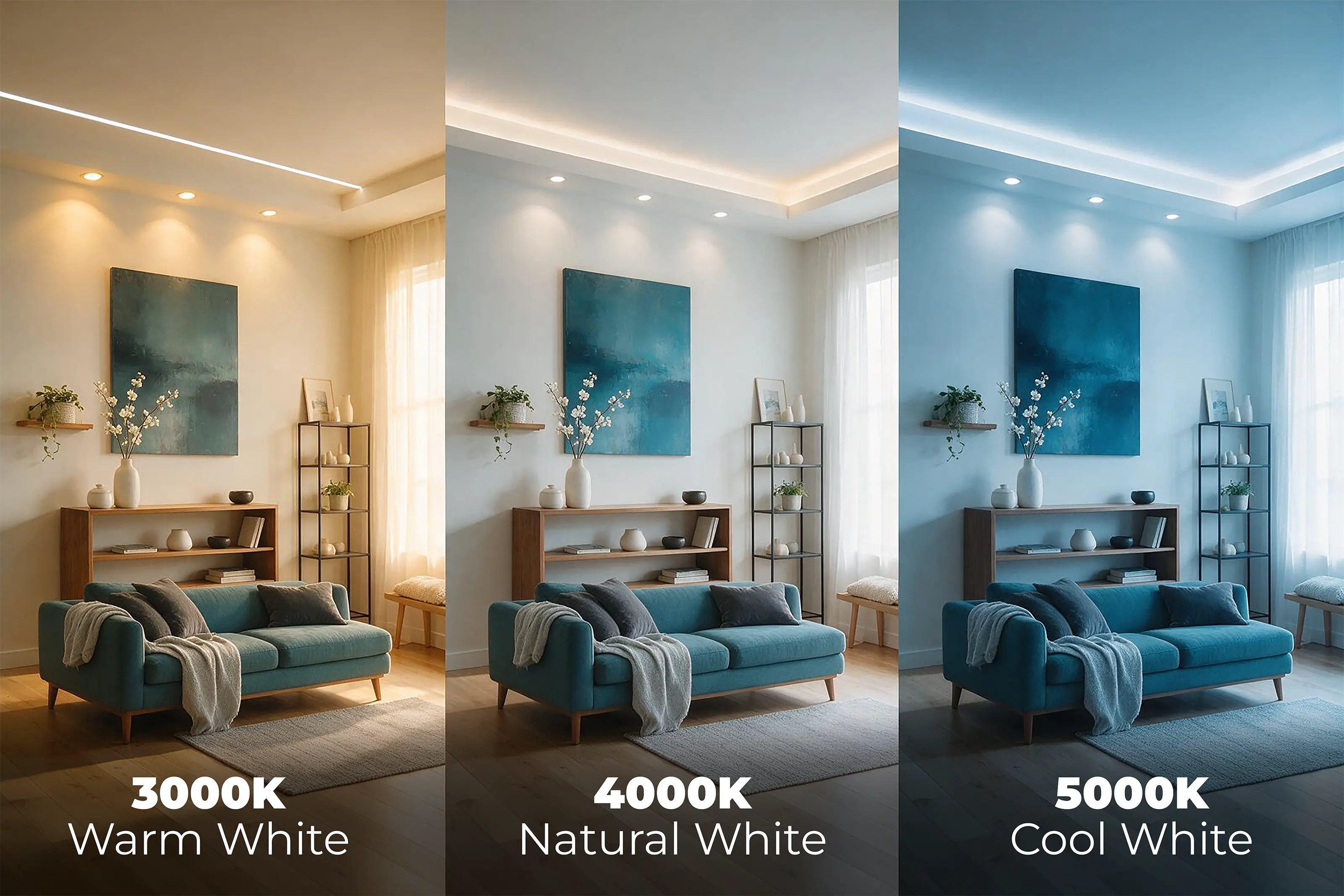
For most homes, 3000K (warm white) is best for living rooms, bedrooms, and dining areas where you want a cosy, relaxing feel, while 4000K (neutral white) is best for kitchens, bathrooms, and workspaces where you need clear, accurate light. 5000K (daylight) is very cool and bright — better suited to garages, utility areas, and outdoor security than living spaces. The single most important rule: keep colour temperature consistent within each room. And remember — a higher Kelvin number does not mean brighter light.
Standing in a lighting store choosing between 3000K, 4000K, and 5000K feels like it should be simple, but the wrong choice can make a cosy bedroom feel like a hospital or a kitchen feel dim and drowsy. This guide gives you the direct answer for every room, clears up the biggest misconceptions, and explains what actually matters.
Who Is This Guide For?
Homeowners choosing bulbs or fixtures for a new home or a renovation and unsure which colour temperature to pick for each room. Architects and interior designers specifying lighting for premium projects in Noida, Greater Noida, Gurgaon, and Delhi NCR. And anyone confused by Kelvin numbers who just wants to know: which one do I buy for this room?
First, What Do 3000K, 4000K and 5000K Actually Mean?
Colour temperature, measured in Kelvin (K), describes how warm or cool white light appears — it has nothing to do with how hot the bulb gets. The lower the number, the warmer (more yellow) the light. The higher the number, the cooler (more blue-white) it looks.
- 3000K — Warm White: A soft, slightly golden glow, similar to traditional incandescent bulbs. Cosy and relaxing.
- 4000K — Neutral White: A clean, balanced white. Crisp and alert without being harsh.
- 5000K — Daylight: A cool, bright blue-white, close to midday sunlight. Energising and clinical.
That's the whole scale in practice. The question isn't which is "best" in general — it's which suits each room's purpose.
The Biggest Myth: Higher Kelvin Does NOT Mean Brighter
This is the single most common misunderstanding, so it's worth stating plainly.
A 5000K bulb is not brighter than a 3000K bulb. Colour temperature (Kelvin) describes the colour of the light. Brightness is measured in lumens, a completely separate number.
A 5000K light often feels brighter because cool blue-white light appears more intense to the eye, but two bulbs at the same lumens put out the same amount of light regardless of their Kelvin. If you want a brighter room, look at lumens — not colour temperature.
Getting this wrong leads people to buy harsh 5000K lighting for living spaces thinking they'll be "brighter," and ending up with a room that feels cold and clinical.
3000K vs 4000K — The Real Decision
For most Indian homes, the genuine choice is between 3000K and 4000K. 5000K is a special case (more on that below). Here's how they compare directly.
| Factor | 3000K (Warm White) | 4000K (Neutral White) |
|---|---|---|
| Appearance | Soft, golden, cosy | Clean, crisp, neutral |
| Feel | Relaxing, inviting | Alert, focused |
| Best for | Living rooms, bedrooms, dining | Kitchens, bathrooms, workspaces |
| Mood | Winds you down | Wakes you up |
| Skin & food tones | Flattering, warm | Accurate, true |
| Interior style | Traditional, wood, warm tones | Modern, white, minimal |
The simple rule of thumb: use 3000K where you relax, and 4000K where you do things. Bedrooms and living rooms are for unwinding — 3000K. Kitchens and bathrooms are for tasks — 4000K.
Interior style matters too. In homes with wood, warm stone, and traditional décor, 3000K feels natural and rich. In modern homes with white cabinetry and minimal palettes, 4000K keeps everything looking crisp rather than yellowed.
Where Does 5000K Fit?
5000K (daylight) is the coolest, and in most homes it's the wrong choice for living spaces — it reads clinical and cold, more like an office or a hospital than a home.
That doesn't make it useless. 5000K genuinely suits:
- Garages and workshops — where you need maximum clarity for detailed work
- Utility and storage areas — function over feel
- Outdoor security lighting — bright, alert, daylight-like
- Study or craft spaces — where sharp, precise vision matters
For living rooms, bedrooms, and dining areas, 5000K is almost always too cool. If you want bright, focused light in a kitchen or office and 4000K feels too warm, 5000K is an option — but for most Indian homes, 4000K is the cooler end you'll actually want indoors.
The Complete Room-by-Room Answer
Here's the direct recommendation for every room.
| Room | Recommended | Why |
|---|---|---|
| Living room | 3000K | Relaxing, inviting, good for gathering |
| Bedroom | 2700K–3000K | Warm, calming, supports winding down |
| Kitchen | 4000K | Clear, accurate light for prep and cooking |
| Bathroom | 4000K | Accurate light for grooming; crisp and clean |
| Dining room | 2700K–3000K | Warm, flattering to food and faces |
| Home office | 4000K | Neutral, focus-supporting, reduces drowsiness |
| Study / craft | 4000K–5000K | Sharp, precise vision for detailed work |
| Wardrobe / dressing | 4000K | Accurate colour so outfits match in daylight |
| Garage / utility | 5000K | Maximum clarity for tasks |
| Outdoor security | 4000K–5000K | Bright, alert, daylight-like |
| Pooja room | 2700K–3000K | Warm, serene, traditional feel |
Notice the pattern: relaxation spaces trend warm (2700–3000K), task spaces trend neutral (4000K), and only utility/security spaces go cool (5000K).
Can You Mix Colour Temperatures in a Home?
Yes — and you should, across different rooms. Different rooms serve different purposes, so a warm bedroom and a neutral kitchen is exactly right. A home lit entirely at one colour temperature usually gets something wrong somewhere.
But within a single room, keep it consistent. Mixing 3000K and 4000K in the same small space looks like a mistake — you'll see one light looking yellow next to another looking white, and it reads as inconsistent rather than intentional.
The one exception: deliberate layering. In a large room, you might use warmer light for the ambient/relaxation layer and slightly cooler, focused light for a task zone — but this needs to be designed intentionally, not accidental. When in doubt, keep each room to one colour temperature.
If you want the flexibility to change colour temperature through the day — warm in the evening, neutral during the day, from the same fixtures — that's what tunable white lighting does, and it removes the need to commit to one number.
What About Your Eyes and Sleep?
Two common concerns, answered honestly.
Eyes: Neither 3000K nor 4000K is harmful to your eyes. Visual comfort depends far more on avoiding glare and choosing quality LEDs with high CRI and stable output than on the colour temperature itself.
Sleep: This one has real substance. Cooler light (higher Kelvin) in the evening can interfere with melatonin and make winding down harder, while warmer 2700–3000K light is gentler and supports the body's natural evening rhythm. This is exactly why bedrooms and evening spaces should be warm — it's not just about mood, it connects to circadian health.
Does Dimming Change Colour Temperature?
Standard LED dimming reduces brightness but does not change the colour temperature — a 4000K light dimmed to 20% is still 4000K, just dimmer. This surprises people used to old incandescent bulbs, which glowed warmer as they dimmed.
If you want that warm-as-you-dim behaviour — cooler when bright, warmer when low — you need specialised dim-to-warm LEDs, or full tunable white. Standard LEDs hold their colour at every brightness level.
Common Colour Temperature Mistakes
Thinking higher Kelvin means brighter. It doesn't — that's lumens. This one misconception causes more bad lighting choices than any other.
Using 5000K in living spaces. It reads cold and clinical. Save it for garages, utility, and security.
Mixing temperatures within one room. Looks like a mistake. Keep each room consistent.
Cool light in the bedroom. Interferes with winding down. Bedrooms should be warm (2700–3000K).
Ignoring interior style. 4000K can look harsh in a warm, wood-heavy interior; 3000K can look yellow against crisp white modern cabinetry. Match the temperature to the palette.
Focusing on Kelvin, ignoring CRI. Colour temperature sets the mood, but CRI decides whether colours look accurate. Both matter.
Expert Recommendation from Brightmatic
For the homes we design across Delhi NCR, our default is simple and it rarely fails: 3000K for living rooms, bedrooms, dining, and pooja spaces; 4000K for kitchens, bathrooms, home offices, and wardrobes; and 5000K only for garages, utility, and outdoor security.
The insight worth passing on: the mistake we correct most often isn't people choosing the "wrong" number — it's people choosing one number for the whole home. A single colour temperature everywhere always compromises somewhere. Warm light in the kitchen makes food prep harder; cool light in the bedroom makes it hard to relax. The right answer is warm where you unwind, neutral where you work.
And for clients who don't want to commit room by room, we increasingly specify tunable white in the key spaces — so the same lights are neutral and bright during the day and warm and low in the evening. It removes the choice entirely. This is the kind of decision best made at the design stage, as part of the home's overall architectural lighting plan.
Choosing Lighting for Your Home?
Colour temperature is one of the easiest things to get wrong and one of the cheapest to get right — if it's decided room by room, before you buy. Warm where you relax, neutral where you work, cool only where you must.
Not sure what suits each room? Get a free consultation.
Planning a home in Noida or Delhi NCR? Contact Brightmatic for a personalised lighting design consultation.
FAQ's
Is 3000K or 4000K better for a home?
Both are good — for different rooms. 3000K (warm white) is better for living rooms, bedrooms, and dining areas where you want a cosy, relaxing feel. 4000K (neutral white) is better for kitchens, bathrooms, and workspaces where you need clear, accurate light. Most homes use both.Is 4000K brighter than 3000K?
No. Colour temperature (Kelvin) describes the colour of light, not its brightness. Brightness is measured in lumens. A 4000K light may appear brighter because cool light seems more intense, but two bulbs at the same lumens produce the same amount of light regardless of Kelvin.Is 5000K good for a home?
Generally not for living spaces — 5000K is cool and clinical, better suited to garages, workshops, utility areas, and outdoor security. For indoor living, 3000K or 4000K is almost always preferable. Only task-heavy spaces like a workshop or craft room benefit from 5000K indoors.What colour temperature is best for a bedroom?
2700K–3000K (warm white) is best for bedrooms. Warm light is calming, supports winding down in the evening, and interferes less with melatonin and sleep than cooler light. Cool white in a bedroom makes it harder to relax.What colour temperature is best for a kitchen?
4000K (neutral white) is best for kitchens. It provides clear, accurate light for food preparation and cooking, and makes colours look true. In warm, wood-heavy kitchens, 3000K can also work if you prefer a cosier feel.Can I mix 3000K and 4000K in my home?
Yes, across different rooms — a warm bedroom and a neutral kitchen is exactly right. But avoid mixing them within a single small room, as it looks inconsistent. Keep each room to one colour temperature unless you're deliberately layering ambient and task light.Does dimming change the colour temperature?
No. Standard LED dimming reduces brightness but keeps the same colour temperature — a dimmed 4000K light is still 4000K. If you want light that warms as it dims, you need dim-to-warm LEDs or tunable white fixtures.Does colour temperature affect your eyes?
Neither 3000K nor 4000K harms your eyes. Visual comfort depends more on avoiding glare and using high-CRI, flicker-free LEDs than on colour temperature. Cool light in the evening can affect sleep, which is why bedrooms should be warm.
Comments
No Comments