

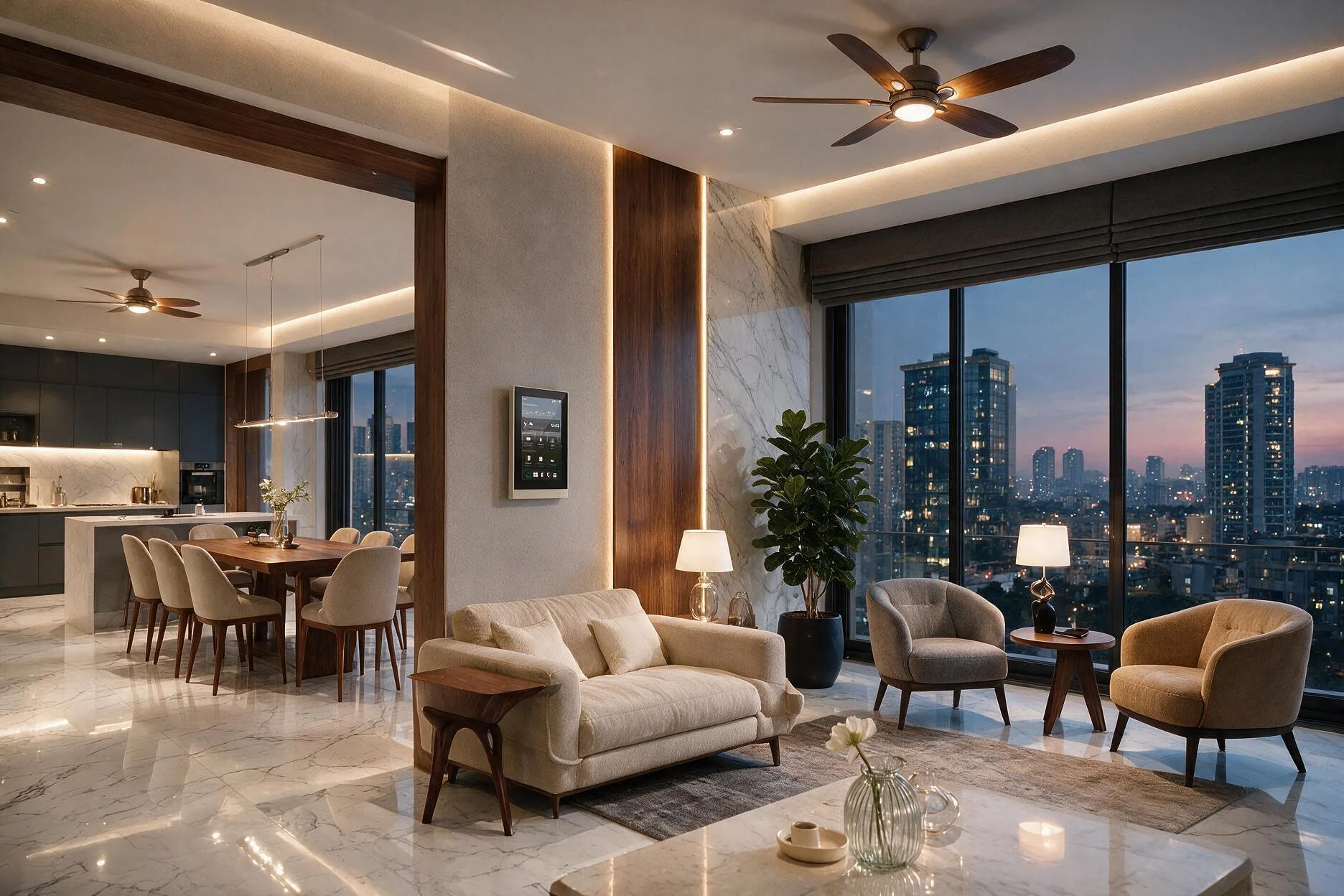
Smart home automation works beautifully in apartments — you just approach it differently than a villa. Because the walls and wiring are usually already done, apartments rely more on wireless systems that need little or no rewiring: smart switches that fit existing boxes, wireless lighting and curtain control, smart locks, and app or voice control. A basic apartment automation setup typically starts around ₹4–5 lakh and rises with the size of the flat and the systems included. Renters can use plug-and-play devices they take with them; owners can go further with switch-level automation. (All figures are indicative estimates, not actual quotes — final cost is confirmed after a site assessment.)
Most smart home advice assumes you're building a villa from scratch. But the majority of Indian homes are apartments — often already finished, sometimes rented, always with the constraint of walls you can't open up. This guide covers what genuinely works in a flat, wired vs wireless, what renters can do, and what it costs.
Who Is This Guide For?
Apartment owners in Noida, Greater Noida, Gurgaon, and Delhi NCR who want to automate a 2, 3, or 4BHK flat without a full renovation. Renters who want a smarter home they can take with them. And anyone in an apartment who assumed automation was only for independent houses and villas.
Can You Automate an Apartment? (Yes — With a Different Approach)
Absolutely. The idea that home automation needs a villa or new construction is outdated. What changes in an apartment isn't whether you can automate — it's how.
In a new villa, the ideal approach is wired automation (like KNX) planned before construction, with control cabling run through the walls. An apartment is usually already built and finished, so opening up walls to run control cabling isn't practical.
The answer is wireless and retrofit automation — systems designed to work with your existing wiring and switchboards, adding intelligence without construction. Modern wireless automation has matured to the point where an apartment can do almost everything a villa can, minus the deepest infrastructure-level integration.
For context on automating within a tower or society, our guide on home automation for high-rise living covers the building-level lifestyle side — this guide focuses on the practical flat-by-flat setup.
Wired vs Wireless — What's Right for an Apartment
This is the core decision, and for apartments it usually leans one way.
| Factor | Wired (e.g. KNX) | Wireless / Retrofit |
|---|---|---|
| Best for | New flats, full renovation | Finished flats, most apartments |
| Rewiring needed | Yes | Little to none |
| Reliability | Highest | Very good |
| Disruption | High (walls opened) | Minimal |
| Renter-friendly | No | Yes |
| Cost | Higher | Lower entry |
| Scalability | Excellent | Good |
If you're doing a full flat renovation — gutting and rewiring anyway — wired automation is worth considering, because the walls are already open.
If your flat is finished (which most are) — wireless retrofit automation is almost always the right choice. Smart switches replace your existing ones in the same box, wireless devices add control, and nothing structural changes.
If you're renting — go fully wireless and plug-and-play, so everything comes with you when you move.
What You Can Actually Automate in an Apartment
Here's what works well in a flat, roughly in order of ease.
Smart lighting. Smart switches that replace your existing switches (same box, no rewiring) let you control lights by app, voice, or schedule. Smart bulbs are even simpler for renters. You can add dimming, scenes, and automated on/off.
Smart switches for appliances. Geysers, ACs (via smart IR controllers), fans, and other appliances can be brought under app and voice control with smart switches and controllers.
Curtains and blinds. Motorised smart curtains can be retrofitted onto existing curtain tracks in most apartments — a high-impact, surprisingly easy upgrade.
Smart locks. A smart lock on your main door adds keyless entry, remote access, and guest codes — one of the most popular apartment upgrades, and fully retrofittable.
Climate control. Smart thermostats and IR-based AC controllers let you control cooling by app and schedule, and even automate it to your routine.
Security. Smart cameras, video door phones, motion sensors, and door/window sensors add a full security layer wirelessly.
Voice and app control. Everything ties together through a single app or voice assistant, so the whole flat responds to one command or a spoken instruction.
Scenes and routines. "Good Morning" raises the lights and opens the curtains; "Leaving" turns everything off and arms security — all without touching a switch.
What's Harder in an Apartment (Be Realistic)
Honesty helps you plan properly. A few things are genuinely harder in a flat than a villa:
Deep infrastructure integration. The seamless, everything-on-one-system feel of a wired KNX villa is harder to fully replicate wirelessly — though good wireless systems get remarkably close.
Structural changes. Running new cabling, adding in-ceiling speakers, or major electrical changes usually aren't practical in a finished, owned flat and are off-limits in a rental.
Society and building rules. Some housing societies have rules about external cameras, façade changes, or common-area modifications. Anything facing a shared corridor or building exterior may need RWA approval.
Shared walls. Sensor and camera placement needs to account for shared walls with neighbours, and external sensors may not be permitted.
None of these stop you automating — they just shape what's realistic. For most apartment owners, the wireless approach covers the vast majority of what they actually want.
Renter vs Owner — What You Can Do
Your situation changes the strategy.
If you rent:
- Stick to plug-and-play: smart bulbs, plug-in smart plugs, portable smart speakers, standalone cameras
- Avoid anything that modifies wiring or fixtures permanently
- Choose devices that are easy to uninstall and take with you
- A smart lock may need landlord permission — keep the original to reinstall
If you own:
- Switch-level automation (replacing switches) is on the table — far more elegant than bulbs
- Motorised curtains, smart locks, and permanent cameras all become options
- You can plan a fuller, more integrated wireless system
- Consider a central control panel that ties everything together
The dividing line is simple: renters automate with devices; owners can automate the flat itself.
Note: plug-and-play renter setups (bulbs, plugs, standalone devices) are a lighter, lower-cost entry point and sit below the figures in the cost table below — those ranges reflect proper switch-level and integrated apartment automation for owners.
Smart Apartment Automation Cost in India
Important: the figures below are indicative estimates for planning only — not actual quotes. Real cost depends on your flat's size, the brands chosen, the number of systems, and the level of integration, and is confirmed only after a site assessment.
| Scope | What It Covers | Indicative Estimate (2-3BHK) |
|---|---|---|
| Basic apartment setup | Smart switches for core lighting, app control, entry-level scenes | ₹4,00,000 – ₹6,00,000 |
| Standard setup | Above + motorised curtains, smart lock, climate control | ₹6,00,000 – ₹10,00,000 |
| Full wireless system | Above + full security, multi-room control, panel + app integration | ₹10,00,000 – ₹18,00,000 |
| Premium integrated | Everything above + AV, deeper whole-home integration | ₹18,00,000+ |
The biggest cost variables are the level of automation (switch-level vs device-level), the number of motorised curtains, and how much security and AV you add. You don't need to do it all at once — a good wireless system lets you start with lighting and expand in phases. These remain indicative ranges; for a fuller breakdown, see our home automation cost guide, and treat any figure as a starting point confirmed after an assessment.
How to Start — A Sensible Order
If you're automating an apartment from scratch, this order gives the best experience per rupee:
- Lighting first — smart switches or bulbs. The most-used, most-noticed upgrade.
- Smart lock — keyless entry and remote access; high daily value.
- Curtains — motorised tracks; high impact, easy retrofit.
- Climate — smart AC control; comfort plus energy savings.
- Security — cameras, sensors, video door phone.
- Tie it together — one app, voice control, and scenes across everything.
Starting with lighting and a lock gives you the biggest everyday difference immediately, and you can expand from there.
Common Apartment Automation Mistakes
Assuming you need a villa. The most common misconception. Wireless automation makes almost everything possible in a flat.
Buying random devices from different brands. A drawer full of apps that don't talk to each other isn't a smart home. Choose devices that work together on one platform.
Smart bulbs when you own the flat. If you own, smart switches are more elegant than bulbs — the switch still works normally and every bulb becomes smart. Bulbs are really a renter's solution.
Forgetting the network. Wireless automation depends on solid Wi-Fi. A weak router means unreliable devices. Sort the network first.
Ignoring society rules. External cameras or corridor-facing devices may need RWA approval. Check before installing.
Over-buying upfront. You don't need everything on day one. Start with lighting and a lock, live with it, then expand.
Expert Recommendation from Brightmatic
For the apartments we work on across Delhi NCR, our standard recommendation for an owned flat is switch-level wireless automation — replacing existing switches with smart ones for lighting, adding motorised curtains and a smart lock, and tying it all into one app with scenes. For renters, we recommend a plug-and-play kit that delivers most of the experience and moves with them.
The insight worth passing on: apartment owners often start by buying smart bulbs because they're cheap and easy — then get frustrated because the switch has to stay "on" for the bulb to work, which defeats the point. For an owned flat, smart switches are almost always the better foundation. The bulbs stay normal, the switch stays usable, and every light becomes controllable. It's a small decision that changes how the whole system feels to live with.
And whatever you choose, pick devices that share one platform. A single control app or panel tying everything together is the difference between a smart home and a pile of gadgets. This is exactly the kind of thing worth planning properly, even in a flat — which is what our home automation approach is built around.
Planning to Automate Your Apartment?
You don't need a villa, a renovation, or open walls to have a genuinely smart home. The right wireless setup turns a finished flat — owned or rented — into a home that responds to you.
Not sure what suits your flat? Get a free consultation.
Planning a smart apartment in Noida or Delhi NCR? Contact Brightmatic for a personalised home automation consultation.
FAQ's
Can you install smart home automation in an apartment?
Yes. Apartments are well-suited to wireless and retrofit automation, which works with your existing wiring — smart switches, wireless lighting and curtains, smart locks, and app control, all without opening walls. Almost everything a villa can do is possible in a flat, minus the deepest infrastructure integration.Is wired or wireless automation better for an apartment?
Wireless is usually better for apartments, because the walls and wiring are already finished. Wired systems like KNX suit new flats or full renovations where cabling can be run. For most finished apartments — and all rentals — wireless retrofit automation is the right choice.Can renters install smart home automation?
Yes. Renters should use plug-and-play devices — smart bulbs, plugs, portable speakers, and standalone cameras — that don't modify wiring and can be taken when moving. A smart lock may need landlord permission. Avoid anything permanent that alters the flat's fixtures.How much does apartment automation cost in India?
A basic apartment automation setup typically starts around ₹4–6 lakh for a 2-3BHK, covering smart switches, app control, and core scenes. A standard setup with curtains, a smart lock, and climate control runs ₹6–10 lakh, and a fuller integrated system ₹10 lakh and above. These are indicative estimates for planning only, not actual quotes — final cost is confirmed after a site assessment.Should I use smart bulbs or smart switches in my apartment?
If you own the flat, smart switches are better — the switch stays usable and every bulb becomes controllable. Smart bulbs only work when the switch is left on, which is inconvenient. Bulbs suit renters who can't change switches; switches suit owners.Do I need to rewire my apartment for automation?
No. Wireless and retrofit automation is designed to work with your existing wiring. Smart switches fit into your current switch boxes, and wireless devices need no cabling. Rewiring is only needed if you choose a wired system during a full renovation.What can I automate in a 2BHK or 3BHK flat?
Lighting, curtains, AC and climate, the main door lock, security cameras and sensors, and appliances — all controllable by app, voice, and scenes. You can start with lighting and a lock and expand to curtains, climate, and security over time.
Comments
No Comments