

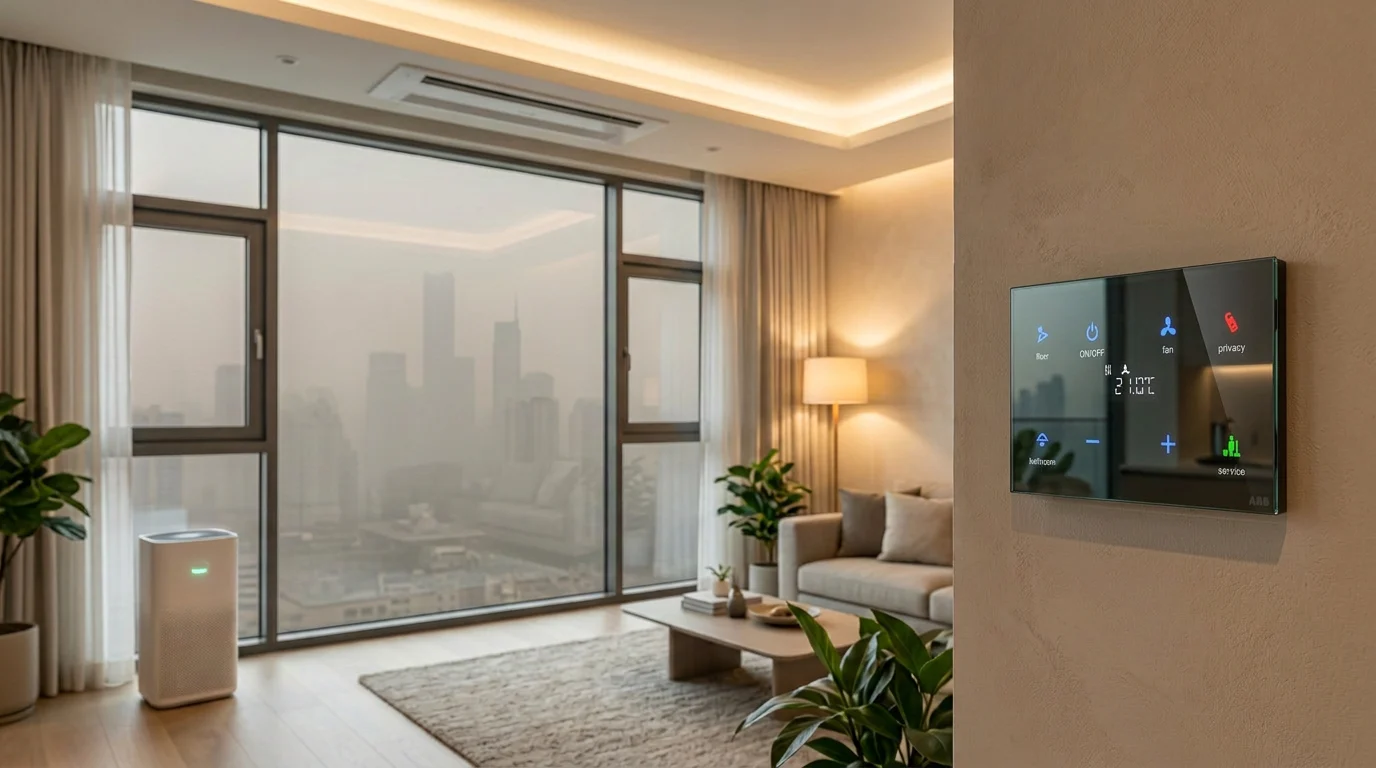
ABB KNX air quality sensors such as ABB Tenton measure indoor CO₂, humidity and temperature, and can automatically control ventilation, climate, blinds and lighting. They don’t measure smog particles (PM2.5), but during smog season they help a sealed home stay fresh by switching on filtered fresh air and air purifiers when indoor CO₂ rises.
It’s November in Delhi NCR. The AQI app turns deep red, the school WhatsApp group fills with warnings, and every window in the house stays shut. The air purifiers hum day and night.
By evening, the living room feels heavy. Someone has a headache, the children are drowsy over homework, and nobody can quite say why. The smog stayed outside. But with every window closed and the family breathing the same air for hours, indoor CO₂ has quietly been building up.
This is the hidden side of smog season, and it’s exactly where an ABB KNX air quality sensor helps. This guide explains what these sensors measure, what they don’t, and how to automate a home that stays sealed against smog yet fresh inside.
Who is this guide for?
- Families in Delhi NCR and north India who keep windows closed through smog season
- Villa and apartment owners planning ABB KNX or ABB-free@home automation
- Homeowners with air purifiers or fresh-air units that still run manually
- Architects and interior designers specifying healthier, smarter homes
What is an ABB KNX air quality sensor?
An ABB KNX air quality sensor is a wall-mounted device that measures indoor air conditions and sends that data to the home’s automation system, so ventilation, climate and other systems respond automatically.
ABB’s Tenton range is a good example. According to ABB, it measures temperature, humidity and CO₂, and combines sensing with a control element that can manage HVAC, shading and lighting from the same wall unit. ABB also offers Tenton for ABB-free@home, its simpler smart home system. Our guides to ABB i-bus KNX and ABB-free@home explain both systems.
Does an ABB air quality sensor measure smog?
No. ABB Tenton measures CO₂, humidity and temperature, not PM2.5, the fine particles that make up most of Delhi’s smog.
That distinction matters, and it’s where many buyers get confused.
- PM2.5 is an outdoor pollutant that enters through gaps, doors and unfiltered ventilation. Air purifiers and filtered fresh-air units handle it.
- CO₂ builds up indoors when people breathe in closed rooms. Many building guidelines use around 1,000 ppm as a comfort reference, above which rooms often feel stuffy.
During smog season, closing windows reduces PM2.5 indoors but lets CO₂ rise. A good smart home manages both: keeping particles out and fresh air coming in, through filters. Official outdoor AQI data is published by the Central Pollution Control Board.
If you also want PM2.5 readings on your keypad or app, separate PM2.5 sensors and many air purifiers can be integrated with KNX through relays, gateways or app integrations.
How can ABB KNX automation help during smog season?
The real value comes when the sensor’s readings trigger the right systems automatically, without anyone checking an app.
A typical “Smog Mode” scene might:
- Switch on the filtered fresh-air unit when CO₂ crosses a set level
- Run air purifiers on a higher setting during the worst AQI hours
- Close motorised curtains and blinds on the most exposed windows
- Keep humidity comfortable, since winter heaters dry indoor air
- Show air status on the Tenton display or app, so the family knows the air is being managed
Our guide to smart lighting scenes explains how scenes like this are triggered from a single keypad button.
At Brightmatic, we typically pair an ABB CO₂ and humidity sensor in each main room with a filtered fresh-air system and purifier integration. Families get sealed windows and fresh air at the same time.
Which rooms need an air quality sensor?
Start with the rooms where people spend the longest with doors closed.
| Room | Why it matters | What to automate |
|---|---|---|
| Master bedroom | Hours of sleep with the door shut | Fresh air and purifier on a night schedule |
| Children’s room | Study and sleep in a closed room | CO₂-based ventilation, comfortable humidity |
| Living room | Family gatherings, guests, long evenings | Smog Mode scene, air status display |
| Home office | Long working hours | Fresh air before CO₂ affects focus and comfort |
| Home theatre | Sealed, dark room with many people | Ventilation linked to the Movie scene |
How much does an ABB air quality system cost?
Costs depend on the number of rooms, the ventilation system and how much is integrated.
Indicative estimates only, not actual quotes.
| Item | Indicative cost |
|---|---|
| ABB Tenton sensor and controller | Rs 30,000 – 70,000 per room |
| Filtered fresh-air unit (whole home) | Rs 80,000 – 3 lakh+ |
| PM2.5 sensor (third-party, KNX-integrated) | Rs 5,000 – 25,000 each |
| Purifier and ventilation integration | Rs 10,000 – 40,000 |
| Programming of scenes and schedules | Often included in KNX projects |
For complete ABB KNX budgets, speak to an authorised ABB dealer who can price your exact rooms.
Living in Noida, Delhi or Gurgaon and planning ABB KNX automation? We can design air quality control alongside lighting, curtains and climate, so your home is ready before next year’s smog season.
Want an ABB air quality plan for your home? Share your floor plan →
Is an ABB air quality sensor worth it?
- Is it expensive? It’s a premium device, but it replaces a thermostat and keypad too, and controls ventilation, climate and blinds from one place.
- Is it complicated? Not once programmed. The home reacts automatically, and the display shows the status.
- What can go wrong? Expecting it to measure smog, having no filtered fresh-air unit to control, and poor sensor placement near windows or vents.
What mistakes should you avoid?
- Assuming a CO₂ sensor measures PM2.5 or AQI
- Sealing the home with no plan for filtered fresh air
- Running purifiers manually with no schedules or scenes
- Placing sensors near doors, windows or AC vents
- Ignoring humidity when winter heaters dry the air
- Adding sensors after the interiors are finished, with no wiring planned
A common myth: closing every window during smog keeps the home’s air healthy. In reality, it keeps particles out but lets CO₂ build up, so filtered fresh air matters as much as purification.
Expert recommendation from Brightmatic
For homes in Delhi NCR and north India, we recommend an ABB Tenton or equivalent ABB KNX sensor in bedrooms and living areas, a filtered fresh-air unit, air purifiers integrated into a “Smog Mode” scene, PM2.5 sensors where you want particle readings, and humidity control for winter. Pair it with ABB KNX lighting and motorised curtains for one-touch control.
Brightmatic is an authorised ABB dealer and distributor and designs and installs ABB KNX home automation for apartments, villas and premium homes.
Still breathing heavy air this winter? Talk to our ABB automation expert. We’ll plan fresher air for your home, free.
Plan fresher air with Brightmatic
Brightmatic designs and installs ABB KNX air quality, climate and lighting automation for homes and villas in Noida, Delhi NCR & across India.
Comments
No Comments