

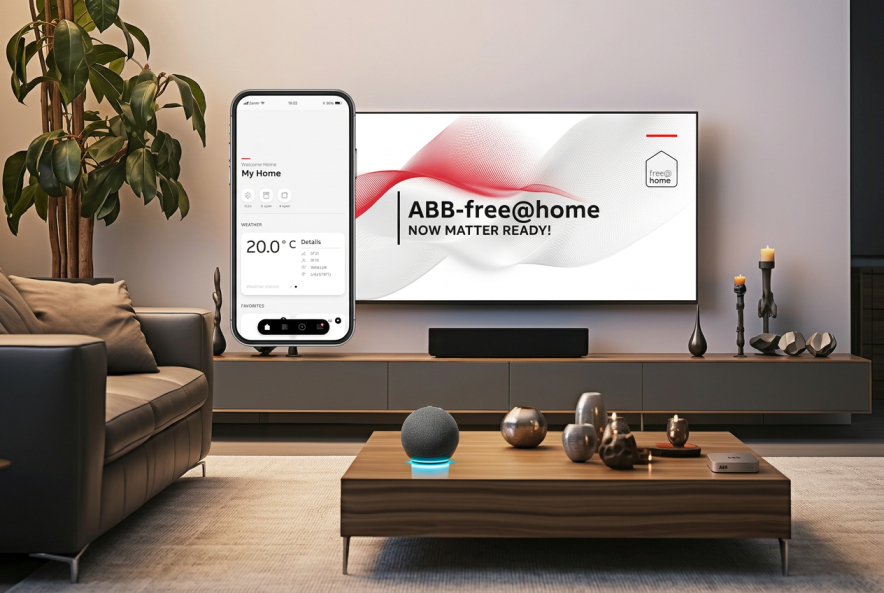
ABB free@home is a wireless smart home system from ABB that converts any existing conventional electrical installation into a fully automated smart home — controlling lighting, blinds, climate, and scenes — without running new cables, without breaking walls, and without civil work of any kind. It is the practical answer for the majority of Indian homeowners who live in completed homes and want smart home functionality without the disruption and cost of a wired KNX installation.
The Problem It Solves
The most common barrier to smart home adoption in India is not cost — it is disruption.
When a homeowner in a completed 3BHK apartment in Noida asks about smart home automation, the conversation typically ends at one sentence: "Will you need to break my walls?"
The answer with wired KNX is yes — new bus cable must be routed through the building. For a completed, furnished home, this means weeks of civil work, dust, plaster repair, repainting, and significant inconvenience.
ABB free@home removes this barrier entirely. The system uses wireless radio frequency communication between devices — no new cables, no wall cutting, no plaster repair. Existing switch boxes are retrofitted with ABB free@home devices that fit behind the current switch plates.
How ABB free@home Works
ABB free@home operates on a wireless mesh network using the 2.4GHz and 868MHz radio frequency bands. Each device in the system — switches, sensors, actuators — communicates directly with the System Access Point, which is the central hub connecting the wireless network to your home's IP infrastructure.
The Three Core Components
1. System Access Point (SAP) The brain of the free@home system. Connects to your home router via Ethernet, bridging the wireless device network with the internet for remote access and app control. One SAP supports up to 64 devices — sufficient for a complete Indian villa installation.
2. Wireless Devices Free@home sensors and actuators install inside standard Indian modular switch boxes — replacing existing mechanical switches without requiring any new wiring. The devices draw power from the existing live and neutral already present in the switch box.
3. free@home App iOS and Android application that provides complete system configuration, scene programming, remote control, and integration with Amazon Alexa and Google Assistant.
What ABB free@home Controls
| Function | Device | How It Works |
|---|---|---|
| Lighting On/Off | Wireless switch actuator | Replaces existing switch — no rewiring |
| Dimming | Wireless dimmer actuator | Installs in switch box — controls existing lights |
| Blind/Shutter | Wireless blind actuator | Installs at motor — controls existing motors |
| Climate/AC | Wireless room thermostat | Replaces existing thermostat — KNX HVAC gateway |
| Scene control | Any switch | One button activates multiple devices |
| Remote access | free@home App | Full control from anywhere via internet |
| Voice control | Alexa / Google | All functions voice-controllable |
ABB free@home vs Traditional Smart Switches Most Indian homeowners considering smart home retrofit are familiar with Wi-Fi smart switches — Alexa-compatible touch panels that replace existing switches individually. ABB free@home is a fundamentally different proposition.
The critical difference is system architecture. Wi-Fi smart switches are individual devices that happen to be connected — they cannot trigger each other without a cloud intermediary. ABB free@home is a unified system where every device communicates with every other device locally — scenes work instantly, reliably, and without internet. Scene Control — Where free@home Transforms Daily LifeThe most impactful feature of ABB free@home for Indian homes is scene programming — the ability to activate a complex, multi-device action from a single button press or voice command. "Good Morning" Scene: Living room lights activate at 60%. Bedroom blinds open 50%. AC shifts from sleep mode to comfort mode. Kitchen lights activate at full output. "Movie Night" Scene: Living room dims to 20%. Bedroom lights off. AC sets to 23°C. Blinds close fully. "Away" Scene: All lights off. All ACs shift to economy mode. Blinds close. Security system arms. "Good Night" Scene: All lights off except bedroom at 5%. AC sets to 26°C sleep mode. Main door confirms locked. Each scene is programmed once in the free@home app and activated by any assigned switch, the app, or a voice command.
The KNX Upgrade Path — Future-Proofing Your InvestmentOne of the most significant advantages of choosing ABB free@home over generic Wi-Fi switches is the upgrade path to full KNX. ABB free@home devices are compatible with ABB i-bus KNX infrastructure. When you eventually renovate — adding a new floor, completing a major interior redesign, or moving to a new property — your free@home investment translates directly into a full KNX installation. The scenes, the logic, and the device configuration carry forward. Generic Wi-Fi switches have no such upgrade path — they are replaced entirely, not evolved.
Our lighting control installations at Brightmatic are designed with this upgrade path in mind — we configure free@home systems with the same scene logic and zone structure that would be used in a full KNX installation, ensuring continuity when the client is ready to upgrade. Installation — What to ExpectTimeline for a Typical Indian Apartment
Total: 1.5–2 days — for a complete 3BHK apartment with full scene programming and voice control integration. What Stays Unchanged
FAQ's1. Does ABB free@home work if my internet goes down?Yes — all local functions operate via the wireless mesh network without internet. Switching, dimming, scene activation, and blind control all function normally during internet outages. The free@home app on your phone continues to work locally over your home Wi-Fi even without broadband. Only remote access from outside your home network requires internet connectivity. 2. How many devices can one ABB free@home system support?One System Access Point supports up to 64 wireless devices — sufficient for a complete Indian 4BHK villa covering all switch positions, blind motors, thermostats, and sensors. Larger installations can use multiple SAPs connected to the same network, each managing its own zone group. 3. Can ABB free@home control my existing split AC units?Yes — through ABB's wireless room thermostat combined with a KNX-to-IR gateway or a compatible AC gateway. The thermostat measures room temperature and sends commands to the gateway, which controls the AC's indoor unit. This works with all major Indian split AC brands including Daikin, Voltas, Blue Star, Carrier, and LG. 4. What happens to my existing switches after free@home installation?In most cases, existing switch mechanisms are replaced by ABB free@home wireless actuator devices that fit into the same flush-mounted boxes. The switch plate — the visible front face — can either remain as-is or be replaced with ABB's design switch range. The choice is the homeowner's — functionality is identical regardless of which plate is used. 5. Is ABB free@home installation something I can do myself?The physical device installation — fitting actuators into switch boxes — requires working with 230V mains wiring and must be done by a qualified electrician. System configuration, scene programming, and app setup require familiarity with the free@home commissioning tool. At Brightmatic, our certified team handles the complete installation and commissioning — ensuring the system is correctly configured and the homeowner is fully trained on operation before handover. 6. What is the difference between ABB free@home and ABB i-bus KNX?
ABB free@home is a wireless retrofit system for completed buildings — no new cables required, consumer-friendly configuration, up to 64 devices per SAP. ABB i-bus KNX is a wired system for new construction or full renovation — requiring dedicated bus cable installation, professional ETS programming, and supporting unlimited device counts with full open-standard interoperability. For completed Indian homes, free@home is the correct choice. For new construction or major renovation, KNX delivers greater long-term capability and energy management precision. |
Comments
No Comments