

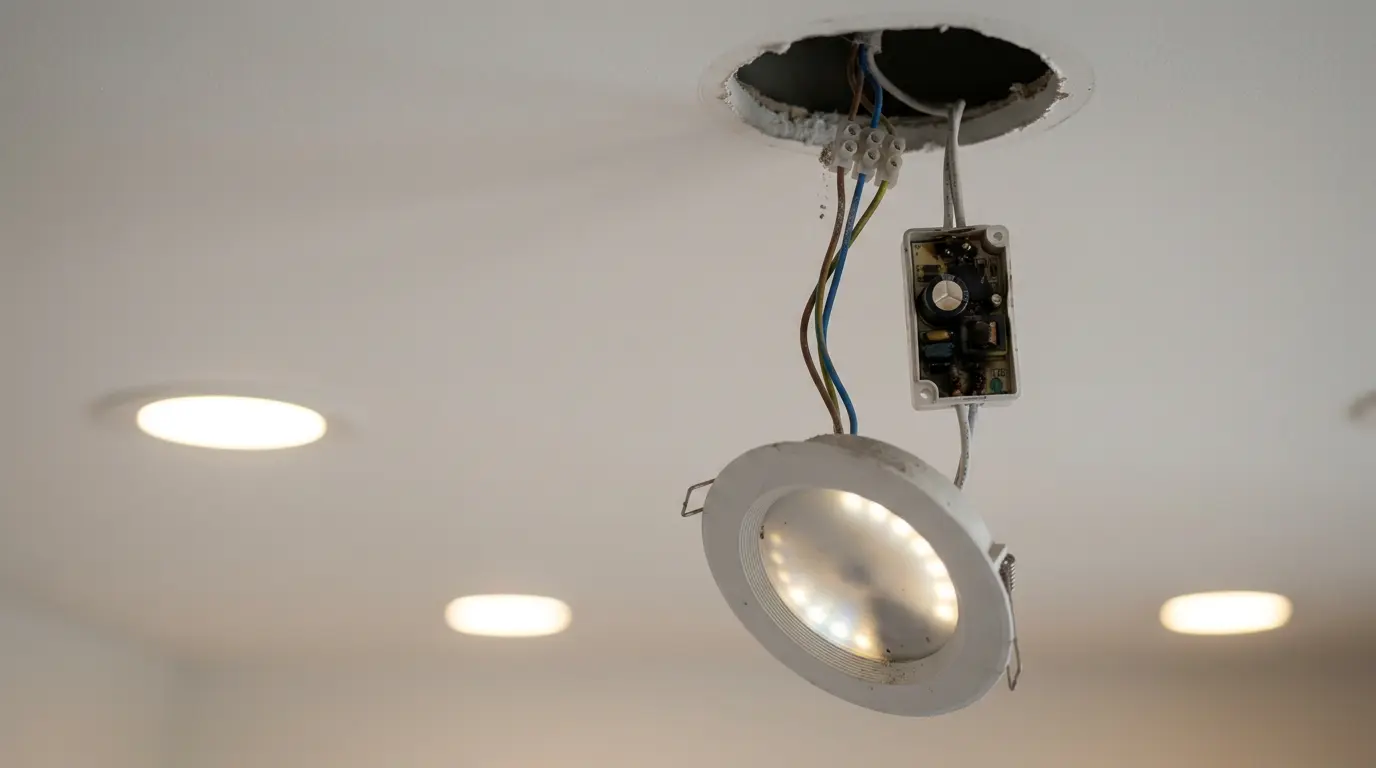
LED lights in Indian homes usually flicker or fail early because of the driver, not the LED chip. Voltage swings, heat trapped above the false ceiling, inverter power, mismatched dimmers and loose neutral connections all stress the driver. Find the cause first, then fix the driver, wiring or switch, not just the bulb.
Swapping the bulb and hoping is what most people do. Sometimes it works. Often the new one starts blinking a few weeks later, because nothing was ever wrong with the bulb.
First, what kind of flicker is it?
How it flickers tells you a lot about why.
| What you see | Most likely cause |
|---|---|
| Flickers all the time, getting worse | Failing driver, often from heat |
| Flickers when the AC, geyser or pump starts | Voltage dip from a heavy load on the same supply |
| Faint glow or blinking when switched off | Illuminated or smart switch, or the switch is on the neutral wire |
| Flickers only on inverter power | Inverter output that the driver doesn't like |
| Flickers only when dimmed | Wrong dimmer, or a non-dimmable LED on a dimmer |
| One end of a strip or profile light is dimmer | Voltage drop on a long 12V run |
| Flickers when you tap the fitting | Loose connection |
8 reasons LED lights flicker in Indian homes
1. Voltage swings. In many Delhi NCR and Noida areas, supply can rise late at night and drop in peak hours. BIS standards for LED lamps expect them to work between 90% and 110% of rated voltage, which is roughly 207V to 253V on a 230V supply. When your supply goes outside that band, a cheap driver can't keep the output steady.
2. Heavy appliances starting. An AC compressor, geyser or water pump pulls a big surge of current when it starts. If the lights share that circuit or a weak supply, you'll see a blink every time.
3. Cheap drivers. The driver turns 230V AC into the low-voltage DC the LED needs. It's the weakest part of most fittings. Low-cost drivers use capacitors that dry out fast, especially in heat.
4. Heat above the false ceiling. This one is very Indian. A recessed downlight sits in a closed gypsum ceiling with no airflow, often under a hot terrace slab. The driver sits on top of it, cooking through a Delhi summer. Heat is the fastest way to kill a driver.
5. Wrong or old dimmer. Old dimmers were made for incandescent and halogen loads. LEDs need a compatible dimmer, and many LEDs aren't dimmable at all. Put the two together and you get flicker, buzzing or a light that won't switch fully off.
6. Loose neutral or connection. A loose screw in a switchboard or junction box makes contact on and off. Besides flicker, it heats up. This one needs an electrician quickly.
7. The ghost glow. Your LED glows faintly or blinks every few seconds when switched off. Three common causes:
- An illuminated (indicator) switch leaks a tiny current through the light
- A smart switch with no neutral wire does the same thing
- The switch was wired on the neutral instead of the live wire, which also means the fitting stays live when "off"
That last one is also a safety risk.
8. Voltage drop in strip and profile lights. Cove and profile lights often run on 12V or 24V strips. Over a long run, voltage drops along the length, so the far end looks dimmer or flickers. The fix is planning: shorter runs, feeding from both ends, 24V instead of 12V, and a properly sized driver. If you're planning profile lights, our profile lighting cost guide and cove lighting cost guide cover what goes into a good installation.
What about inverters?
Many homes run lights on inverter backup during power cuts. Older square-wave and modified sine-wave inverters produce a rough output that some LED drivers handle badly. You'll notice flicker or a faint buzz only when the power is out. A pure sine-wave inverter solves this for most fittings.
Why do LED lights fail before their rated life?
The "25,000 hours" printed on the box is tested under controlled conditions: steady voltage, open air, comfortable temperature. Your false ceiling in June is none of those.
In most failed LEDs, the chips are fine and the driver has given up. A 2022 study on LED failures found that under overvoltage, heat in the control circuit rises sharply, and that's what kills the lamp. Heat and voltage stress add up, and most Indian homes have both.
So a 25,000-hour LED in a sealed ceiling, on a supply that swings every evening, can easily fail in a year or two.
The phone camera test for hidden flicker
Some flicker is too fast to see. On 50 Hz Indian mains, a poor driver lets the light pulse 100 times a second. You won't notice it, but some people get eye strain or headaches under it.
To check:
- Open your phone camera (slow-motion mode works best).
- Point it at the light from a short distance.
- Look for dark bands rolling across the screen.
Strong bands mean a poor-quality driver. A good fitting shows a steady image. Most LED boxes in India don't state a flicker rating, so this check is up to you.
How to fix it: what you can check vs what needs an electrician
| You can check | Call an electrician |
|---|---|
| Is the LED marked dimmable, and is the dimmer LED-compatible? | Loose connections, burning smell or warm switchboards |
| Does it flicker only when the AC or geyser starts? | Switch wired on neutral |
| Does it flicker only on inverter power? | Rewiring circuits away from heavy appliances |
| Is the switch illuminated or a smart switch? | Replacing drivers inside the false ceiling |
| Does a different fitting on the same switch behave the same way? | Voltage problems across the whole house |
A voltage stabiliser for the whole house can help in areas with bad supply. For new projects, plan surge protection for lighting circuits at the distribution board.
How to buy LEDs that don't flicker
- Ask about the driver, not just the LED. Brand, warranty and whether it's isolated or non-isolated. Our guide on how to read a lighting specification sheet shows what to look for.
- Check the warranty covers the driver. Some warranties only cover the LED chip.
- Leave space and airflow for drivers in the false ceiling. Remote drivers in an accessible spot are easier to replace later. See our false ceiling lighting ideas for planning.
- Match dimmers and drivers from the start. For larger homes, a proper dimming protocol like DALI avoids most dimming flicker.
- Use neutral-wire smart switches where possible. Our smart switches guide explains the options.
- Do the camera test on a sample before you buy 40 of them.
Get lighting that stays steady
Brightmatic designs, supplies and installs architectural lighting, drivers and lighting controls for homes and businesses in Noida, Delhi NCR & across India. If you're planning new lighting or replacing an installation that keeps failing, we'll specify the right drivers, dimmers and layout from the start.
FAQ's
Is a flickering LED light dangerous?
The flicker itself usually isn't, but its cause can be. A loose connection or a switch on the neutral wire can overheat or leave the fitting live, so get those checked.
Why does my LED glow faintly when switched off?
Usually because of an illuminated switch, a smart switch without a neutral wire, or the switch being on the neutral instead of the live wire.
Can an inverter cause LED flicker?
Yes. Square-wave and modified sine-wave inverters can make some LED drivers flicker or buzz. A pure sine-wave inverter usually fixes it.
Does a voltage stabiliser stop LED flicker?
It helps when the cause is voltage swings across the house. It won't fix a bad driver, a wrong dimmer or a loose connection.
Comments
No Comments