

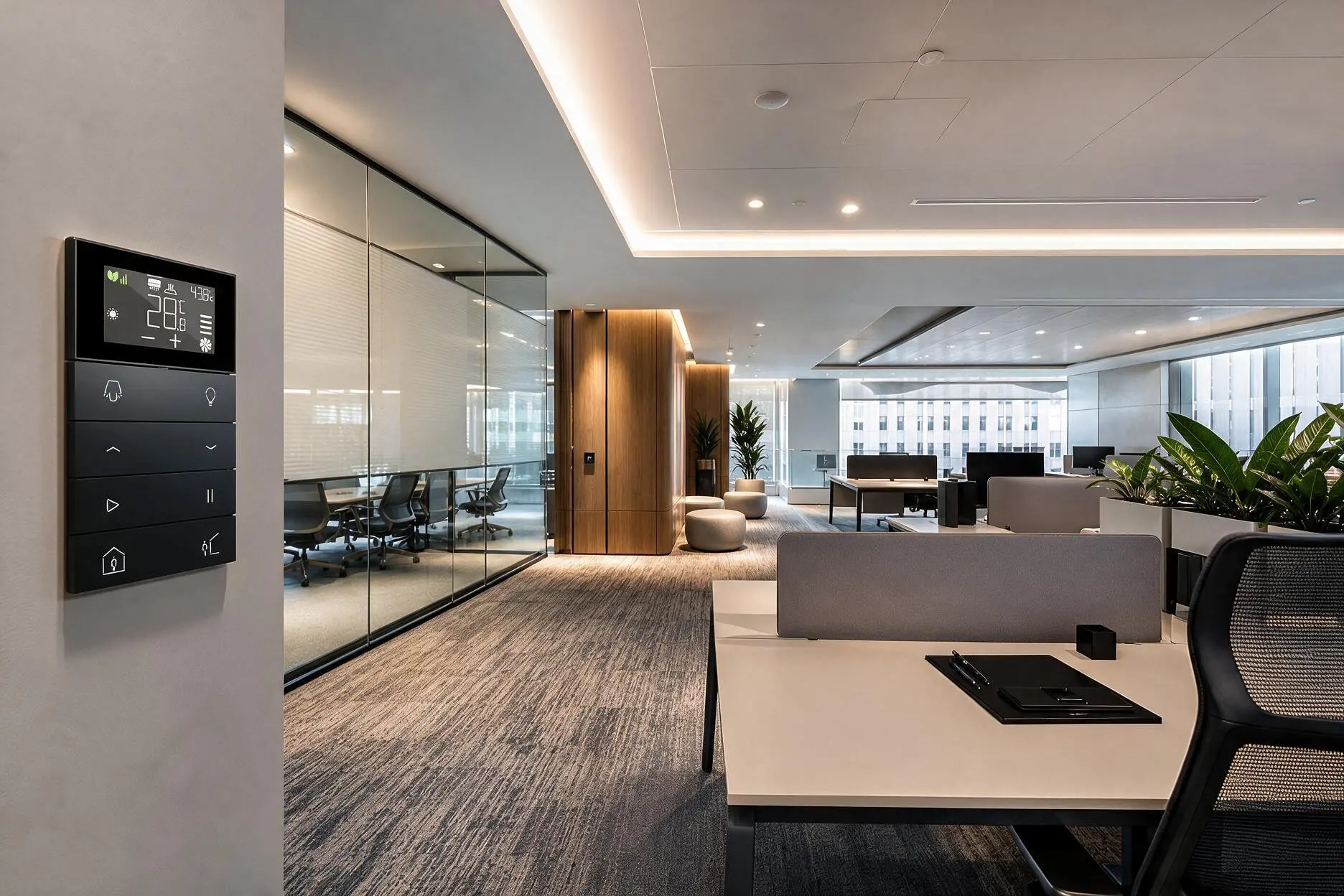
Office automation is the use of an integrated system to control and coordinate a workplace's lighting, climate, access, meeting rooms, security, and energy from one platform — automatically and intelligently. Instead of managing each system separately, office automation ties them together: lights and air conditioning adjust to occupancy, meeting rooms are booked and set up at a touch, access is controlled centrally, and energy is managed across the whole space. The result is a workplace that's more comfortable and productive for people, cheaper and easier to run for facilities teams, and significantly more energy-efficient. It's how modern offices become smart buildings.
Today's offices are expected to be efficient, flexible, and sustainable — and manually managing lighting, climate, and systems across a whole workplace doesn't achieve that. Office automation is the answer. This guide explains what it is, how it works, its benefits, and what it involves.
Who Is This Guide For?
Business owners, facilities managers, and developers building, fitting out, or upgrading an office in Noida, Greater Noida, Gurgaon, Delhi NCR, or across India. Architects and consultants specifying systems for a commercial workplace. And anyone wanting to understand what office automation covers and what it delivers.
What Is Office Automation?
Office automation is an integrated building-automation system applied to the workplace. Rather than lighting, air conditioning, access, and security each running as separate, manually-managed systems, automation connects them into one coordinated platform that can be controlled and automated centrally.
The shift is from manual and separate to automatic and unified. Lights that switch off in empty meeting rooms. Air conditioning that eases back after hours. Access controlled from one system. Energy monitored across the whole floor. Meeting rooms that set themselves up at the touch of a button.
This is the workplace application of the same principles behind commercial lighting automation — extended across every system in the office, not just lighting.
What Does Office Automation Control?
A complete office automation system typically brings together several areas:
Lighting. Automated, scene-based, and occupancy-driven lighting — lights that respond to whether spaces are used and to daylight levels. (Lighting is a big enough topic on its own; our office lighting design guide covers the workplace-lighting specifics in depth.)
Climate / HVAC. Coordinated heating and cooling that adjusts to occupancy and schedule — one of the largest energy costs in any office, and one of the biggest saving opportunities.
Access control. Centralised, secure entry — managing who can access which areas, integrated with the wider system rather than standalone locks.
Meeting & conference rooms. Booking systems, and rooms that set up at a touch — lighting, AV, blinds, and climate configured for a presentation or call automatically.
Security & surveillance. Integrated cameras, sensors, and alarms coordinated with access and the wider system.
Energy management. Monitoring and optimising energy across the whole workplace, with data to inform decisions.
Occupancy sensing. The intelligence layer — detecting how spaces are actually used, driving both energy savings and smarter space planning.
How Does Office Automation Work?
The core idea is a central, integrated platform — often built on a reliable open standard like KNX — that connects all these systems so they work together and can be automated.
In practice: occupancy sensors detect which areas are in use and adjust lighting and climate accordingly. Schedules ease systems back outside working hours. A meeting room, once booked, sets its own lighting, blinds, and AV for the session. Facilities teams manage and monitor everything from one dashboard, with data on energy and usage. Where useful, systems respond automatically — no one manually switching off floors at night.
The intelligence is in the coordination. Individually, these are separate conveniences. Together, integrated and automated, they make a genuinely smart, efficient workplace.
The Benefits of Office Automation
For the Business & Facilities
Significant energy savings. The strongest driver for most offices. Lighting and HVAC that run only when and where needed cut energy waste substantially — a major, ongoing operating cost reduced across the whole workplace.
Easier management. Facilities teams control and monitor everything from one platform instead of juggling separate systems, with data to spot issues and optimise.
Lower operating costs. Beyond energy, automation reduces manual effort, flags maintenance issues early, and extends equipment life through smarter operation.
Sustainability. Reduced energy use supports environmental goals and green-building standards — increasingly important for modern businesses.
For the People
Comfort and productivity. Well-managed lighting and climate create a more comfortable environment, which supports focus and wellbeing — and comfortable employees are more productive.
Better meeting experiences. Rooms that just work — set up correctly, on time, without fiddling with controls — remove a daily source of friction.
A modern workplace. Automation signals a forward-looking business, which matters for attracting talent and impressing clients.
Energy & Efficiency — The Business Case
For most offices, the financial case rests heavily on energy. Lighting and air conditioning are among the largest operating costs, and in a manually-run office, both are routinely wasted — lights left on in empty rooms, AC cooling unoccupied floors, systems running after hours.
Office automation targets exactly this waste. Occupancy-driven lighting and climate ensure energy is used only where and when needed. Automated scheduling handles out-of-hours efficiency. Energy monitoring reveals where more can be saved. Across a whole workplace, running every day, these savings become a meaningful, recurring reduction in operating costs — often the clearest return on the investment.
The combination of lower running costs and a better workplace is what makes office automation a sound business decision, not just a technology upgrade.
What to Consider
Choose a reliable, open platform. Offices need robust, proven systems that can integrate multiple functions and expand over time. Open standards like KNX are widely used for this.
Plan integration from the start. The value is in systems working together. Plan for lighting, climate, access, and security to integrate, rather than bolting on isolated pieces.
Design around how the office is used. Good automation reflects real working patterns — occupancy, hours, meeting-room demand — not a generic template.
Plan during fit-out where possible. Wired systems are best built in during construction or fit-out. Retrofit is possible but planning early is cheaper and cleaner.
Think about scalability. A growing business needs a system that can expand. Build for where the office is going, not just where it is.
What Does Office Automation Cost?
These are indicative estimates for planning only, not actual quotes. Actual cost depends on the office size, the systems included, the integration level, and the platform — confirmed after a detailed assessment.
Office automation is usually scoped by the size of the space and the systems included. A basic setup might cover automated lighting and climate control; a full system integrates access, meeting rooms, security, and comprehensive energy management across the whole workplace.
The important framing: office automation is an investment with a measurable return. The energy and operational savings offset the cost over time, while the productivity and workplace benefits add value that's harder to quantify but real. The right scope depends on the office's size, use, and goals. For related principles, our home automation cost guide explains how automation is costed, though commercial projects are quoted specifically.
Expert Recommendation from Brightmatic
For the workplace projects we work on across Delhi NCR, our guidance is consistent: build office automation on a reliable, open platform, integrate the systems from the start, and design around how the office is actually used — because automation designed around real working patterns delivers far more than a generic install.
The insight worth passing on: businesses sometimes approach office automation as a checklist of gadgets — smart lights here, a booking screen there. But the value isn't in the individual pieces; it's in the coordination. An office where lighting, climate, access, and meeting rooms all work together, driven by how the space is genuinely used, is transformative in a way that a collection of disconnected smart devices never is. The energy savings come from the whole system knowing when spaces are empty. The productivity comes from everything simply working. That only happens when it's designed as one integrated system, not assembled piecemeal.
Design it as a whole, around your workplace's real rhythms, and it pays back in both cost and experience. That's the thinking behind our approach — workplaces that are Designed Around Experience, for the business and the people in it.
Planning to Automate Your Office?
Office automation turns a workplace into a smart building — more comfortable and productive for people, leaner and greener to run for the business. The key is designing it as one integrated system around how your office actually works.
Planning an office project? Get a consultation.
Building or upgrading an office in Noida or Delhi NCR? Contact Brightmatic for a personalised office automation consultation.
FAQ's
What is office automation?
Office automation is the use of an integrated system to control and coordinate a workplace's lighting, climate, access, meeting rooms, security, and energy from one platform, automatically and intelligently. Instead of managing each system separately, it ties them together so the office is more comfortable, easier to run, and significantly more energy-efficient.What does an office automation system control?
A complete office automation system typically controls lighting, climate/HVAC, access control, meeting and conference rooms, security and surveillance, and energy management, with occupancy sensing as the intelligence layer. These are integrated into one platform so they work together rather than as separate, manually-managed systems.How does office automation save energy?
Office automation uses occupancy sensing and scheduling so that lighting and air conditioning run only where and when needed, easing back in empty spaces and outside working hours. Since lighting and HVAC are among the largest office operating costs, this targeted reduction in waste delivers substantial, recurring energy savings across the whole workplace.What are the benefits of office automation?
The main benefits are significant energy savings, easier centralised management, lower operating costs, and sustainability for the business, plus better comfort and productivity, smoother meetings, and a modern workplace for the people. It reduces running costs while creating a better environment to work in — value on both sides.What platform is used for office automation?
Office automation is often built on reliable, open standards like KNX, which can integrate lighting, climate, access, and other systems into one coordinated platform and expand over time. Offices need robust, proven systems, so the choice of a dependable, scalable platform is an important early decision, best made through professional assessment.Is office automation worth the investment?
For most offices, yes. It delivers a measurable return through energy and operational savings that offset the cost over time, alongside less easily quantified but real benefits in productivity, comfort, and workplace quality. Designed as one integrated system around how the office is used, it's a sound business decision rather than just a technology upgrade.
Comments
No Comments