

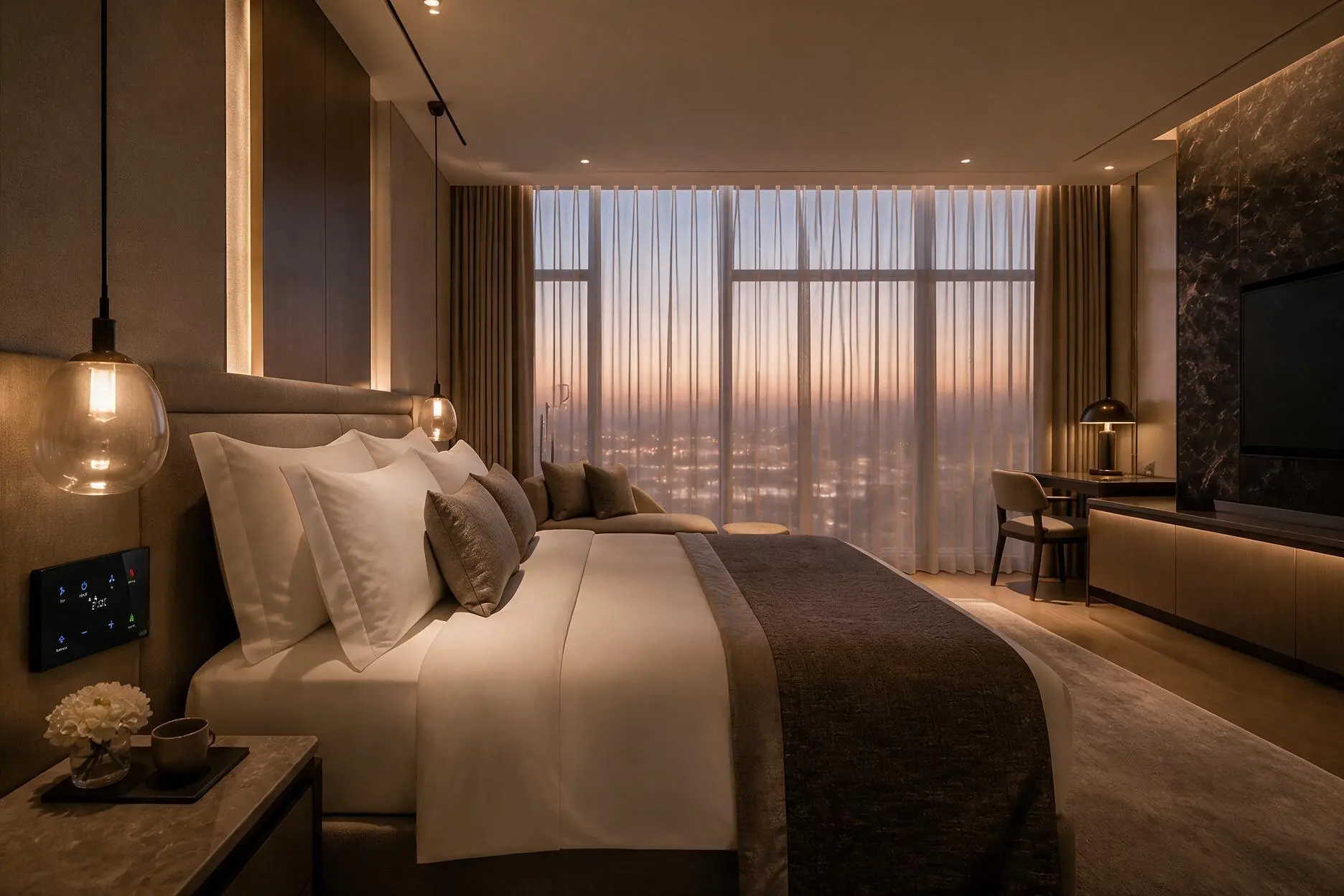
Hotel automation uses a Guest Room Management System (GRMS) to control a room's lighting, climate, curtains, and services from one interface — a bedside panel, the guest's phone, or automatically. When a guest checks in, the room can switch from vacant to occupied mode, set a welcoming temperature and lighting scene, and when they leave, sensors turn off lights and ease the air conditioning to save energy. Integrated with the hotel's Property Management System (PMS), automation streamlines operations — housekeeping status, energy management, and guest requests — while giving guests a modern, comfortable, personalised stay. For hotels, it delivers two things at once: a better guest experience and lower running costs.
For a modern hotel, automation isn't a luxury add-on — it's increasingly what guests expect and what keeps running costs under control. This guide explains how hotel automation works, its benefits, the key systems, and what to consider.
Who Is This Guide For?
Hotel owners, developers, and operators building or upgrading a property in Noida, Greater Noida, Gurgaon, Delhi NCR, or across India. Architects and consultants specifying systems for a hospitality project. And anyone wanting to understand what hotel automation involves, what it costs, and what it delivers.
What Is Hotel Automation?
At its core, hotel automation is built around a Guest Room Management System (GRMS) — a centralised platform that automates and controls a guest room's functions from a single interface, for both guests and staff.
Instead of scattered switches and controls, a GRMS manages the whole room environment — lighting, climate, curtains, and service requests — through one system. For the guest, it means simple, intuitive control. For the hotel, it means real-time room visibility, energy control, and smoother operations.
This is the hospitality-specific version of the commercial lighting automation principles applied elsewhere — tailored to the unique demands of a hotel, where every room is both a guest's private space and an operational unit.
How Does Hotel Automation Work?
The real power comes from integration with the hotel's Property Management System (PMS) — the software that manages bookings and check-ins.
Here's the flow: when a guest checks in through the PMS, the GRMS can automatically switch the room from "vacant" to "occupied" mode — setting a welcoming temperature and turning on a gentle arrival lighting scene. During the stay, the guest controls lighting, climate, and curtains from a bedside panel or their phone. Sensors detect when the room is empty and adjust lighting and HVAC to save energy. At check-out, the system returns the room to an efficient standby, and access is revoked.
Behind the scenes, staff benefit too. "Do Not Disturb" and "Make Up Room" statuses are set from the room and instantly visible to housekeeping and the front desk. Maintenance and cleaning crews can have dedicated modes. Room status updates in real time, reducing manual checks. This coordination is what makes automation as valuable to operations as it is to guests.
The Key Systems in Hotel Automation
Guest Room Management System (GRMS). The heart of it — controlling in-room lighting, climate, curtains, and scenes, often built on a reliable platform like KNX.
Lighting control. Scene-based lighting — a warm "welcome" scene on arrival, a "sleep" scene, reading light, and full brightness for housekeeping.
Climate/HVAC control. Automated temperature that welcomes guests comfortably and pulls back to save energy when the room is empty — one of the biggest cost savers.
Motorised curtains. Motorised curtains controlled from the bedside panel or included in scenes, adding a premium touch guests notice.
Occupancy sensing. Detecting whether a room is occupied to drive energy savings and housekeeping status.
PMS integration. Linking automation to bookings so rooms respond to check-in and check-out automatically.
In-room control interface. A bedside touch panel, or the guest's own phone, as the single point of control.
The Benefits for Hotels
For the Guest Experience
A modern, personalised stay. Guests increasingly expect intuitive control — the right temperature as they walk in, easy lighting, simple room controls. Automation delivers this from the moment they enter.
Simplicity. A single, intuitive panel replaces the confusion of finding unfamiliar switches in a new room — a small frustration automation quietly removes.
A premium feel. Scene lighting, motorised curtains, and seamless control signal quality and care, elevating the perceived value of the stay.
For Hotel Operations
Significant energy savings. This is often the biggest driver. Automatically adjusting lighting and HVAC based on occupancy cuts energy waste substantially — and over a property's long operational hours, that saves considerably on utility costs.
Smoother operations. Real-time room status reduces manual checks and helps housekeeping and front desk work faster. "Do Not Disturb" and "Make Up Room" statuses coordinate staff efficiently.
Better data and decisions. Built-in reporting helps track energy usage, occupancy trends, and guest preferences, informing smarter management.
Early issue detection. The system can flag faults — a sensor issue, an energy spike, an open window — before they become problems.
Enhanced security. Access is automatically managed with check-in and check-out, and revoked when a guest leaves.
Energy Savings — The Business Case
For hotels, the operational case for automation is compelling. Guest rooms are frequently empty — guests are out for much of the day — yet lighting and air conditioning are often left running.
Automation solves this precisely. Occupancy sensors ensure lights and HVAC operate only when needed. HVAC eases back when a room is empty and returns to comfort as the guest returns. Across a whole property, running continuously, these savings add up to a meaningful reduction in utility costs — often the single strongest financial argument for hotel automation, and one that pays back the investment over time.
What to Consider
Choose reliable, proven systems. Hotels run continuously and can't afford unreliable technology. Platforms like KNX are widely used for their robustness and interoperability.
Plan PMS integration. The automation's value multiplies when linked to the hotel's booking system. Ensure the systems can integrate.
Design for guests and staff. The best hotel automation serves both — an intuitive guest experience and genuine operational efficiency.
Keep the guest interface simple. Guests arrive tired, in an unfamiliar room. Controls must be immediately obvious, not a puzzle.
Plan during construction where possible. Wired GRMS (like KNX) is best built into the electrical infrastructure during construction or major renovation.
What Does Hotel Automation Cost?
These are indicative estimates for planning only, not actual quotes. Actual cost depends on the number of rooms, systems included, integration level, and platform — confirmed after a detailed assessment.
Hotel automation is usually costed per room, then scaled across the property. A basic guest-room automation setup covers core lighting and climate control; a full system adds curtains, advanced scenes, PMS integration, and comprehensive energy management. Public areas — lobbies, restaurants, facades — are typically planned alongside as part of the wider project.
The key point: hotel automation should be viewed as an investment with a return, not just a cost. The energy savings and operational efficiencies offset the outlay over time, while the guest-experience improvement supports the property's positioning and ratings. For related figures, our home automation cost guide explains the principles, though hotel projects are quoted specifically.
Expert Recommendation from Brightmatic
For the hospitality projects we work on across Delhi NCR, our guidance is consistent: build hotel automation on a reliable, proven platform, integrate it with the PMS from the start, and design equally for the guest experience and operational efficiency — because the best hotel automation serves both at once.
The insight worth passing on: some hoteliers see automation purely as a guest-facing luxury, and others see it purely as an energy-saving tool. The truth is it's most powerful when it's both — and the two reinforce each other. A room that welcomes a guest with the perfect temperature and lighting is the same room that saves energy when they step out. A system that gives guests effortless control is the same system that tells housekeeping the room is ready. You don't choose between experience and efficiency; a well-designed system delivers both from the same investment.
That dual value — a better stay and a leaner operation — is what makes hotel automation worth it. It's the thinking behind our approach: hospitality that's Designed Around Experience, for guests and operators alike.
Planning Automation for Your Hotel?
Hotel automation is one of the few investments that improves the guest experience and lowers running costs at the same time — a better stay for guests, a leaner operation for you. Done well, on the right platform, it pays back over time while setting the property apart.
Planning a hotel project? Get a consultation.
Building or upgrading a hotel in Noida or Delhi NCR? Contact Brightmatic for a personalised hotel automation consultation.
FAQ's
What is hotel automation?
Hotel automation uses a Guest Room Management System (GRMS) to control a guest room's lighting, climate, curtains, and services from one interface — a bedside panel, the guest's phone, or automatically. Integrated with the hotel's Property Management System, it improves the guest experience while cutting energy costs and streamlining operations.What is a GRMS in a hotel?
A GRMS (Guest Room Management System) is a centralised platform that automates and controls a hotel room's in-room functions — lighting, climate, curtains, and service requests — for both guests and staff. It replaces scattered manual controls with one system, giving guests simple control and hotels real-time room visibility and energy management.How does hotel automation save energy?
Hotel automation uses occupancy sensors to ensure lighting and HVAC run only when a room is occupied, easing the air conditioning and switching off lights when guests are out. Across a whole property running continuously, this cuts energy waste substantially, making energy savings one of the strongest financial reasons hotels invest in automation.How does hotel automation work with check-in?
When integrated with the Property Management System (PMS), automation responds to check-in automatically — switching the room from vacant to occupied mode, setting a welcoming temperature and lighting scene. At check-out, the room returns to an efficient standby and guest access is revoked, all synchronised with the booking system.What can guests control in an automated hotel room?
Guests can typically control lighting (including scenes), room temperature, motorised curtains, and service requests from a bedside touch panel or their own smartphone. The aim is a single, intuitive interface that replaces the confusion of finding unfamiliar switches, making the room comfortable and easy to control from the moment they arrive.Is hotel automation worth the investment?
For most hotels, yes. It delivers two returns at once — a better, more modern guest experience that supports the property's positioning, and significant operational savings through reduced energy use and smoother staff coordination. The energy and efficiency savings offset the investment over time, making it a business decision rather than just a luxury.
Comments
No Comments