

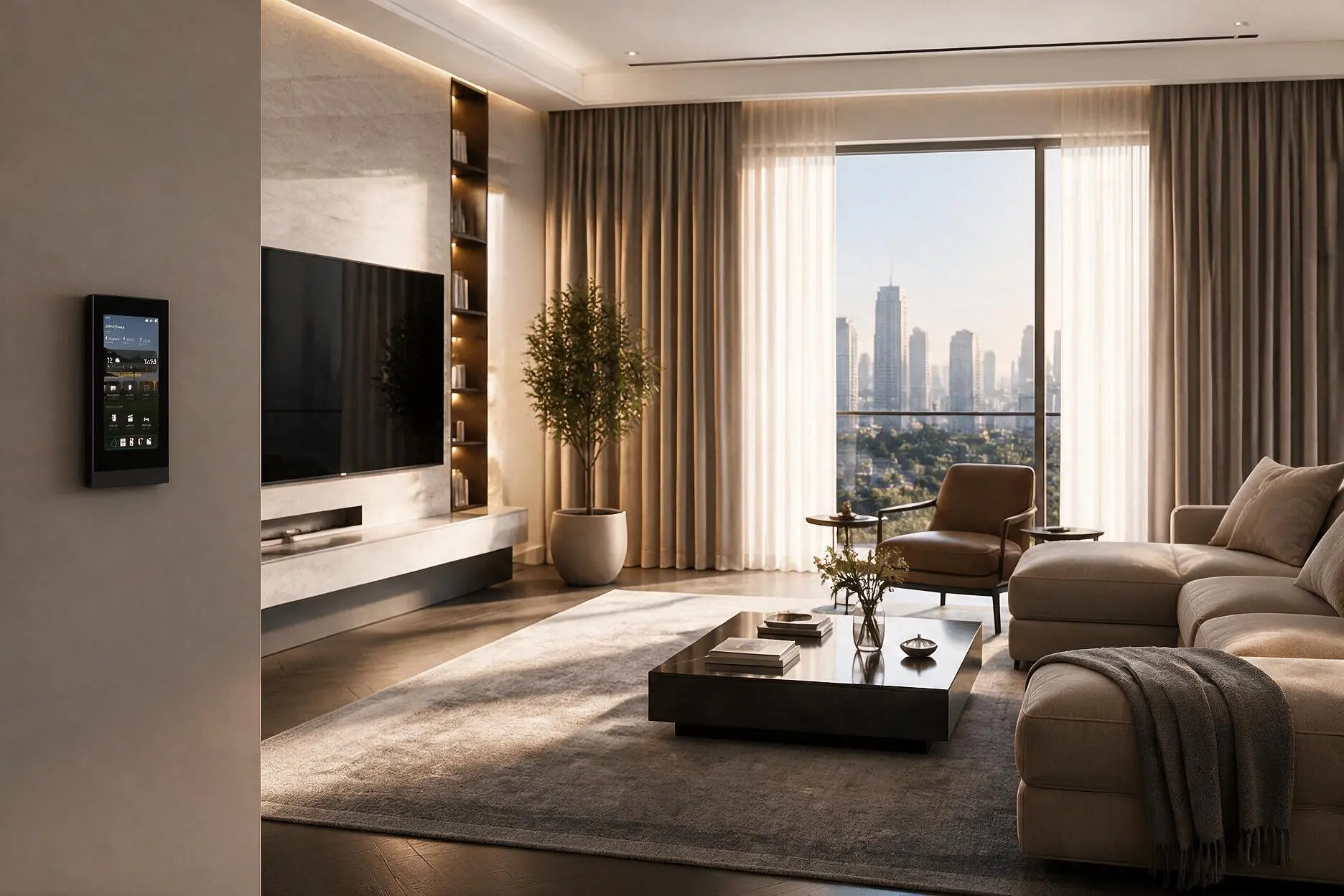
Motorised curtains are curtains that open and close automatically using a quiet electric motor, controlled by a remote, wall switch, app, voice assistant, or schedule. Instead of pulling them by hand, you tap a button — or they open on their own at sunrise and close at sunset. They're one of the most popular entry points into home automation because the benefit is instant and visible: convenience, better light control, privacy, and a premium feel. Motorised curtains can be wired or wireless (battery/rechargeable), retrofitted to existing curtains or built in, and integrated into a wider smart home. Indicative cost starts around ₹15,000–₹25,000 per window and rises with track size, motor quality, and integration.
Of all the ways to make a home smarter, motorised curtains are among the most satisfying — because you feel the difference every single day. This guide covers how they work, the types, benefits, cost, and whether they're worth it.
Who Is This Guide For?
Homeowners in Noida, Greater Noida, Gurgaon, or Delhi NCR considering motorised or smart curtains, whether for a new home or a retrofit. Architects and interior designers specifying window treatments for a project. And anyone wondering how motorised curtains work, what they cost, and if they're worth it.
How Do Motorised Curtains Work?
At their simplest, motorised curtains replace the manual pull with a quiet electric motor mounted on the curtain track. When triggered, the motor moves the curtains along the track — smoothly and silently.
What triggers them is where it gets interesting:
- Remote or wall switch — a simple button press.
- App — control from your phone, anywhere.
- Voice — "close the curtains" via Alexa, Google, or Siri.
- Schedule — open at sunrise, close at sunset, automatically.
- Sensors/automation — tied to light levels, temperature, or a "goodnight" scene that closes every curtain in the home at once.
The last two are the magic. Curtains that respond to time or a single scene — the whole home settling for the night with one tap — is what separates a smart home from a manual one. This ties into a wider lighting control and automation system.
Types of Motorised Curtains
By Power
Wired (hardwired) motors — connected to mains power, ideal when planned during construction or renovation. Reliable, never need charging, and best for permanent integration.
Wireless (battery or rechargeable) motors — powered by a rechargeable battery, perfect for retrofitting to existing homes without wiring work. Convenient, though the battery needs occasional recharging.
By Installation
Retrofit — a motor added to your existing curtain track, or a new motorised track fitted to existing curtains. Great for upgrading a finished home.
Built-in — motorised tracks planned and installed during construction, hidden and seamless.
By Curtain Style
Motorisation works with most styles — regular sliding curtains, sheer and blackout layers (dual tracks), roller blinds, Roman blinds, and more. You can motorise just the main curtains or every window in the home.
The Benefits of Motorised Curtains
Convenience. The obvious one — no reaching, pulling, or struggling with tall or wide windows. A tap, a word, or nothing at all.
Light control. Effortlessly adjust natural light through the day — open for morning light, close against harsh afternoon sun. Better light control also means better comfort.
Privacy on demand. Close every curtain in the home instantly, or on schedule, without walking room to room.
Energy efficiency. Closing curtains against the harsh summer sun reduces heat gain and eases the load on air conditioning — a real benefit in India's climate. Scheduling this automatically maximises the saving.
Access for hard-to-reach windows. Tall, wide, or high windows — behind furniture, in double-height spaces — become effortless to operate.
A premium, effortless feel. Curtains gliding open on their own is one of those touches that makes a home feel genuinely luxurious and considered.
Great for everyone. Especially valuable for the elderly or anyone for whom heavy curtains are a daily struggle.
Security when away. Scheduled curtains that open and close make a home look occupied even when you're travelling.
Motorised Curtains and the Smart Home
Motorised curtains are often someone's first step into home automation — the benefit is so immediate. But their real power emerges when integrated into a wider system.
Tied into a smart home, curtains join scenes: a "goodnight" scene closes every curtain, dims the lights, and locks the doors with one tap. A "good morning" scene opens the bedroom curtains gently at your wake time. A "movie" scene closes the living room curtains as the projector drops. This is the same logic as our apartment automation approach, applied to windows.
That integration — curtains as one part of a coordinated home, not an isolated gadget — is what turns a nice convenience into a genuinely smart experience.
What Do Motorised Curtains Cost?
These are indicative estimates for planning only, not actual quotes. Actual cost depends on track width, motor quality, wired vs wireless, curtain style, and integration — confirmed after assessment.
| Setup | Indicative Cost (per window) |
|---|---|
| Basic wireless retrofit motor | ₹15,000 – ₹25,000 |
| Quality wired motorised track | ₹25,000 – ₹50,000 |
| Premium / dual-track (sheer + blackout) | ₹50,000+ |
The cost per window depends most on track width (wider needs stronger motors), motor quality (quiet, durable motors cost more but last), and whether it's wired or wireless. Integrating into a full smart home adds to the system but multiplies the value. For the bigger picture, see our home automation cost guide.
A tip: quality matters here. A cheap motor that's noisy or fails is a daily irritation on something you use constantly. Better to do fewer windows well than many poorly.
Are Motorised Curtains Worth It?
Yes, for most people who try them — because the benefit is felt daily and immediately. Unlike some automation you set and forget, motorised curtains are used every single day, so the convenience compounds.
They're especially worth it if: you have tall, wide, or hard-to-reach windows; you want scheduling and scene integration; you value the premium feel; there are elderly family members; or you want automated light and heat control.
They may be less essential if: you have few, small, easily-reached windows and no interest in smart-home integration. But even then, many find the convenience addictive once experienced.
The honest take: motorised curtains are one of the highest-satisfaction automation upgrades precisely because you interact with them constantly. Few smart features get used as often, or appreciated as consistently.
Common Mistakes to Avoid
Buying cheap, noisy motors. On something used daily, a loud or unreliable motor ruins the experience. Quality matters most here.
Not planning for power. Wired motors need power provision (plan during construction); wireless need charging access. Decide early.
Ignoring integration. A motorised curtain that only works on its own remote misses most of the value. Plan for smart-home integration if you want scenes and scheduling.
Wrong motor for the track. Wide or heavy curtains need appropriately powerful motors. Undersized motors struggle and fail.
Forgetting the retrofit option. You don't need to rebuild — quality retrofit and wireless options work beautifully in finished homes.
Expert Recommendation from Brightmatic
For the homes we work on across Delhi NCR, our usual guidance on motorised curtains is: invest in quality, quiet motors, plan power early where possible, and always integrate them into the wider smart home rather than leaving them as standalone.
The insight worth passing on: clients are sometimes unsure whether motorised curtains are a gimmick. They aren't — they're one of the few automation upgrades people use every single day, which is exactly why they deliver such consistent satisfaction. But the difference between "nice" and "magical" is integration. A curtain on its own remote is convenient. A curtain that opens gently at your wake-up time, closes with your goodnight scene, and shuts against the afternoon sun automatically — that's when it stops being a motor and becomes part of how the home cares for you.
Do them well, integrate them properly, and they're among the most loved features in any smart home. That's the thinking behind our home automation approach — systems that are Designed Around Experience.
Thinking About Motorised Curtains?
Motorised curtains are one of those upgrades you don't fully appreciate until you live with them — and then can't imagine being without. Done well and integrated properly, they're among the most loved features in any smart home.
Curious if they're right for your home? Get a free consultation.
Planning a home in Noida or Delhi NCR? Contact Brightmatic for a personalised motorised curtains and automation consultation.
FAQ's
How do motorised curtains work?
Motorised curtains use a quiet electric motor mounted on the curtain track to open and close them automatically. You control them via a remote, wall switch, app, voice assistant, or automatic schedule. They can also be integrated into a smart home to respond to scenes, sensors, or time of day.Can motorised curtains be added to existing homes?
Yes. Wireless (battery or rechargeable) motors and retrofit motorised tracks are designed exactly for existing homes — they can be added to your current curtains or fitted as a new track without major wiring work. Wired motors are better planned during construction or renovation.How much do motorised curtains cost in India?
Indicatively, a basic wireless retrofit motor starts around ₹15,000–₹25,000 per window, a quality wired motorised track ₹25,000–₹50,000, and premium or dual-track setups ₹50,000 and above. Cost depends on track width, motor quality, and integration. These are indicative estimates confirmed after assessment.Are motorised curtains worth it?
For most people, yes — because they're used every day, so the convenience compounds. They're especially worthwhile for tall, wide, or hard-to-reach windows, for scheduling and scene integration, for elderly family members, and for automated light and heat control. Their daily use makes them one of the highest-satisfaction automation upgrades.Are motorised curtains noisy?
Quality motorised curtains are very quiet — a soft, smooth glide. Cheap motors, however, can be noticeably noisy, which becomes irritating on something used daily. This is why investing in a good-quality, quiet motor matters more here than in many other automation choices.Can motorised curtains work with Alexa or Google Home?
Yes, when integrated into a compatible smart-home system, motorised curtains can be controlled by voice through assistants like Alexa, Google Home, or Siri, and included in automated scenes and schedules. The level of integration depends on the system and motor chosen.
Comments
No Comments