

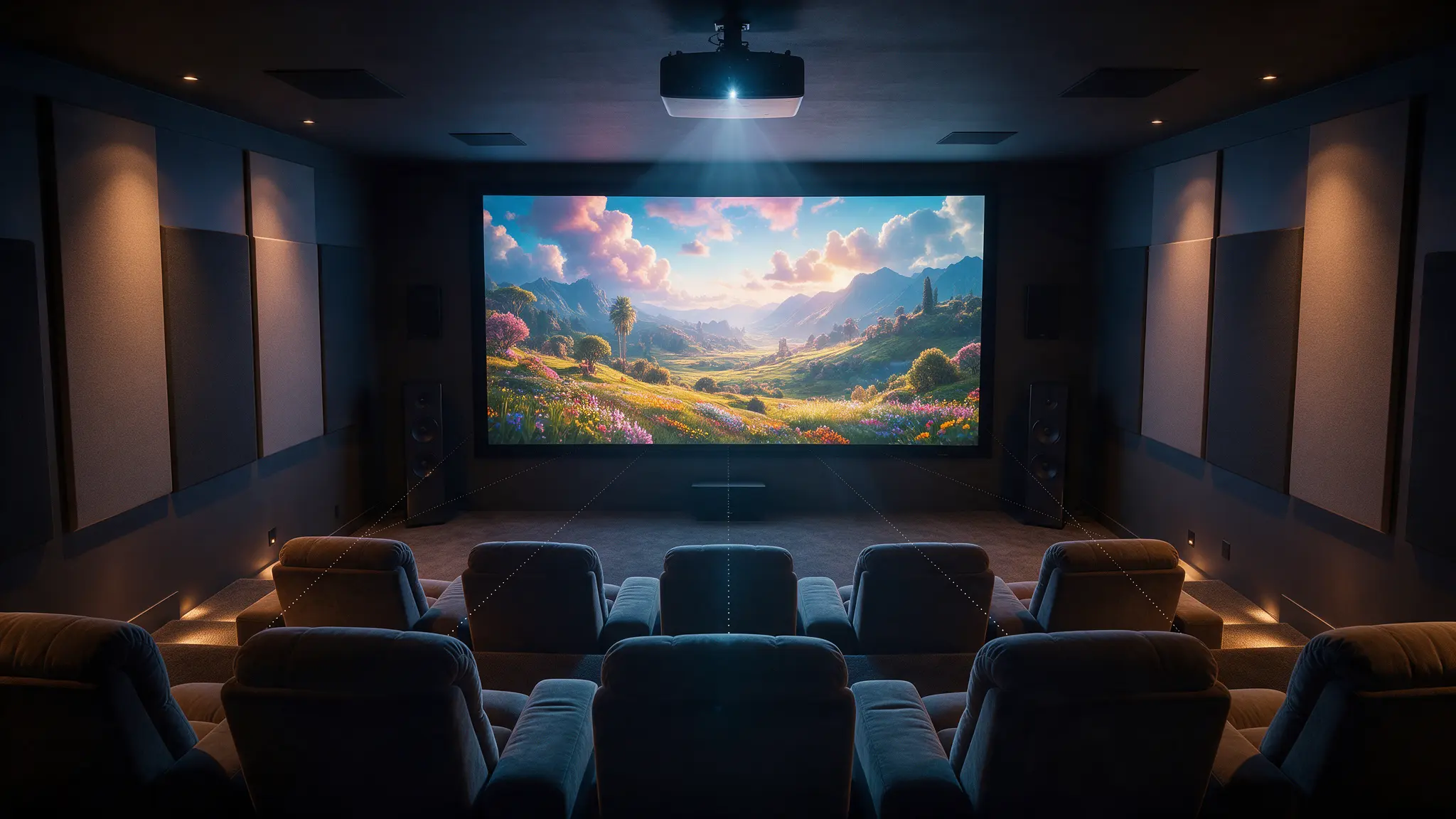
For a 16:9 projector screen, a good rule is a screen diagonal of about 0.6 to 0.8 times your seating distance. From 10 feet away, that means roughly 75 to 100 inches. From 12 feet, about 90 to 120 inches. Wall width, ceiling height, projector throw and room light also decide the final size.
The projector arrived. The family chose the biggest screen the wall could hold, because bigger must be better.
On movie night, everyone in the front row kept turning their heads to follow the action. Subtitles disappeared off the edge of their vision. After half an hour, someone moved to the back, and the rest followed.
Screen size is the single biggest decision in a home theatre, and also the easiest one to get wrong. This guide explains how to choose the right size for your room, what fits your walls and ceiling, which screen type to pick and what it costs.
Who is this guide for?
- Homeowners planning a home theatre or media room
- Living room owners replacing a TV with a projector
- Villa owners building a dedicated cinema room
- Interior designers planning screen walls, seating and ceilings
How do you choose the right projector screen size?
Choose your screen size from your seating distance, so the screen fills a comfortable part of your field of view.
A commonly used guideline, based on cinema standards from organisations such as SMPTE, is a viewing angle of about 30 degrees for comfortable viewing, rising to around 40 degrees for a more immersive, cinema-like feel. For 16:9 screens, that works out to a diagonal of roughly 0.6 to 0.8 times your seating distance.
| Seating distance (eyes to screen) | Comfortable screen (about 30°) | Immersive screen (about 40°) |
|---|---|---|
| 8 ft | about 60 inches | about 80 inches |
| 10 ft | about 75 inches | about 100 inches |
| 12 ft | about 90 inches | about 120 inches |
| 14 ft | about 105 inches | about 140 inches |
| 16 ft | about 115 inches | about 160 inches |
Families who watch mostly news and sport often prefer the comfortable size. Film lovers usually prefer the immersive end. With good 4K content, sitting closer works well without seeing pixels.
How big is each screen size in feet?
Before choosing, check that the screen fits your wall, with space around it for speakers and trim.
| 16:9 screen size | Width | Height |
|---|---|---|
| 80 inches | about 5.8 ft | about 3.3 ft |
| 100 inches | about 7.3 ft | about 4.1 ft |
| 120 inches | about 8.7 ft | about 4.9 ft |
| 135 inches | about 9.8 ft | about 5.5 ft |
| 150 inches | about 10.9 ft | about 6.1 ft |
Leave space on each side for the left and right speakers, and above or below for the centre speaker, unless you use an acoustically transparent screen with speakers behind it.
Should you choose a 16:9 or 2.35:1 screen?
Choose 16:9 for mixed viewing such as TV, sport and streaming, and 2.35:1 (cinemascope) for a dedicated cinema room focused on films.
Most streaming content and sport is 16:9. Many feature films are wider, so on a 16:9 screen they show black bars at the top and bottom. A wider 2.35:1 screen fills edge to edge with films, but shows bars on the sides for TV content. For most Indian homes, 16:9 is the more flexible choice.
How high should the screen be placed?
The bottom edge of the screen usually sits around 2 to 3 feet above the floor, so the front row can see comfortably without tilting their heads.
- In rooms with two rows, add a riser for the back row rather than raising the screen too high.
- Check that ceiling height allows both the screen and the projector’s position.
- Keep the centre of the screen roughly at or slightly above seated eye level.
Does projector throw distance affect screen size?
Yes. A projector’s throw ratio decides how far it must be from the screen to create a particular image size.
For example, a projector with a throw ratio of 1.5 needs to sit about 11 feet from a 100-inch 16:9 screen. Short-throw and ultra-short-throw projectors can create large images from much closer, which suits living rooms. Our lamp vs LED vs laser projector guide explains projector types, and our comparison of projector vs TV helps if you are still deciding.
At Brightmatic, we typically plan the screen, projector position and seating together on a section drawing before anything is mounted. A few inches of difference in projector position can decide whether the image fills the screen perfectly.
Which type of projector screen should you choose?
The right screen depends on whether the room is dedicated and dark, or a living room with daylight.
| Screen type | Best for | Note |
|---|---|---|
| Fixed-frame | Dedicated home theatres | Flattest, most consistent image |
| Motorised drop-down | Living rooms and dual-use spaces | Hides away when not in use |
| Ambient light rejecting (ALR) | Rooms with some daylight or lamps on | Better contrast in brighter rooms |
| Acoustically transparent | Cinema rooms with speakers behind the screen | Allows ideal speaker placement |
How much does a projector screen cost?
Projector screens in India indicatively range from about Rs 15,000 for a basic fixed screen to several lakh for large ALR or acoustically transparent screens.
Indicative estimates only, not actual quotes.
| Screen type (around 100–120 inches) | Indicative cost |
|---|---|
| Fixed-frame screen | Rs 15,000 – 60,000 |
| Motorised screen | Rs 25,000 – 1.5 lakh |
| Ambient light rejecting (ALR) screen | Rs 50,000 – 3 lakh+ |
| Acoustically transparent screen | Rs 75,000 – 3 lakh+ |
For complete home theatre budgets, see our home cinema installation cost guide.
Planning a home theatre in Noida or Delhi NCR? We can plan the screen size, projector position, seating and lighting together for your exact room.
Not sure what size fits? Share your room dimensions →
Is a bigger screen always better?
- Is it expensive? Larger screens cost more and need brighter projectors. The right size often costs less than the biggest one.
- Is it complicated? Not if seating, screen and projector are planned together.
- What can go wrong? A screen too big for the seating, a projector that can’t fill it, and daylight washing out the picture.
What mistakes should you avoid?
- Choosing the largest screen the wall can hold, without checking seating distance
- Ignoring projector throw distance before fixing the screen
- Mounting the screen too high for the front row
- Leaving no space for left, right and centre speakers
- Using a standard white screen in a bright living room
- Forgetting blackout curtains and dimmable lighting for the room
A common myth: the biggest possible screen always gives the best experience. In reality, the right size for your seating distance feels more immersive, because your eyes can take in the whole picture without strain.
Expert recommendation from Brightmatic
For most homes, we recommend a 16:9 screen sized at about 0.7 times the seating distance, a fixed-frame screen for dedicated theatres or a motorised ALR screen for living rooms, projector position confirmed against its throw ratio, and blackout curtains with a dimmable “Movie” lighting scene. Our motorised curtains cost guide helps with light control.
Brightmatic designs and installs home theatre and audio-video systems, including projectors from brands like BenQ.
Still deciding on screen size? Talk to our home theatre expert. We’ll plan it for your room, free.
Plan your home theatre with Brightmatic
Brightmatic designs and installs home theatres, projectors and screens for homes and villas in Noida, Delhi NCR & across India.
Comments
No Comments