


Choosing between a lamp, LED, or laser projector is the first real decision in any home theatre project — and it shapes everything that follows. Lamp projectors run on a traditional bulb that needs replacing every 2,000–5,000 hours. LED projectors use light-emitting diodes that last 20,000+ hours. Laser projectors use a phosphor laser light source lasting 20,000–30,000 hours, with the best brightness and colour accuracy of the three. For a dedicated home theatre in India, laser is usually the smart long-term pick — but the right answer depends on your room, your budget, and how often the projector runs.
This guide breaks down every practical difference between the three — brightness, lifespan, cost, maintenance — and tells you exactly which type fits which use case in an Indian home.
Who Is This Guide For?
Homeowners planning a dedicated home theatre or a living room projector setup who want to know which technology is actually worth the money. Architects and interior designers specifying projection systems for premium villas and residential projects across Noida, Greater Noida, Gurgaon, and Delhi NCR. And home theatre enthusiasts who want a straight, technically honest comparison instead of a brand-driven sales pitch.
What Is a Lamp Projector?
A lamp projector uses a high-pressure mercury or UHP (Ultra High Performance) bulb as its light source — the same core technology that has driven projectors since they went mainstream in the 1990s. The bulb throws out a bright white light that passes through LCD or DLP imaging chips to form the projected image.
Lamp projectors are the most widely available and usually the cheapest to buy upfront. The catch is the bulb itself — it fades over time, losing brightness gradually before it eventually fails and needs replacing. A replacement lamp typically costs ₹8,000 to ₹25,000 depending on the brand and model.
Best for: Budget-conscious buyers who want a large screen and don't mind replacing the lamp every few years. Setups where the projector runs only occasionally.
What Is an LED Projector?
An LED projector uses light-emitting diodes as the light source instead of a bulb. The big advantage is lifespan — typically 20,000 hours or more, which effectively removes the lamp replacement cost and the maintenance cycle that comes with traditional projectors.
The tradeoff is brightness. Most LED projectors put out 1,000–3,000 ANSI lumens — noticeably less than lamp or laser units. That makes them a good fit for small, dark rooms but a poor one for larger home theatres or any space with ambient light.
Best for: Small media rooms with tight light control. Portable setups. Spaces where low maintenance matters most and the room can be fully darkened.
What Is a Laser Projector?
A laser projector uses a solid-state phosphor laser light source to create the image — a fundamentally different approach from both lamp and LED. Laser units deliver the highest brightness (3,000–10,000+ ANSI lumens in home theatre models), the best colour accuracy, and the longest usable life of the three.
At Brightmatic, we specify laser projectors for most of our dedicated home theatre installations. The mix of high brightness, rich colour, and zero lamp replacement makes them the most sensible long-term choice for a serious home theatre in India's climate.
Best for: Dedicated home theatres, large rooms, premium installs where picture quality comes first, and any setup where the projector runs frequently.
Lamp vs LED vs Laser Projector — Complete Comparison
| Factor | Lamp Projector | LED Projector | Laser Projector |
|---|---|---|---|
| Light source | UHP/mercury bulb | Light-emitting diodes | Phosphor laser |
| Brightness (lumens) | 2,000–5,000 ANSI | 500–3,000 ANSI | 3,000–10,000+ ANSI |
| Lifespan | 2,000–5,000 hours | 20,000+ hours | 20,000–30,000 hours |
| Colour accuracy | Good | Good | Excellent — wide colour gamut |
| Warm-up time | 30–60 seconds | Instant | Instant |
| Maintenance | Lamp replacement needed | Minimal | Virtually none |
| Upfront cost (India) | ₹60,000 – ₹3,00,000 | ₹30,000 – ₹1,50,000 | ₹1,50,000 – ₹15,00,000+ |
| Long-term cost | Higher (lamp replacements) | Low | Low |
| 4K availability | Yes | Limited | Yes — wide range |
| Best room size | Any | Small to medium | Any — especially large |
| India suitability | Moderate — heat affects lamp | Good | Excellent |
Brightness — The Spec That Matters Most in India
Brightness carries more weight in India than in most markets — and it's the single most important factor when picking between lamp, LED, and laser.
Indian homes, especially across Delhi NCR, Noida, and Gurgaon, tend to have large windows, high ambient light, and strong overhead lighting. A projector that looks spectacular in a dark European screening room can look washed out in a typical Indian villa living room with afternoon light streaming in.
Rough brightness guidelines for Indian homes:
- Fully dark dedicated theatre room: 1,500–2,500 ANSI lumens — LED or laser both work
- Living room with curtains drawn: 2,500–4,000 ANSI lumens — lamp or laser
- Room with some ambient light: 4,000+ ANSI lumens — laser only
- Large room (20+ feet throw distance): 4,000–6,000 ANSI lumens — laser strongly preferred
LED projectors, despite the lifespan advantage, simply don't push enough brightness for most Indian living rooms unless the space can be fully blacked out.
Lifespan and Maintenance — Where Laser Pulls Ahead
The maths here is hard to argue with.
Lamp projector: A typical lamp runs 3,000–5,000 hours in normal mode. At 3 hours a day, that's roughly 3–4 years before it needs replacing at ₹8,000–25,000. Brightness also fades on the way there — a unit rated 3,500 lumens when new might be down to around 2,200 lumens by the time the lamp gives out.
LED projector: Rated at 20,000+ hours, but the brightness ceiling limits how useful that is in most Indian rooms.
Laser projector: Rated 20,000–30,000 hours with very little brightness drop over time. At 3 hours a day, that's roughly 18–27 years before the light source needs attention. No lamp swaps, no slow dimming, no interruptions.
In one of our recent villa projects in Noida, the client was already on their second lamp replacement within five years of the original install. We replaced the whole setup with a laser projector — and the cost, including installation, was effectively recovered through the lamp replacement cycles the client no longer had to pay for.
From a Recent Brightmatic Project
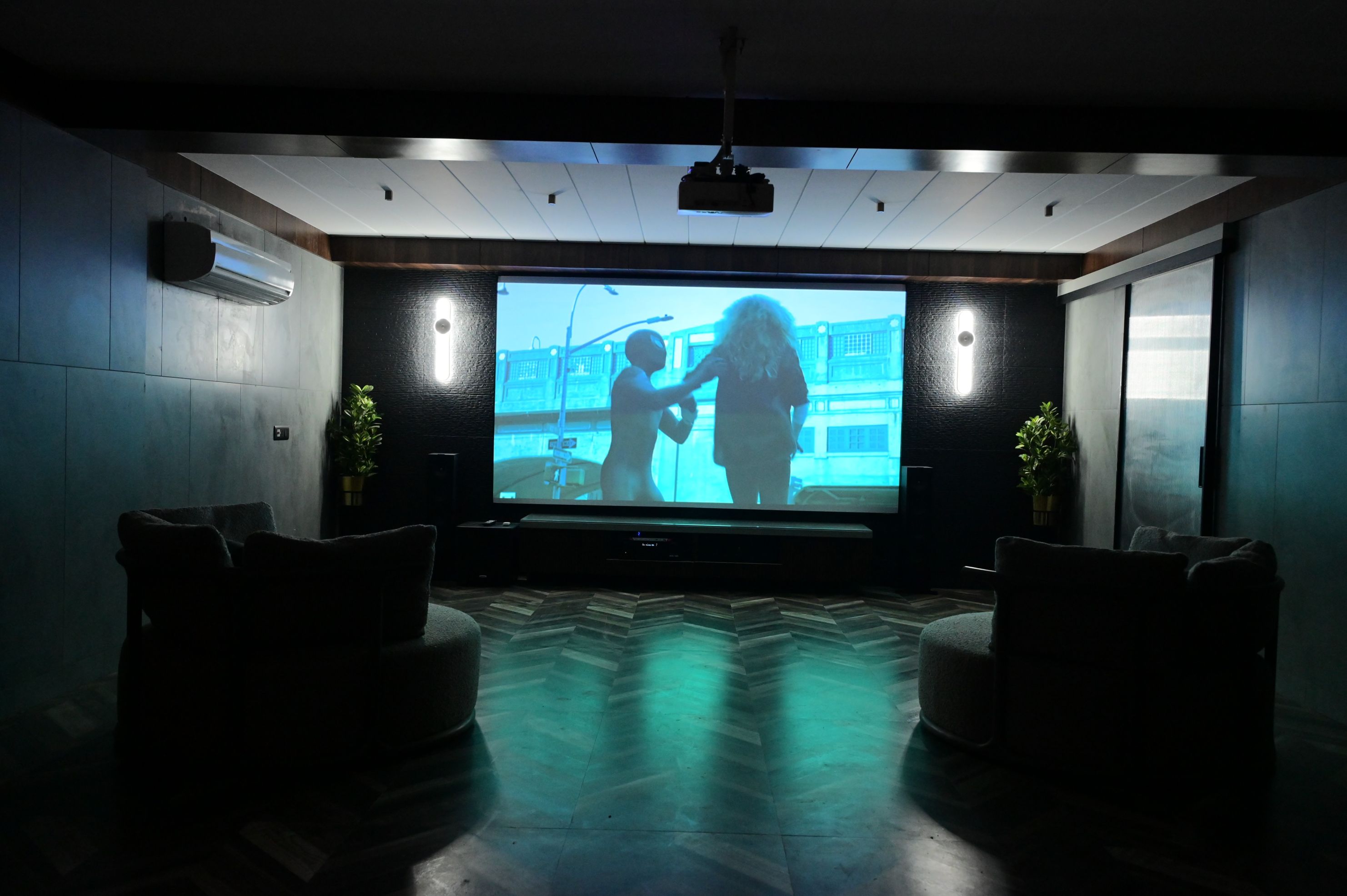
At Brightmatic, we generally recommend laser projectors for any home theatre that will see regular use — the zero-maintenance benefit starts paying off within the first 3–4 years.
Cost Comparison — Upfront vs Long-Term
These are indicative estimates based on typical home theatre projects in India. Actual cost depends on brand, resolution, brightness, and installation requirements.
| Lamp Projector | LED Projector | Laser Projector | |
|---|---|---|---|
| Upfront cost (entry) | ₹60,000 – ₹1,20,000 | ₹30,000 – ₹80,000 | ₹1,50,000 – ₹3,00,000 |
| Upfront cost (premium) | ₹1,50,000 – ₹3,00,000 | ₹80,000 – ₹1,50,000 | ₹3,00,000 – ₹15,00,000+ |
| Lamp replacement (per cycle) | ₹8,000 – ₹25,000 | None | None |
| 10-year maintenance estimate | ₹24,000 – ₹75,000 | Minimal | Minimal |
| Total 10-year cost (mid-range) | ₹2,50,000 – ₹4,50,000 | ₹80,000 – ₹1,50,000 | ₹3,00,000 – ₹5,00,000 |
Over a 10-year window, the total cost of owning a mid-range lamp projector often catches up to — or overtakes — an entry-level laser unit, once you factor in lamp replacements and the slow slide in performance.
Which Projector Is Best for Different Use Cases?
Dedicated Home Theatre Room
Laser — clear winner.
A dedicated home theatre in a Noida or Gurgaon villa usually has a 12–20 foot throw distance, a 100–150 inch motorised screen, and acoustic treatment. It runs 3–5 hours daily and needs steady, high-quality brightness. Laser projectors deliver exactly the brightness, colour accuracy, and zero-maintenance profile this kind of room demands.
For premium dedicated theatres, 4K laser projectors with HDR support are now the standard spec at Brightmatic. On a large screen, the jump in image quality over a lamp-based system is obvious to anyone watching.
Living Room Setup
Laser for quality, lamp for budget.
A living room projector in Delhi NCR has to fight ambient light — curtains help, but rarely kill all of it in a typical Indian home. A laser projector at 3,000–4,000 lumens handles this far better than a lamp unit of similar spec, and much better than any LED projector.
If budget is the hard constraint, a bright lamp projector (3,500+ lumens) paired with good curtains is a workable compromise. LED is rarely the right call for an Indian living room.
Portable / Occasional Use
LED or entry-level lamp.
For a projector that only comes out for movie nights or the odd presentation rather than daily viewing, the lower upfront cost of LED or lamp makes more sense. The lamp replacement cycle barely matters if the unit runs a few hours a week instead of every day.
Commercial / Hospitality Spaces
Laser — always.
Hotels, conference rooms, and hospitality venues run projectors for long hours every day. Lamp replacement downtime and fading brightness just aren't acceptable in a commercial setting. Laser is the only practical spec for commercial AV integration. For more on how these systems are designed, see our guide on AV integration.
Projector vs TV — Should You Choose a Projector at All?
Before locking in any projector technology, it's worth asking whether a large-format LED TV might actually suit your space better. Our projector vs TV guide for Indian homes covers this decision in full.
The short version: projectors win on screen size per rupee above 100 inches, but they need a darker room and more installation planning. Where light control is difficult, a large LED display can deliver a better everyday experience than even a strong laser projector.
Common Mistakes When Choosing a Projector in India
Choosing by lumens alone: Manufacturer lumen figures aren't standardised and are often inflated — especially on LED and lamp units. Always look for ANSI lumens, not marketing numbers.
Ignoring throw ratio: The throw ratio decides how far the projector sits from the screen for a given image size. Get it wrong and the projector ends up in an awkward position or can't fill the screen.
Not planning for lamp replacement: If you're buying a lamp projector, check the replacement cost and lamp availability for that exact model. Some older units have lamps that become expensive or hard to find within 5–7 years.
Underestimating ambient light: Indian rooms with big windows and light-coloured walls bounce around far more ambient light than a dark theatre. Always judge brightness in your actual room, not a showroom.
Buying the projector before planning the screen: A projector without a properly matched screen loses a big chunk of its potential image quality. The screen matters as much as the projector — our home theatre setup guide for Indian homes covers screen selection.
Expert Recommendation from Brightmatic
For dedicated home theatres in premium Indian villas — the bulk of our audio video integration projects — we specify laser projectors in almost every case.
The reasoning is consistent: India's heat and humidity speed up lamp degradation. In a well-used theatre, lamp replacements turn into a recurring headache. And the picture from a calibrated 4K laser projector on a 120+ inch screen is genuinely a different experience from what a lamp system delivers at the same price.
For clients on a tighter budget who want something now and plan to upgrade later, a mid-range lamp projector with a good screen is a fair starting point. But for anyone building a home theatre they intend to actually use, laser is what we recommend without hesitation.
Not Sure Which Projector Is Right for Your Space?
Choosing between lamp, LED, and laser comes down to your room size, ambient light, how often you'll use it, and your budget. Getting this call wrong at the specification stage is expensive to fix later.
Still confused? Talk to our expert — get a free consultation.
Planning a home theatre in Noida or Delhi NCR? Contact Brightmatic for a personalised audio video integration consultation.
Comments
No Comments