

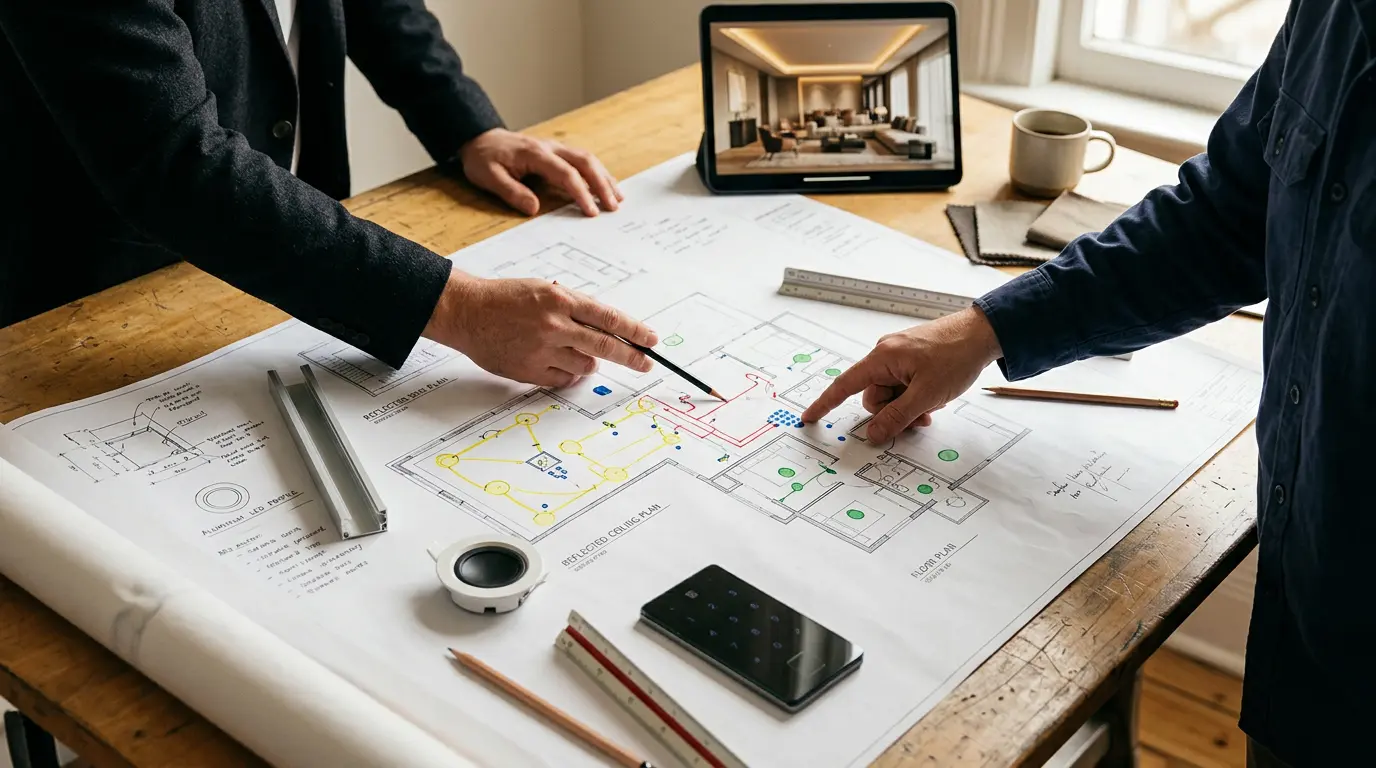
Integrated lighting, automation and AV means planning lighting, KNX or DALI control, audio-video and security as one coordinated system from the concept stage. For architects, early integration protects the design intent: clean ceilings, fewer switches, hidden speakers and correct cable routes. The best time to involve an integrator is during design development.
The render was perfect. A floating ceiling with a soft cove, a calm feature wall, a long uninterrupted living space.
Then the site happened. The cove was built 40 mm too shallow, so the light line shows hot spots. Twelve switches crowd the feature wall. A speaker grille sits off-centre in the ceiling. The projector arrives, and there’s no conduit to the screen.
None of these were design failures. They were coordination failures, and almost every one could have been solved on drawings rather than on site. This guide explains how architects can integrate lighting, automation and AV early, and what a good integration partner should deliver.
Who is this guide for?
- Architects designing villas, premium apartments, hotels and offices
- Interior designers coordinating lighting, controls and AV for clients
- Design-and-build firms managing multiple services on one site
- Project managers and PMCs responsible for coordination and handover
What is integrated lighting, automation and AV?
Integrated lighting, automation and AV is the coordinated design of lighting, control systems, audio-video and security, so they work as one system and fit the architecture instead of interrupting it.
In practice, that means lighting that is planned with its control from day one, keypads that replace banks of switches, speakers and screens built into walls and ceilings, and one platform such as KNX tying lighting, curtains, climate and AV together. The KNX Association maintains the open standard many of these systems use.
Why should architects involve an integrator early?
Because most integration decisions are fixed by ceilings, walls and conduits, and those are decided long before fittings are bought.
| If decided early | If decided late |
|---|---|
| Ceiling depths suit coves, tracks and speakers | Shallow coves, visible hot spots |
| Keypads placed where they suit the design | Banks of switches on feature walls |
| Conduits and back boxes in the right places | Chasing finished walls and ceilings |
| Hidden speakers and screens planned in | Visible boxes and trailing cables |
| AV rack space with ventilation | Equipment squeezed into a wardrobe |
| One coordinated drawing set | Clashes discovered on site |
At Brightmatic, we typically join projects at design development, once the layout is fixed but before electrical and ceiling drawings are issued. That’s when our input costs the client least and protects the design most.
What should be coordinated at each project stage?
Integration works best when it follows the architectural stages.
| Stage | What the integrator contributes |
|---|---|
| Concept | Lighting mood, control approach, AV and security wish list |
| Design development | Lighting layout, control zones, keypad positions, speaker and screen locations |
| Construction drawings | Ceiling sections, conduit routes, back boxes, rack and power requirements |
| Site execution | First-fix checks, cable testing, fitting installation |
| Commissioning | Programming scenes, AV calibration, aiming lights |
| Handover | Training, documentation, as-built drawings |
Which systems should be planned together?
Lighting, control, AV and security share ceilings, walls, cables and keypads, so they should be planned as one.
- Lighting: layered lighting, coves, profiles, magnetic tracks and facade lighting
- Control: KNX or DALI, with dimming, scenes and sensors. Our DALI vs 0-10V guide explains the dimming choices
- Audio-video: home theatre, multi-room audio, hidden speakers, projectors and screens
- Comfort: motorised curtains, blinds and climate
- Security: CCTV, video door phones and access control
Planning a premium residence, hotel or office in Noida or Delhi NCR? We can review your drawings at design development and mark up lighting, control and AV requirements on your plans.
Have a project on the board? Share your drawings for a coordination review →
How much should be budgeted for integration?
Lighting, automation and AV budgets vary widely, but planning them as a share of the interior budget helps set client expectations early.
Indicative estimates only, not actual quotes.
| System | Typical share of interior budget (premium projects) |
|---|---|
| Architectural lighting (design and fittings) | 5 – 10% |
| Lighting control and automation (KNX or DALI) | 3 – 8% |
| Audio-video (multi-room audio, home theatre) | 3 – 10% |
| Security and access control | 1 – 3% |
For control budgets in rupees, see our lighting control system cost guide.
What should a good integration partner deliver?
A good partner works like a consultant on drawings and a contractor on site, with one point of responsibility.
- Lighting layouts, fitting schedules and mock-ups where needed
- Control zoning, keypad schedules and scene descriptions
- AV and speaker layouts, rack drawings and cable schedules
- Ceiling and wall details for coves, tracks and recessed speakers
- Site supervision, commissioning and client training
- As-built documentation for future maintenance
Is early integration worth it?
- Is it expensive? Early coordination usually saves money by avoiding rework, broken ceilings and change orders.
- Is it complicated? It adds a coordination partner, but it reduces the number of trades the architect has to manage.
- What can go wrong? Joining too late, unclear scope between electrical and AV contractors, and no single owner for programming.
What mistakes should you avoid?
- Issuing ceiling drawings before lighting and speaker positions are fixed
- Leaving keypad and switch positions to the electrician
- Treating AV as furniture to be added after handover
- Forgetting rack space, ventilation and dedicated power
- Splitting lighting, control and AV across vendors with no coordinator
- Skipping mock-ups for coves and feature lighting
A common myth: technology always compromises clean architecture. In reality, when integrated early, it disappears: keypads replace switch banks, speakers vanish into ceilings and light becomes part of the architecture.
Expert recommendation from Brightmatic
We recommend involving the integrator at design development, agreeing one control platform such as KNX, fixing ceiling sections and keypad positions together, planning AV rack space early and appointing one partner for design, installation and commissioning. CEDIA, the global association for smart home professionals, offers resources for designers and architects working with integrators.
Brightmatic works with architects and interior designers on architectural lighting, lighting control and audio-video for homes, hotels and workplaces.
Partner with Brightmatic on your next project
Brightmatic partners with architects and interior designers on integrated lighting, automation and AV across Noida, Delhi NCR & across India.
FAQ's
When should an architect involve a lighting and automation integrator?
Ideally at design development, after the layout is fixed but before electrical and ceiling drawings are issued.What does an integrator provide to architects?
Lighting layouts, control zoning, keypad schedules, AV layouts, ceiling details, cable schedules, commissioning and handover documents.Which control system is best for integrated projects?
KNX is widely used for whole-building integration, often combined with DALI for precise lighting control.Can automation be added without changing the design?
Yes, if planned early. Keypads, hidden speakers and recessed tracks can be designed to suit the architecture.How much should clients budget for lighting, automation and AV?
In premium projects, combined systems indicatively range from about 10 to 30% of the interior budget, depending on scope.Does integration delay the project?
No. Early coordination usually prevents delays caused by rework and site clashes.Have a project on the board? Talk to our integration team. We’ll review your drawings, free.
Comments
No Comments