

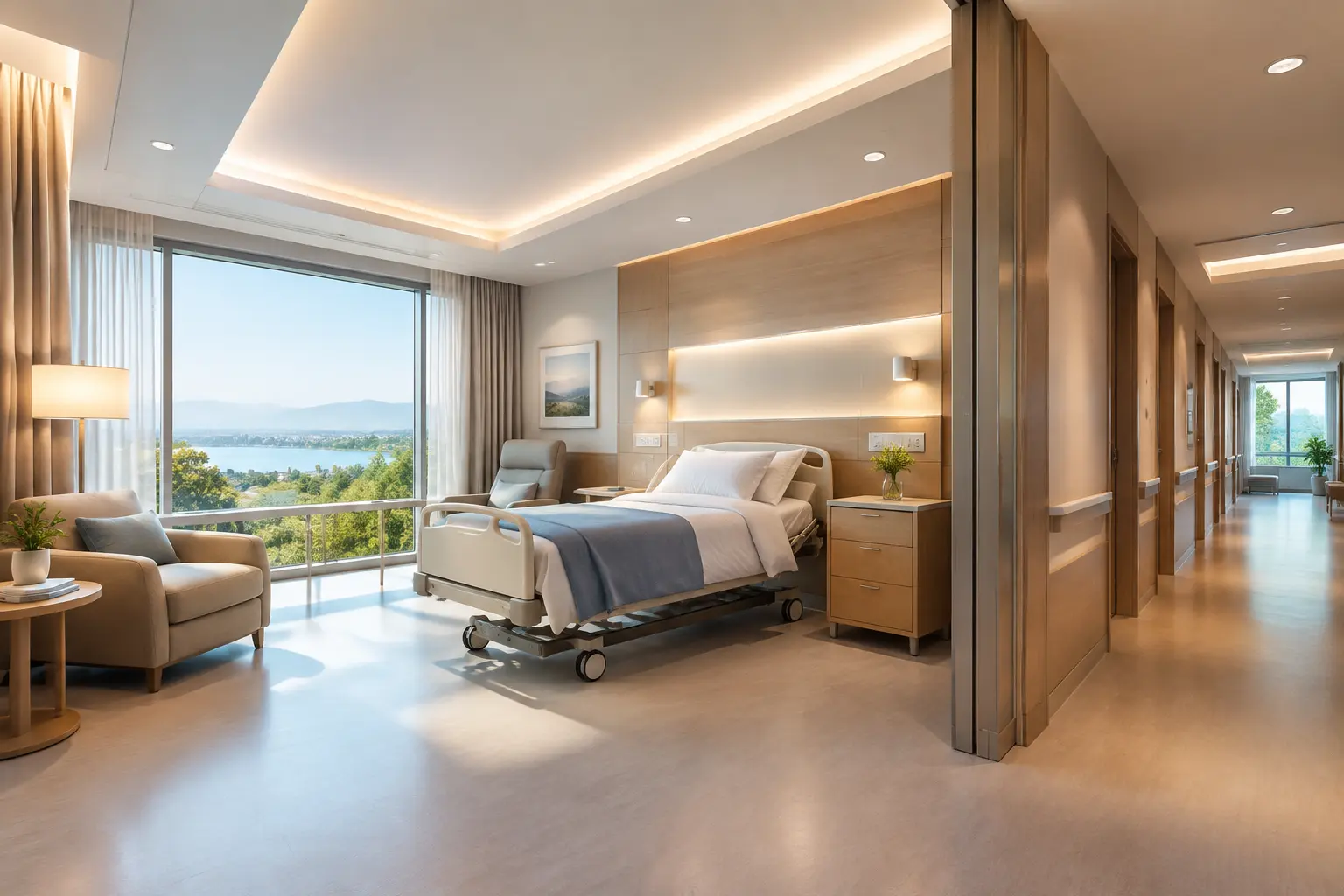
Human-centric lighting (HCL) in hospitals uses tunable LED lighting that changes brightness and colour temperature through the day, following a natural daylight pattern. It is cooler and brighter in the morning, and warmer and dimmer in the evening and at night. In hospitals, where patients may spend days indoors away from daylight and staff work round-the-clock shifts, research suggests this approach can support better sleep, comfort, and alertness. A well-designed hospital HCL system adapts by space: calm and glare-free in patient rooms, low and gentle at night in wards and ICUs, alert-supporting at nurse stations, and paired with high-CRI task lighting for clinical work. Planned with the building, it improves the care environment while remaining practical to run and maintain.
A hospital never switches off. Lights burn through the night, patients lose track of day and night, and staff work hours that run against their body clock. Lighting is one of the few things in that environment that touches everyone, every hour. Human-centric lighting uses it more thoughtfully.
Who Is This Guide For?
Hospital administrators and facility heads planning new wings or refurbishments. Healthcare developers and hospital groups building new facilities. Architects and MEP consultants designing clinics, nursing homes, and multi-speciality hospitals in Noida, Delhi NCR, and across India.
What Is Human-Centric Lighting?
Human-centric lighting is lighting designed around people's biology, not just visibility. Our bodies run on a roughly 24-hour circadian rhythm that is set largely by light, especially its intensity and colour. Daylight changes from cool and bright at midday to warm and low at dusk, and our sleep and alertness follow it.
HCL recreates that pattern indoors using tunable white lighting and automated control. For a deeper look at the science, see our guide to circadian lighting.
Standards bodies increasingly recognise this. The WELL Building Standard includes circadian lighting design, the CIE has defined how to measure light's non-visual effects (melanopic light), and the IES publishes recommended practice for lighting healthcare facilities.
Why Hospitals Are a Natural Fit
Patients lose daylight. Many patients spend long stretches indoors, often in rooms with limited windows. Flat, unchanging light all day can blur the line between day and night.
Sleep matters to recovery. Hospitals are hard places to sleep. Bright light during night checks and the same light at 3 pm and 3 am don't help. Research suggests a clearer day-night lighting pattern can support better rest.
Staff work against the clock. Doctors and nurses on night shifts need to stay alert and safe while the rest of the hospital rests.
The environment shapes experience. Calm, well-designed light makes rooms feel less clinical and more reassuring for patients and visitors.
HCL Space by Space
Patient Rooms and Wards

The priority is comfort and a clear day-night rhythm. Brighter, cooler light in the morning, warmer and dimmer in the evening, and very low light at night.
One detail is often missed: patients spend much of their time lying down, looking at the ceiling. Downlights directly above the bed shine into their eyes. Use indirect lighting, cove lighting, or carefully positioned fittings so the light is soft from a lying position.
ICUs and Critical Care

ICUs are lit round the clock, which makes them the hardest place to rest. Use dimmable, zoned lighting so the overall room can stay low at night while a separate, focused examination light serves clinical checks. Warm, low-level night lighting lets staff move around without fully waking patients.
Nurse Stations and Staff Areas

Staff on night duty benefit from lighting that supports alertness at the station, while corridors and patient areas nearby stay dim. Break rooms can use warmer, calmer light for rest between duties.
Corridors

Bright and clear by day for safe movement and wayfinding, then dimmed to a lower, warmer level at night. This avoids flooding patient rooms with corridor light every time a door opens.
OPD, Reception and Waiting Areas

Calm, welcoming light that feels less clinical, with good daylight integration where possible. Anxious patients and families notice the difference.
Examination and Treatment Rooms

Clinical work comes first. These spaces need bright, high-quality task lighting with high colour accuracy, so HCL here supports the general room light while dedicated clinical lighting handles assessment.
Design Essentials for Hospital HCL
High colour rendering (CRI 90+). Clinicians judge skin tone and patient condition by eye. Poor colour rendering can hide or distort what they need to see. See our guide to CRI in lighting.
Glare control. Low-glare fittings matter everywhere, and especially above beds. Our guide to UGR and anti-glare lighting explains the measures.
Flicker-free drivers. Flicker causes eye strain and headaches, which matter more for unwell patients.
Hygiene and maintenance. Sealed, easy-to-clean fittings suitable for healthcare cleaning routines, with access planned for maintenance without disrupting care.
Smart, reliable control. Automated schedules run the day-night pattern without staff effort, with simple manual overrides for clinical needs and patient preference. Protocols such as DALI give individual control of every fitting across a large building.
Energy efficiency. Hospitals run 24/7. Efficient LEDs, dimming, and occupancy control in support areas reduce running costs.
What Does Hospital HCL Cost?
Indicative estimates only, not actual quotes. Final cost depends on the number of rooms, fittings, controls, and whether it is a new build or retrofit.
| Scope | What's Included | Indicative Range |
|---|---|---|
| Single patient room | Tunable fittings, indirect lighting, night light, scheduled control | ₹30,000 – ₹1,00,000 per room |
| Ward or ICU pilot | Zoned HCL across one ward or unit, central control | Project-based |
| Full wing or new hospital | Building-wide HCL integrated with lighting control and BMS | Project-based |
Many hospitals begin with a pilot ward, measure feedback from patients and staff, and then roll out further.
Common Mistakes
Treating HCL as just "colour-changing lights." Without the right schedule, intensity, and control, tunable fittings achieve little.
Downlights over beds. Glare straight into the eyes of patients lying down.
Ignoring night mode. The night lighting plan matters as much as daytime.
Low CRI fittings. Distort skin tones in a clinical setting.
Planning lighting last. Indirect details and controls are far easier to build in from the start.
Expert Recommendation from Brightmatic
When we plan healthcare lighting, we start by lying down in the room. It sounds simple, but it changes everything. A patient spends most of their stay looking at the ceiling, and what feels fine to someone standing in the doorway can be harsh glare from the bed.
Good hospital lighting is designed from the patient's pillow and the night nurse's station outward. Get those two views right, give the building a clear day-night rhythm, and support clinical work with proper task lighting, and the whole environment feels calmer for everyone in it.
That's how we approach human-centric lighting for healthcare spaces. Crafting Brighter Lives, where it matters most.
Planning a Hospital, Clinic or Healthcare Facility?
Lighting is with every patient and every staff member, every hour of the day and night. Designed around them, it becomes part of better care.
Get a free human-centric lighting consultation for your healthcare project.
Serving Noida, Delhi NCR & across India. Contact Brightmatic to discuss lighting for your hospital or clinic.
FAQ's
What is human-centric lighting in hospitals?
Human-centric lighting in hospitals uses tunable LED lighting that changes brightness and colour temperature through the day to follow a natural daylight pattern. It is cooler and brighter in the morning and warmer and dimmer at night, supporting a clearer day-night rhythm for patients and staff in an environment that runs 24 hours a day.How does human-centric lighting help patients?
Research suggests that a clear day-night lighting pattern can support better sleep and comfort, especially for patients who spend long periods indoors away from daylight. Softer, glare-free lighting and low night lighting also make rooms feel calmer and less clinical. It supports the care environment but does not replace medical treatment.Can human-centric lighting help hospital staff on night shifts?
Lighting can support alertness at nurse stations and work areas during night shifts, while nearby patient areas stay dim. Break rooms can use warmer, calmer light. The aim is to help staff stay alert and safe without disturbing patients' rest.Which hospital areas benefit most from human-centric lighting?
Patient rooms, wards, and ICUs benefit most, because patients spend long periods there and need a clear day-night rhythm. Nurse stations, corridors, and waiting areas also benefit. Examination and treatment rooms still need dedicated high-CRI clinical task lighting alongside the general HCL system.How much does human-centric lighting cost for a hospital?
As an indicative estimate, human-centric lighting for a single patient room may cost around ₹30,000 to ₹1,00,000, while ward, ICU, or full-hospital projects are priced individually. These are indicative estimates, not actual quotes. Final cost depends on room count, fittings, controls, and whether it is a new build or retrofit.
Comments
No Comments