
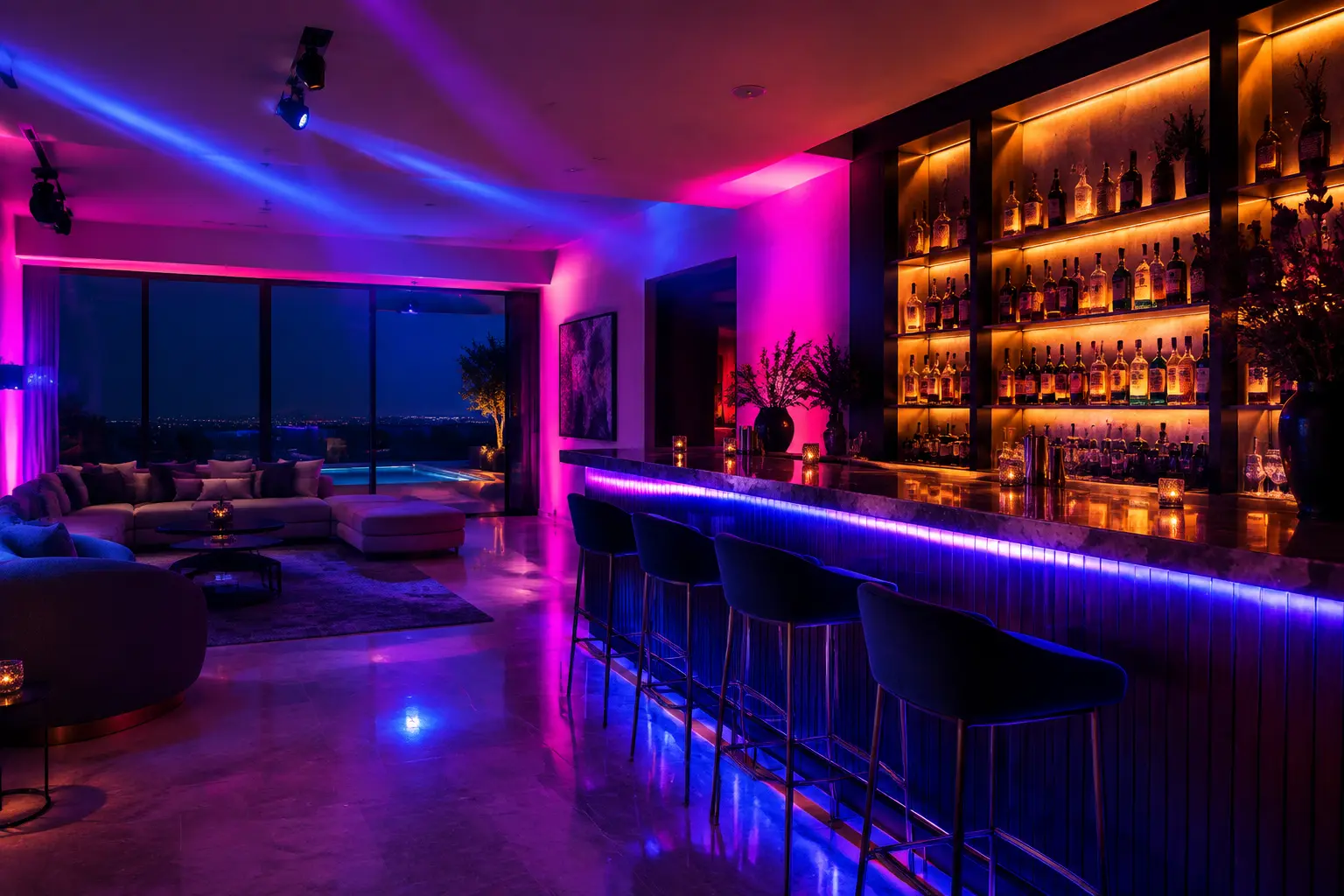
DMX lighting brings real club-style lighting into a home bar, party room, or private lounge. DMX (DMX512) is the professional control standard used in clubs and stages. It lets one controller run colour washes, moving heads, pixel strips, and effects together as programmed scenes, often synced to music. The best home setups do two jobs: a calm, elegant lounge look for everyday evenings, and a full party mode at the touch of a button. Plan the fixtures, the control, and the room together, keep effects restrained, and design around how often the space is actually used for parties. Done well, it turns a room into a venue without making it look like one when the music is off.
A home bar with a few warm pendants is lovely. But if you want the energy of a club — colour that moves with the music, a dance floor that comes alive — you need a different kind of lighting. That's where DMX comes in.
Who Is This Guide For?
Homeowners building a home bar, party room, basement lounge, or rooftop entertainment space in Noida, Greater Noida, Gurgaon, or Delhi NCR. Villa and penthouse owners who host often and want a private venue feel. And interior designers planning an entertainment space that needs more than decorative lighting.
What Is DMX, in Simple Terms?
DMX is the control language professional lighting speaks. One DMX line, called a universe, carries up to 512 control channels. Each light fixture is given an address, and the controller tells it exactly what to do — which colour, how bright, where to point, how fast to move.
Because everything runs from one controller, dozens of lights can act together as a single, choreographed scene. That coordination is what makes a club feel like a club. For the full technical background, see our guide on what DMX lighting is.
In a home, you don't need a stage-sized system. You need the same control, scaled to your room.
Why a Home Club Needs DMX (Not Just Smart Bulbs)
Smart bulbs can change colour. That's not the same as club lighting.
Synchronisation. DMX fixtures change together, in time, as one scene. Consumer smart bulbs often lag and fall out of sync.
Movement and effects. Moving heads, beam effects, and pixel-mapped strips need DMX-level control. Smart bulbs can't sweep or chase.
Programmed scenes. A DMX system stores full looks — "Lounge," "Party," "Dance floor," "Last call" — and switches between them instantly.
Music sync. DMX controllers can react to sound, so light pulses and changes with the beat.
Reliability. It's built for venues that run for hours. It doesn't drop off Wi-Fi mid-song.
If the goal is atmosphere that moves, DMX is the right tool.
The Building Blocks of a Home Club Setup
RGB / RGBW wash lights. These flood walls and ceilings with colour. They set the mood of the whole room and do most of the work. Adding a white channel (RGBW) also gives you clean, usable white light when the party isn't on. Our guide to RGB lighting covers how colour mixing works.
LED pixel strips. Strips where each section can be a different colour. They create chases, waves, and patterns along the bar counter, ceiling coves, steps, or DJ booth.
Moving heads. Fixtures that pan, tilt, and project beams or patterns across the room. One or two are enough for a home space. Too many and it turns into a nightclub you can't relax in.
Beam and effect lights. Small, punchy effects for peak moments. Use sparingly.
Bar and counter lighting. Under-counter and back-bar lighting that can glow warm for everyday use, then shift colour for parties.
The controller. A hardware console, a software controller, or an app-based controller with stored scenes and a simple wall panel. For most homes, simple wall-panel or app scene buttons are the right answer. Nobody wants to operate a console at their own party.
Design It for Every Night, Not Just Party Night
This is the most important decision, and the one most people get wrong.
A home party room might host a big night a few times a month. The other nights, it's a place to have a drink, watch a match, or sit with friends. If the lighting only looks good at full party mode, the room feels like an empty club the rest of the time.
The best home setups start with the calm look. That means warm, layered light on the bar, soft washes on the walls, and effects hidden or switched off. Party mode is built on top as a scene. One button takes the room from lounge to club, and one button brings it back.
When the fixtures are well chosen, a moving head sitting quietly in a cove or a pixel strip glowing soft amber doesn't look like "club equipment." It just looks like good design.
Scene Ideas That Work at Home
- Lounge — warm white, dim, back-bar glowing, no movement.
- Match night — soft neutral light, glare kept off the screen.
- Arrival — warm with a slow colour drift. Welcoming, not loud.
- Party — saturated colours, pixel chases on the bar, slow moving-head sweeps.
- Dance floor — sound-synced, faster movement, beam effects on.
- Last call — lights ease back to warm, effects off.
Six well-designed scenes are worth more than a hundred random ones.
Planning Considerations
Ceiling and mounting. Moving heads and washes need solid mounting points and cabling. It's far easier to plan during construction or renovation.
Cabling and control. DMX runs on dedicated control cabling between fixtures. Plan routes, power, and the controller location early.
Integration. DMX can sit alongside your home automation. A "Party" button on the same wall panel that controls your main lights and curtains keeps things simple.
Sound. A home club gets loud. If it's in an apartment or near bedrooms, plan soundproofing along with the lighting.
Safety. Use only eye-safe, properly rated effects. Avoid aiming beams at seated eye level. Haze or smoke machines can trigger smoke detectors, so plan for that before using them.
Heat and ventilation. Effect fixtures produce heat. Give them space and airflow, especially in enclosed coves or small basements.
Indicative Cost
Indicative estimates only, not actual quotes. Final cost depends on room size, fixtures, control, and integration.
| Setup | What's Included | Indicative Range |
|---|---|---|
| Starter home bar | RGBW washes, pixel strip on bar, app/panel scenes | ₹50,000 – ₹1,50,000 |
| Party room | Washes, pixel strips, 1–2 moving heads, sound sync, stored scenes | ₹1,50,000 – ₹5,00,000 |
| Private club / lounge | Full DMX rig, multiple effects, integrated control, acoustic planning | ₹5,00,000+ |
Common Mistakes
Too many effects. More lights moving doesn't mean more fun. It gets tiring fast.
No everyday look. A room that only works as a club feels empty the other six nights.
Consumer bulbs for club effects. They drift out of sync and can't move.
Complicated control. If guests need instructions, the system is wrong. Scene buttons win.
Ignoring sound and neighbours. Great lights and a noise complaint don't mix.
Expert Recommendation from Brightmatic
For the home bars and party rooms we light across Delhi NCR, our approach is simple: design the quiet night first, then the party.
The rooms that feel special aren't the ones with the most fixtures. They're the ones that look beautiful on a Tuesday with two people and a drink, and then, when the music goes up, transform completely at one touch. That switch — from warm lounge to living, moving colour — is the moment guests remember. It only works when the lighting, control, and room are planned together.
That's how we approach every DMX and club lighting project. Crafting Brighter Lives — and better nights.
For quieter bar ideas without DMX, see our guide to home bar lighting.
Planning a Home Bar or Party Room?
The best home club lighting is invisible on a quiet night and unforgettable on a big one. Plan the fixtures, control, and room together, and one button will take the space from lounge to venue.
Want club-level lighting at home? Get a free consultation.
Building a home bar or party room in Noida or Delhi NCR? Contact Brightmatic for a personalised DMX lighting consultation.
FAQ's
Can DMX lighting be used in a home?
Yes. DMX is the professional standard used in clubs and stages, but it scales down well for home bars, party rooms, and lounges. A home setup uses fewer fixtures and simpler control, usually scene buttons on a wall panel or app, while giving the same synchronised colour, movement, and effects.What is the difference between DMX lighting and smart bulbs?
Smart bulbs can change colour individually, but they often lag and fall out of sync, and they can't move or create effects. DMX controls many fixtures together as one choreographed scene, supports moving heads and pixel effects, can sync to music, and is built to run reliably for hours.What lights do I need for a home club?
Most home clubs start with RGB or RGBW wash lights for colour, LED pixel strips along the bar or ceiling for chases and patterns, and one or two moving heads for movement. Add bar and counter lighting that works warm for everyday use, plus a controller with stored scenes.How much does DMX lighting for a home bar cost?
As an indicative estimate, a starter home bar setup ranges from about ₹50,000 to ₹1,50,000, a full party room from ₹1,50,000 to ₹5,00,000, and a private club-style lounge from ₹5,00,000 upwards. These are indicative estimates, not quotes. Final cost depends on the room, fixtures, and control.Can DMX lighting sync with music?
Yes. Many DMX controllers can react to sound, so lights pulse, change colour, or move with the beat. In a home, sound sync usually runs inside a "Party" or "Dance floor" scene, so it's only active when you want it.
Comments
No Comments