

Acoustic soundproofing reduces how much sound passes between spaces — keeping noise out (traffic, neighbours) or in (a home theatre, a music room). It works on four principles: adding mass, decoupling surfaces so vibration can't travel, damping, and absorption. Effective soundproofing isn't a single product but a designed assembly for walls, ceilings, floors, doors, and windows — and its success depends on sealing every gap, since one weak point undoes the rest. Professional soundproofing services assess your space, identify the noise paths, and design a solution to the performance you need. Indicative cost in India ranges from a few hundred rupees per square foot for basic treatment to significantly more for high-isolation rooms like home theatres.
Whether it's traffic noise invading your bedroom, a home theatre disturbing the rest of the house, or a home office that needs quiet, soundproofing solves it — but only when done properly. This guide covers the solutions, what they cost, and how to choose the right provider.
Who Is This Guide For?
Homeowners wanting to block outside noise, or contain sound from a home theatre, music room, or home office. Architects and interior designers specifying soundproofing for a residential or commercial project. And anyone planning a space in Delhi NCR where noise control matters and wanting to understand the solutions and cost.
First — Soundproofing Is Not Acoustic Treatment
This confusion causes expensive mistakes, so it's worth clearing up first.
Soundproofing blocks sound from passing between spaces — stopping noise getting in or out of a room. Acoustic treatment improves how sound behaves inside a room — controlling echo and reflections for better sound quality.
They're different jobs with different products and methods. Foam panels on a wall (acoustic treatment) will not stop noise passing through it. If your goal is to keep sound in or out, you need soundproofing. If it's to make a room sound better inside, you need treatment. A good home theatre usually needs both — and a professional will address each correctly.
How Soundproofing Actually Works
Effective soundproofing combines four principles:
Mass. Heavier, denser materials are harder for sound to vibrate through. Adding mass — extra drywall layers, mass-loaded vinyl, dense materials — is the foundation of blocking sound.
Decoupling. This is often the most effective technique. When two surfaces are rigidly connected, sound vibration crosses straight through. Decoupling — breaking that rigid path with resilient channels, isolation clips, staggered or double studs — lets the surfaces move independently, dramatically cutting transmission.
Damping. Applying damping compounds between layers converts sound energy into tiny amounts of heat, reducing vibration.
Absorption. Filling wall cavities with acoustic insulation (mineral wool, fibreglass) absorbs sound energy inside the assembly.
The best soundproofing designs combine these — mass and decoupling and absorption — into a proper wall, ceiling, or floor assembly. No single product does it alone.
The Critical Detail: Sealing Every Gap
Here's what separates professional soundproofing from a disappointing DIY attempt: a perfect wall is ruined by a single gap.
Sound leaks through the weakest point — an unsealed door, a gap under it, electrical outlets, air gaps around pipes. This is called flanking, and it can make an expensive soundproof wall perform far worse than its rating. A hollow-core door or unsealed outlet can drop real-world performance dramatically.
This is exactly why professional soundproofing matters. Getting the assembly right is only half the job; sealing every path — doors, windows, outlets, ducts, junctions — is what makes it actually work. It's meticulous work, and it's where amateur attempts usually fail.
Understanding STC — The Soundproofing Rating
Soundproofing performance is measured by STC (Sound Transmission Class) — a single number rating how well a wall, floor, or partition blocks airborne sound. Higher is better.
As a rough guide: a standard wall might rate around STC 33 (loud speech audible through it); an STC 50 assembly blocks loud speech but not bass-heavy music; and a home theatre or music room typically wants STC 60+ to contain low frequencies. Knowing the target STC for your goal is central to designing the right solution — and it's part of what a professional determines for your space.
Where Soundproofing Is Used
Home theatres. The biggest demand — containing loud, bass-heavy sound so a movie doesn't disturb the whole home. This pairs with our home cinema and AV work.
Bedrooms. Blocking traffic, street, or household noise for better sleep.
Home offices & study rooms. Creating quiet for focus and calls, and privacy for confidential conversations.
Music rooms & studios. Containing instruments or recording, needing high isolation.
Media & living rooms. Where quality speakers are used and sound should stay in the room.
Apartments. Blocking noise between units or from shared walls, increasingly important in dense developments.
Commercial spaces. Offices, clinics, studios, and hospitality where privacy and quiet matter.
Soundproofing Solutions
A professional service typically addresses several elements:
Walls — added mass, decoupling (resilient channels, clips), and cavity insulation built into a designed assembly.
Ceilings & floors — critical in apartments and multi-storey homes, especially for impact noise (footfall) which needs different treatment from airborne noise.
Doors — often the weakest point; solid-core or acoustic doors with proper seals.
Windows — double or acoustic glazing, or secondary glazing, for external noise.
Sealing — the meticulous closing of every gap, outlet, and junction that makes it all work.
The right combination depends on your space, the noise, and the isolation you need — which is what an assessment determines.
What Does Soundproofing Cost?
These are indicative estimates for planning only, not actual quotes. Actual cost depends on the space, the level of isolation required, existing construction, and the elements involved — confirmed after an assessment.
| Scope | What It Involves | Indicative Cost |
|---|---|---|
| Basic sound reduction (one room) | Added mass, sealing, some treatment | ₹150 – ₹400 / sq ft |
| Standard soundproofing | Decoupled assembly, insulation, doors | ₹400 – ₹800 / sq ft |
| High-isolation (home theatre, studio) | Full assembly, high STC, doors, sealing | ₹800+ / sq ft |
Cost is driven most by the level of isolation needed — a bedroom needing modest quiet is very different from a home theatre needing to contain cinema-level bass. High isolation means more mass, full decoupling, acoustic doors, and meticulous sealing, all of which add up. It's an investment in the room being genuinely usable for its purpose.
Why Use a Professional Soundproofing Service
Correct diagnosis. Identifying whether you have airborne or impact noise, and the paths it travels, determines the right solution. Getting this wrong wastes money.
Designed assemblies. Professionals design wall, ceiling, and floor assemblies to the STC you need — combining mass, decoupling, and absorption correctly.
The sealing that makes it work. Meticulous sealing of every gap is where DIY fails and professionals deliver real results.
Integration with the room. Especially for a home theatre, soundproofing must work alongside acoustic treatment, AV, and lighting — best coordinated by one team.
No expensive mistakes. Soundproofing done wrong is costly to redo. Done right the first time, it simply works.
How to Choose a Soundproofing Provider
- Do they assess your space and diagnose the noise before quoting?
- Do they understand the difference between soundproofing and acoustic treatment?
- Can they design to a target STC for your goal?
- Do they address sealing and flanking, not just wall build-up?
- Can they integrate with your home theatre, AV, and interiors?
- Is the quote itemised and clear on what's included?
A serious provider assesses first and explains the approach. Be wary of anyone quoting a flat rate without seeing the space or asking what you're trying to achieve.
Expert Recommendation from Brightmatic
For the soundproofing we do across Delhi NCR — most often for home theatres — our approach starts with one question: what are you trying to keep in, or out, and to what level? From there we design the assembly, specify the doors and seals, and coordinate with the acoustic treatment and AV.
The insight worth passing on: people often spend on visible soundproofing — thick walls, expensive materials — then leave a hollow door and unsealed outlets, and wonder why sound still leaks. The truth is that soundproofing is only as good as its weakest point. A well-designed, well-sealed assembly of modest cost outperforms an expensive one with gaps every time. The money is best spent on getting the whole envelope right — every wall, the ceiling, the floor, the doors, and every seal — not on one dramatic element.
Get the whole picture right, and a room becomes genuinely quiet, or genuinely contained. That's part of how we design home cinema and AV spaces that are Designed Around Experience — where the sound stays exactly where it should.
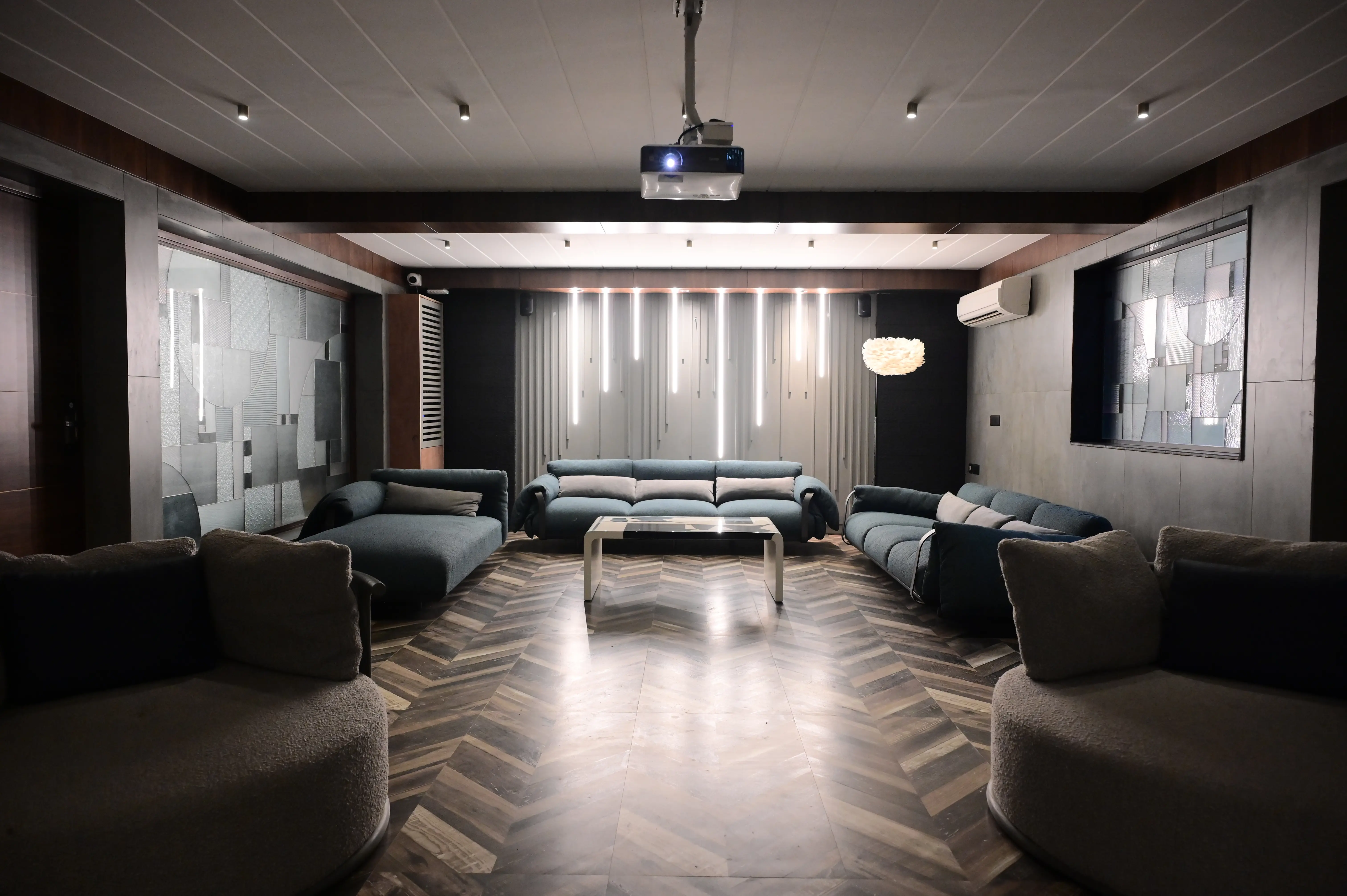
From a Recent Brightmatic Project
Planning a Soundproofing Project?
Soundproofing, done right, transforms a space — a home theatre that doesn't disturb the house, a bedroom free of traffic noise, an office that's genuinely quiet. The key is a designed, properly sealed solution, not a single product.
Want a space that stays quiet, or keeps sound in? Get a free consultation.
Planning a home theatre or quiet space in Noida or Delhi NCR? Contact Brightmatic for a personalised soundproofing and AV consultation.
FAQ's
What is acoustic soundproofing?
Acoustic soundproofing reduces how much sound passes between spaces — blocking noise from entering or leaving a room. It works by adding mass, decoupling surfaces so vibration can't travel, damping, and absorption, built into designed wall, ceiling, and floor assemblies. It's different from acoustic treatment, which improves sound quality inside a room rather than blocking it.What is the difference between soundproofing and acoustic treatment?
Soundproofing blocks sound from passing between spaces — keeping noise in or out. Acoustic treatment improves how sound behaves inside a room, controlling echo and reflections for better sound quality. They're different jobs; foam panels (treatment) won't stop noise passing through a wall. A home theatre usually needs both, addressed correctly.How much does soundproofing cost in India?
Indicatively, basic sound reduction runs around ₹150–400 per square foot, standard soundproofing ₹400–800, and high-isolation rooms like home theatres ₹800+ per square foot. Cost depends most on the level of isolation needed, the existing construction, and the elements involved. These are indicative estimates confirmed after an assessment.Does soundproofing really work?
Yes, when done properly. Effective soundproofing combines mass, decoupling, and absorption in a designed assembly, and — critically — seals every gap, since sound leaks through the weakest point. Professionally designed and sealed soundproofing works well; DIY attempts often disappoint because a single unsealed door or outlet undermines the whole thing.Can you soundproof an existing room?
Yes. Soundproofing can be added to existing rooms by building up walls, treating ceilings and floors, upgrading doors and windows, and sealing gaps. The approach depends on the room and the isolation needed. A full build allows the most effective assemblies, but existing rooms can be significantly improved with the right professional solution.What is STC in soundproofing?
STC (Sound Transmission Class) is a single-number rating of how well a wall, floor, or partition blocks airborne sound — higher is better. A standard wall might be around STC 33, an STC 50 assembly blocks loud speech, and a home theatre typically wants STC 60+ to contain bass. Knowing your target STC guides the right solution.
Comments
No Comments