

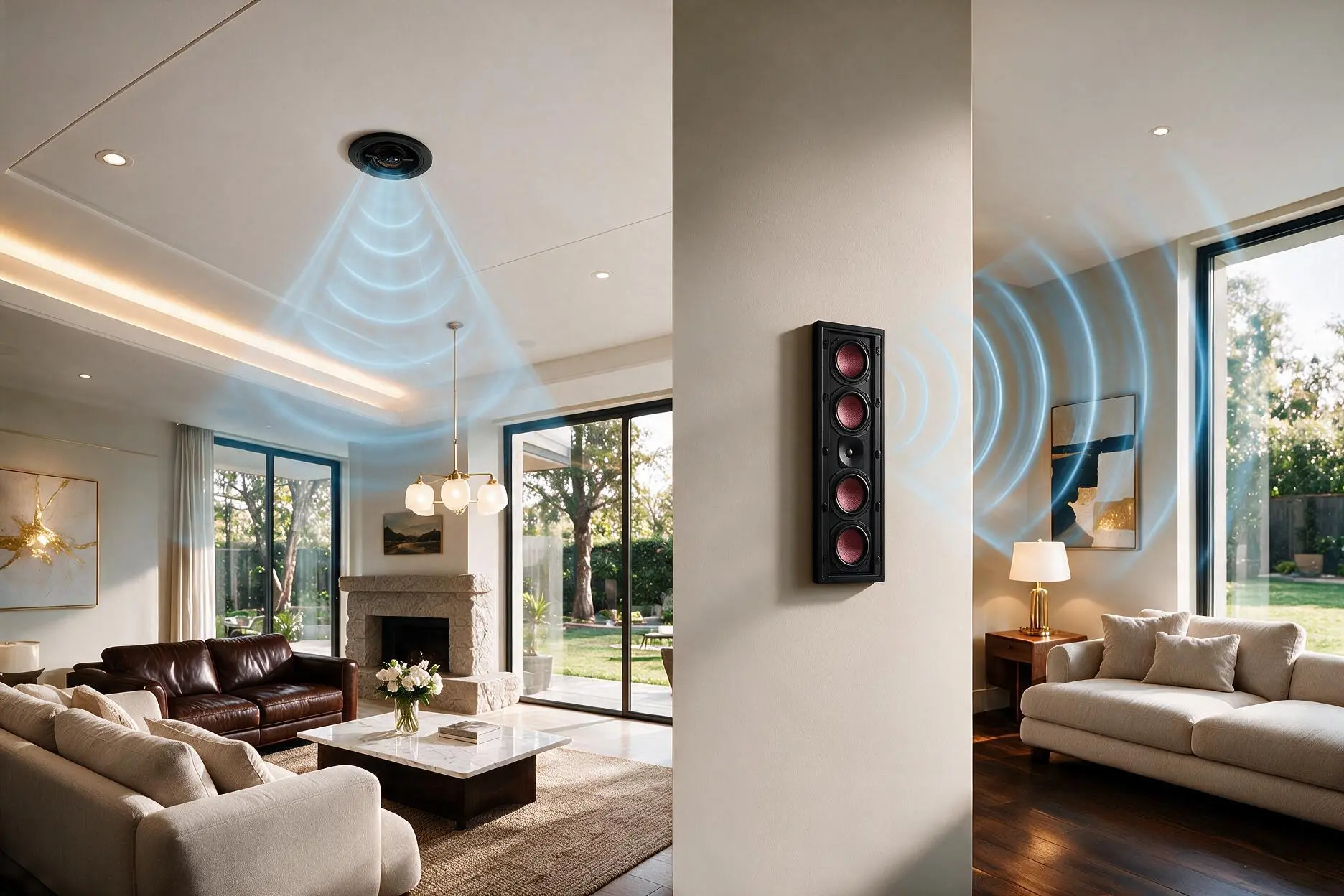
In-ceiling speakers mount flush into the ceiling and fire sound downward, spreading it evenly across a room — ideal for ambient background music and whole-home audio. In-wall speakers mount into the wall and fire sound horizontally toward you, giving more direct, focused sound — better for home theatre and dedicated listening where you want the audio aimed at a seating area. Neither is simply "better": ceiling speakers win for even, discreet coverage, while wall speakers win for directional, immersive sound. The right choice depends on the room and how you'll use it.
Both in-ceiling and in-wall speakers deliver the same goal — great sound without bulky boxes cluttering your room. But they're not interchangeable. The difference comes down to physics: which direction the sound fires. This guide explains that difference and helps you choose for each space.
Who Is This Guide For?
Homeowners planning built-in audio — whole-home music, a home theatre, or both — in Noida, Greater Noida, Gurgaon, and Delhi NCR. Architects and interior designers specifying architectural speakers for a project. And anyone deciding between in-ceiling and in-wall speakers and unsure which suits which room.
What Are In-Ceiling & In-Wall Speakers?
Both are architectural speakers — built flush into the ceiling or wall so only a slim grille is visible, delivering quality sound while staying almost invisible. They're the discreet, premium alternative to floor-standing or bookshelf speakers.
In-ceiling speakers sit in the ceiling and fire sound downward into the room. In-wall speakers sit in the wall and fire sound horizontally out toward the listener. That single difference — the direction the sound travels — shapes everything about where each one shines.
The Core Difference: Sound Direction
In-ceiling speakers spread sound; in-wall speakers aim it.
Because in-ceiling speakers fire downward from above, the sound disperses evenly across the whole room. You don't get a strong sense of where it's coming from — which is exactly what you want for background music that fills a space without dominating it.
Because in-wall speakers fire horizontally at ear level, the sound is more direct and you get a clearer sense of stereo imaging — left, right, and a defined "stage." That's what you want for focused listening and home theatre, where sound should come at you from the front.
This is the heart of the decision. Not which is better, but which direction suits the room.
In-Ceiling vs In-Wall — Side by Side
| Factor | In-Ceiling | In-Wall |
|---|---|---|
| Sound direction | Downward, spread | Horizontal, directed |
| Best for | Ambient / background music | Focused / home theatre |
| Stereo imaging | Softer, diffuse | Stronger, defined |
| Visual footprint | Nearly invisible (ceiling) | Slim grille on wall |
| Whole-home audio | Ideal | Less common |
| Home theatre front stage | Less ideal | Ideal |
| Placement flexibility | High (anywhere on ceiling) | Limited (needs wall space) |
When to Choose In-Ceiling Speakers
Choose in-ceiling speakers for even, ambient sound across a space — the go-to for:
- Whole-home / multi-room audio — music flowing through living areas, kitchen, bedrooms, and bathrooms. Our multi-room audio guide covers this in depth.
- Background music — filling a room without a visible speaker or a strong directional source.
- Open-plan spaces — even coverage across a large, flowing area.
- Rooms with limited wall space — where walls are full of windows, art, or furniture.
- Maximum discretion — where you want sound with virtually nothing visible.
In-ceiling is the default for whole-home audio, where the goal is music everywhere, evenly, from an invisible source.
When to Choose In-Wall Speakers
Choose in-wall speakers for directed, immersive sound — the better pick for:
- Home theatre front channels — where left, centre, and right should fire from the front wall toward the seating, at ear level, for proper imaging. See our home theatre setup guide.
- Dedicated music listening — where you want a defined stereo image and a sense of "stage."
- Stereo pairs in a living room aimed at a sofa.
- Rooms with high or vaulted ceilings — where ceiling speakers would be too far overhead to be effective.
In-wall shines wherever the sound should have direction and come at you from a defined point, rather than washing down from above.
Can You Use Both Together?
Yes — and in many homes, that's the ideal. The two aren't rivals; they complement each other.
A common premium setup uses in-wall speakers for the front stage of a home theatre (directional, immersive) and in-ceiling speakers for surround or height channels and for ambient audio in the rest of the home. In a whole-home system, ceiling speakers handle most rooms while a media room or living room adds in-wall fronts for serious listening.
The best approach isn't picking a side — it's using each where its strength fits, planned as one coherent audio system. This is where AV integration matters: tying it all together so it works as one.
What Matters Beyond the Type
Whichever you choose, a few things decide whether built-in speakers sound great or disappointing:
Speaker quality. A cheap architectural speaker sounds cheap, wherever it's placed. Quality brands — like TruAudio, which we work with — make the difference between "background noise" and genuinely good sound.
Placement and spacing. Even the best speakers underperform if badly positioned. Correct spacing and placement for the room's size and layout is essential — a design decision, not a guess.
Wiring planned early. Built-in speakers need cabling run through walls and ceilings before they're closed up. This has to be planned during construction or renovation — retrofitting later means opening finished surfaces.
Proper amplification. Architectural speakers need appropriate amplification and, for multi-room, the right distribution system behind them.
Common Mistakes
Using ceiling speakers for a home theatre front stage. Sound firing down from above can't create the front "stage" a film needs. Use in-wall for front channels.
Using wall speakers for whole-home ambient audio. Directional sound is the wrong tool for even, background coverage. Use ceiling.
Buying on price alone. Cheap architectural speakers disappoint regardless of placement. Quality matters more than the ceiling-vs-wall choice.
Ignoring placement design. Randomly positioned speakers sound uneven. Spacing should be designed for the room.
Planning too late. Speaker wiring must go in before ceilings and walls close. Decide early.
Expert Recommendation from Brightmatic
For the homes we fit with audio across Delhi NCR, our rule of thumb is simple: in-ceiling for ambient and whole-home audio, in-wall for home theatre front stage and dedicated listening — and often both, each where it belongs.
The insight worth passing on: people ask us which type is "better," but that's the wrong question. It's like asking whether a wide lens is better than a zoom — they do different jobs. Ceiling speakers spread sound so you feel music everywhere; wall speakers aim sound so you feel it come at you. The mistake is forcing one type to do the other's job — ceiling speakers straining to anchor a home theatre, or wall speakers awkwardly covering a whole floor. Match the speaker to how the room is used, and both sound superb.
And plan the wiring early — the best audio system is the one designed into the home before the walls close. That's the thinking behind our audio-video approach: sound that's Designed Around Experience, integrated into the space rather than added on.
Planning Built-In Audio?
Great built-in sound comes from matching the speaker to the room — ceiling for ambience, wall for immersion, often both — with quality speakers, proper placement, and wiring planned early.
Not sure what suits your space? Get a free consultation.
Planning a home in Noida or Delhi NCR? Contact Brightmatic for a personalised home audio consultation.
FAQ's
What is the difference between in-ceiling and in-wall speakers?
In-ceiling speakers mount in the ceiling and fire sound downward, spreading it evenly across a room — ideal for ambient and whole-home audio. In-wall speakers mount in the wall and fire sound horizontally toward you, giving more direct, focused sound — better for home theatre and dedicated listening. The key difference is sound direction.Which is better, in-ceiling or in-wall speakers?
Neither is simply better — they suit different uses. In-ceiling speakers are better for even, ambient background music and whole-home audio; in-wall speakers are better for directional, immersive sound in a home theatre or for focused listening. The right choice depends on the room and how you'll use it.Are in-ceiling speakers good for a home theatre?
In-ceiling speakers work well for surround and height (Dolby Atmos) channels in a home theatre, but not for the front left, centre, and right channels — those need to fire toward the seating from the front, which in-wall speakers do far better. Many home theatres use in-wall fronts and in-ceiling surrounds together.Can I use in-ceiling and in-wall speakers together?
Yes, and it's often ideal. A common premium setup uses in-wall speakers for a home theatre's front stage and in-ceiling speakers for surround, height, and ambient audio elsewhere. Using each where its strength fits, planned as one system, gives the best result.Do built-in speakers need wiring planned in advance?
Yes. Both in-ceiling and in-wall speakers need cabling run through walls and ceilings before they're closed up, so it must be planned during construction or renovation. Retrofitting later means opening finished surfaces, so it's best decided early in the project.
Comments
No Comments