

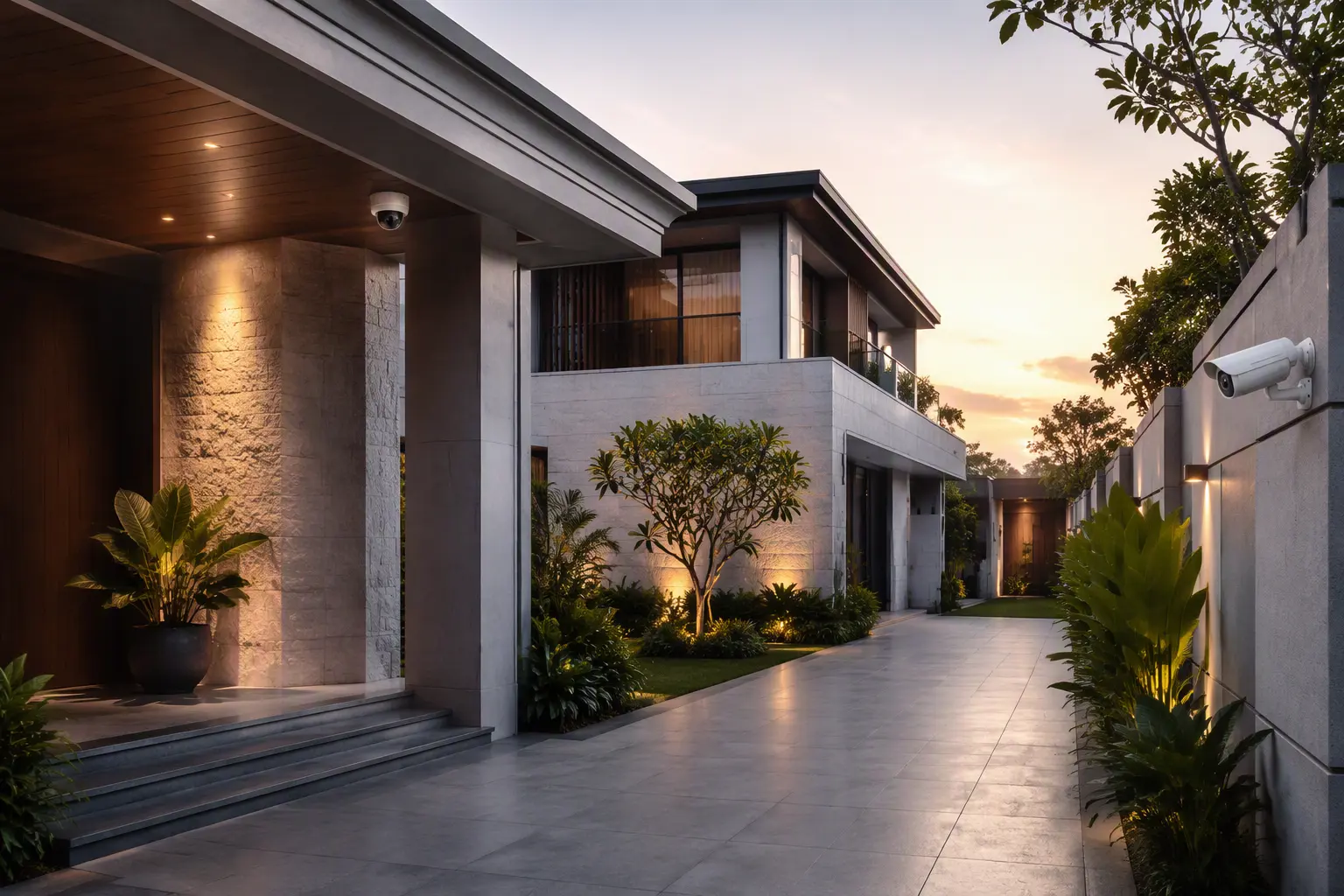
CCTV installation involves choosing the right cameras (dome, bullet, PTZ, or smart IP cameras), placing them to cover entry points and vulnerable areas, and connecting them to a recorder and monitoring system — wired or wireless. The right system depends on your property size, whether you need day/night or high-resolution footage, and how you want to view and store it. Indicative cost in India ranges from around ₹15,000–₹30,000 for a basic few-camera home setup to significantly more for larger or high-resolution systems with smart features. The most important decision isn't the cameras — it's choosing an installer who assesses your property, places cameras correctly, and integrates the system properly.
A CCTV system is only as good as its design and installation. The same cameras, placed badly, leave blind spots; placed well, they cover everything that matters. This guide covers the camera types, what installation costs, and how to choose the right installer.
Who Is This Guide For?
Homeowners wanting to secure a house, villa, or apartment in Noida, Greater Noida, Gurgaon, or Delhi NCR. Business owners securing an office, shop, or commercial space. And anyone comparing CCTV options and installers, wanting to understand types, cost, and what to look for before committing.
Types of CCTV Cameras
Choosing the right camera type for each location is the foundation of a good system.
Dome cameras. Dome-shaped, discreet, and hard to tell which way they're pointing. Ideal for indoors and entrances — common in homes, shops, and offices.
Bullet cameras. Visible, cylindrical, and a clear deterrent. Good for outdoor use and covering longer distances like driveways, boundaries, and gates.
PTZ (Pan-Tilt-Zoom) cameras. Can move and zoom, remotely or automatically, to cover large areas with one camera. Suited to bigger properties and commercial spaces where active monitoring matters.
IP / smart cameras. Network cameras offering high resolution, remote viewing on your phone, motion alerts, and smart features. Increasingly the standard for their clarity and app control.
Wireless cameras. Connect over Wi-Fi for easier installation, ideal for retrofits where running cables is difficult. Convenient, though they still need power and depend on network reliability.
Most properties use a mix — dome cameras at entrances, bullet cameras covering the perimeter, perhaps a PTZ for a large area. Matching the camera to each spot is what a good installer gets right.
Wired vs Wireless CCTV
Wired systems connect cameras to the recorder by cable. They're reliable, stable, and best for permanent installations, especially when planned during construction — no dependence on Wi-Fi. The trade-off is more involved installation.
Wireless systems connect over Wi-Fi, making them easier to install and ideal for finished homes or retrofits. The trade-off is dependence on network strength and reliability.
For a permanent, robust setup, wired is often preferred. For flexibility and retrofits, wireless works well. Many systems combine both. A good installer recommends based on your property, not a one-size-fits-all approach.
Key Components of a CCTV System
Beyond cameras, a complete system includes:
Recorder (DVR/NVR). Records and stores footage — a DVR for analog cameras, an NVR for IP cameras. The heart of the system.
Storage. Hard drives sized to how many days of footage you want to keep. More cameras and higher resolution need more storage.
Monitoring & viewing. Live and recorded footage viewed on a monitor or, increasingly, your phone from anywhere via an app.
Power & backup. Cameras need reliable power, and in India, backup matters — a security system that dies in a power cut isn't secure. A good installer plans for this.
Network. For IP and remote viewing, a stable network is essential.
What Does CCTV Installation Cost?
These are indicative estimates for planning only, not actual quotes. Actual cost depends on the number and type of cameras, resolution, wired vs wireless, storage, and installation complexity — confirmed after a site survey.
| Setup | What It Covers | Indicative Cost |
|---|---|---|
| Basic home (2–4 cameras) | Entry-level cameras, DVR/NVR, basic storage | ₹15,000 – ₹30,000 |
| Standard home (4–8 cameras) | HD cameras, NVR, remote viewing, good storage | ₹30,000 – ₹70,000 |
| Premium / large property | High-res IP/PTZ, extensive coverage, smart features | ₹70,000+ |
| Commercial | Many cameras, high resolution, integration | Varies widely |
Cost is driven most by the number of cameras, their resolution, and type (basic vs high-res IP/PTZ), plus storage and installation complexity. The cheapest system is rarely the best value — poor cameras with blind spots defeat the purpose. Spend on covering what matters, at a resolution that's actually useful.
Where to Place CCTV Cameras
Good placement is what makes a system effective. Key areas:
Main entrance and doors — every entry point should be covered.
Gates and driveways — capturing anyone approaching, and vehicles.
Perimeter and boundary — covering the property's edges.
Ground-floor windows — common entry points for intruders.
Backyard and blind sides — the areas out of casual view, often most vulnerable.
Garage and parking — protecting vehicles.
Key interior areas — main hallways or valuables, as needed.
The goal is no blind spots at the points that matter — entries and vulnerable areas. This is exactly where professional assessment beats guesswork: an installer who surveys the property spots the vulnerabilities an untrained eye misses.
CCTV and the Smart Home
Modern CCTV increasingly integrates into the wider smart home and security system. Cameras can tie into smart home security, sending motion alerts to your phone, integrating with alarms and access control, and letting you view any camera from the same app that controls your home. For a complete picture, CCTV works alongside intrusion alarms (like Ajax) and smart locks — surveillance being one layer of a coordinated security system, not a standalone.
Why Use a Professional CCTV Installer
Correct camera placement. The single biggest factor. Professionals place cameras to eliminate blind spots at entries and vulnerable areas — the difference between footage that helps and footage that misses the moment.
Right camera for each spot. Matching dome, bullet, PTZ, and resolution to each location, rather than the same camera everywhere.
Proper setup and integration. Recorder, storage, remote viewing, and integration with your wider security, configured correctly.
Reliable, tidy installation. Secure mounting, proper cabling, weatherproofing outdoor cameras, and planning for power backup.
Support afterwards. A system needs occasional support — a camera angle adjusted, storage checked, remote access fixed. A local installer can help.
How to Choose a CCTV Installer
- Do they survey your property and plan camera placement before quoting?
- Do they recommend the right camera types for each location, not just a package?
- Do they cover remote viewing, storage, and power backup?
- Can they integrate CCTV with your wider security and smart home?
- Do they handle outdoor weatherproofing properly?
- Is the quote itemised — cameras, recorder, storage, installation — and clear?
- Do they offer after-sales support?
A serious installer surveys first and designs for your property. Be cautious of anyone quoting a fixed package without seeing the site — placement is everything, and it can't be planned from a price list.
Expert Recommendation from Brightmatic
For the CCTV and security work we do across Delhi NCR, our approach begins with a survey: walking the property to find its vulnerable points, then placing the right camera at each one. We plan coverage, storage, remote viewing, and power backup, and integrate it with the wider security system.
The insight worth passing on: people often focus on how many cameras or how high the resolution, and overlook the thing that actually determines whether a system works — placement. Eight cameras placed badly leave blind spots exactly where an intruder enters; four placed well cover everything that matters. The camera count and specs are secondary to a design that sees your property's real weak points. That's why we survey first — because a CCTV system isn't a box of cameras, it's a coverage plan for your specific home or business.
Get the placement right, plan for power, and integrate it properly, and CCTV becomes genuine security rather than a false sense of it. That's part of how we approach security and surveillance — protection that's Designed Around Experience.
Planning a CCTV System?
Good CCTV isn't about the most cameras or the highest specs — it's about the right cameras, placed where they cover what matters, set up and integrated properly. That's what turns a box of cameras into real security.
Want your property properly covered? Get a free consultation.
Securing a home or business in Noida or Delhi NCR? Contact Brightmatic for a personalised CCTV and security consultation.
FAQ's
How much does CCTV installation cost in India?
Indicatively, a basic home setup of 2–4 cameras runs around ₹15,000–30,000, a standard 4–8 camera HD system ₹30,000–70,000, and premium or large-property systems ₹70,000 and above, with commercial varying widely. Cost depends most on the number, type, and resolution of cameras plus storage and complexity. These are indicative estimates confirmed after a site survey.What types of CCTV cameras are there?
The main types are dome cameras (discreet, for indoors and entrances), bullet cameras (visible, for outdoor and long-distance), PTZ cameras (pan-tilt-zoom, for covering large areas), IP or smart cameras (high-resolution with remote app viewing), and wireless cameras (Wi-Fi, easy to retrofit). Most properties use a mix matched to each location.Should I choose wired or wireless CCTV?
Wired systems are more reliable and stable, best for permanent installations planned during construction, with no dependence on Wi-Fi. Wireless systems are easier to install and ideal for finished homes or retrofits, though they depend on network strength. Many systems combine both; a good installer recommends based on your property.Where should CCTV cameras be placed?
Cameras should cover all entry points — the main entrance, doors, gates, and driveways — plus the perimeter, ground-floor windows, backyard and blind sides, garage, and any key interior areas. The goal is no blind spots at the points that matter. Professional placement, based on a property survey, eliminates the vulnerabilities an untrained eye misses.Can I view CCTV footage on my phone?
Yes. Modern IP and smart CCTV systems let you view live and recorded footage on your phone from anywhere via an app, and can send motion alerts. This is one of the main advantages of newer systems, and they can integrate with your wider smart home and security for unified control.Why should I use a professional CCTV installer?
A professional surveys your property to place cameras where they eliminate blind spots, matches the right camera type and resolution to each location, and sets up recording, storage, remote viewing, and power backup correctly. Poor placement leaves gaps exactly where they matter, so professional design is what makes CCTV genuine security rather than a false sense of it.
Comments
No Comments