

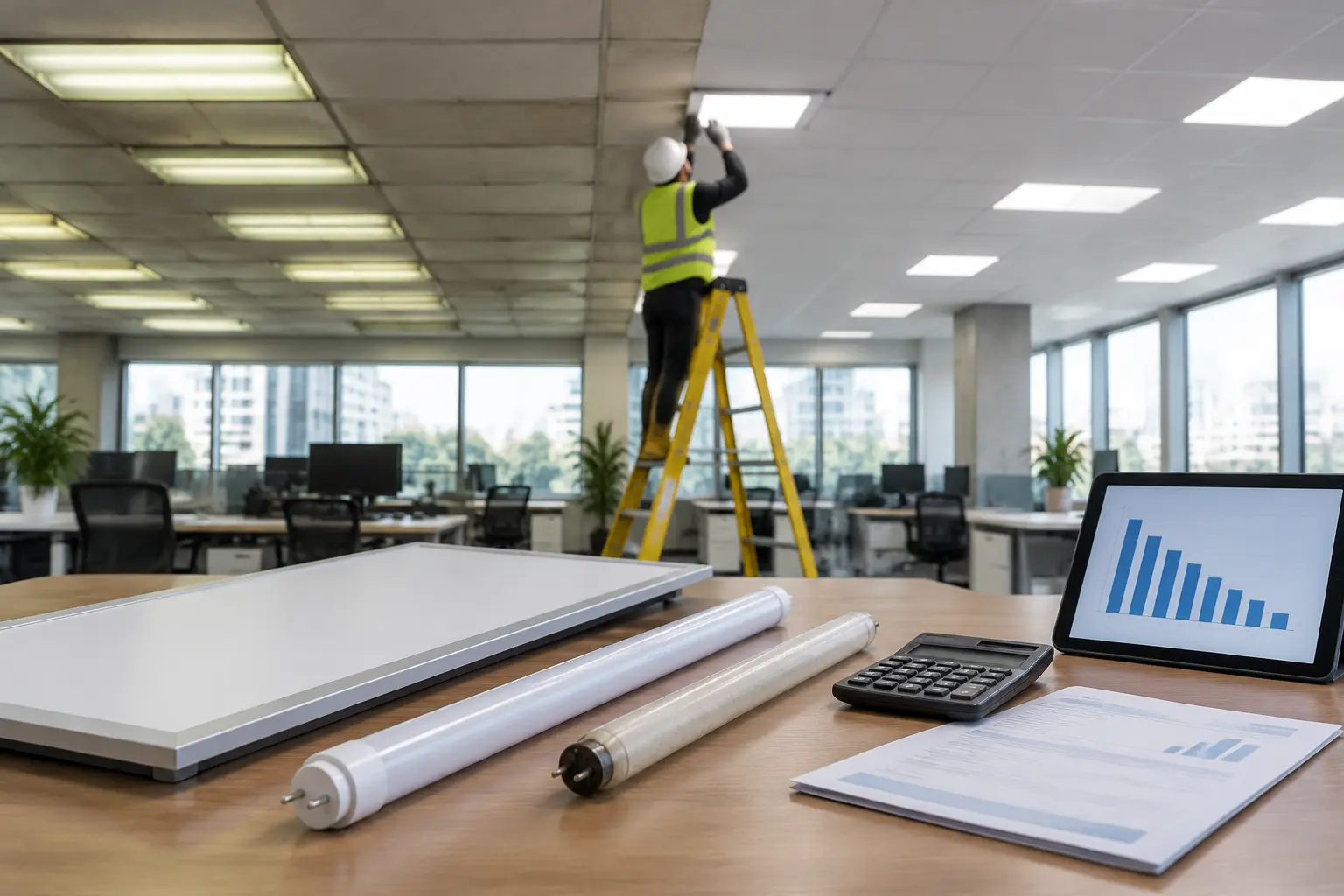
A commercial lighting retrofit in India indicatively costs Rs 40 to 150 per sq ft for a straight LED upgrade, and Rs 150 to 400 per sq ft with sensors, dimming and redesign. A 5,000 sq ft office typically spends Rs 2 to 8 lakh. Because commercial lights run long hours, payback is often two to three years.
Every month, the electricity bill arrives. Every month, it’s a little higher. Somewhere above the false ceiling, eighty old tube lights are humming, a few are flickering, and the corridor lights have been on since 7 am in an empty building.
Nothing is broken, so nothing gets changed. But those lights are quietly one of the easiest costs in the building to cut.
That’s what a lighting retrofit does. This guide explains what a retrofit costs, what you save and how to plan one without disrupting your business.
Who is this guide for?
- Office owners and facility managers facing rising electricity bills
- Retail and showroom owners whose lighting looks dull or dated
- Hotel and restaurant owners upgrading lobbies, corridors and back-of-house
- Warehouse and factory owners still running old high-bay lights
What is a commercial lighting retrofit?
A commercial lighting retrofit is the upgrade of an existing building’s lighting, usually from fluorescent, CFL, halogen or metal halide to LED, often with added controls such as sensors and dimming.
Unlike a new fit-out, a retrofit works with the ceiling, wiring and layout you already have. That keeps costs lower and work faster, and it means most businesses can stay open while the upgrade happens.
What types of retrofit are there?
There are four main retrofit approaches, and the right one depends on the age of your fittings and what you want to achieve.
| Retrofit type | What it involves | Best for |
|---|---|---|
| Lamp swap | Replace tubes or bulbs with LED equivalents in existing fittings | Tight budgets, fittings in good condition |
| Fixture replacement | Replace old fittings with new LED panels, downlights or linears | Offices and retail with ageing fittings |
| Lighting redesign | New layout, colour temperature and fittings planned for the space | Showrooms, hotels, spaces that look dated |
| Controls retrofit | Add sensors, dimming, scheduling or DALI to existing or new LEDs | Large offices, hotels, long operating hours |
At Brightmatic, we usually recommend fixture replacement with sensors for offices. A lamp swap alone saves energy, but old fittings often have yellowed diffusers and poor optics, so the space never actually looks better.
How much does a commercial lighting retrofit cost?
Cost depends mainly on the type of fitting, the number of points and whether controls are added.
Indicative estimates only, not actual quotes.
| Item | Indicative cost per point (supply + installation) |
|---|---|
| LED tube replacing fluorescent tube | Rs 400 – 1,200 |
| LED panel replacing 2x2 fluorescent fitting | Rs 1,500 – 4,000 |
| LED downlight replacing CFL or halogen | Rs 800 – 3,000 |
| LED linear or profile light | Rs 1,500 – 5,000 per metre |
| LED track spot for retail | Rs 2,500 – 8,000 |
| LED high-bay replacing metal halide | Rs 5,000 – 15,000 |
| Occupancy or daylight sensor | Rs 1,500 – 8,000 |
For full control systems, our lighting control system cost guide breaks down keypads, actuators and DALI gateways.
What does a full retrofit cost by building type?
Project costs indicatively range from about Rs 2 lakh for a small office to Rs 40 lakh or more for hotel common areas.
Indicative estimates only, not actual quotes.
| Space | LED upgrade only | With controls and redesign |
|---|---|---|
| Office, 5,000 sq ft | Rs 2 – 4 lakh | Rs 4 – 8 lakh |
| Retail showroom, 3,000 sq ft | Rs 2 – 4 lakh | Rs 4 – 9 lakh |
| Restaurant, 2,500 sq ft | Rs 1.5 – 3 lakh | Rs 3 – 7 lakh |
| Warehouse, 20,000 sq ft | Rs 5 – 12 lakh | Rs 8 – 18 lakh |
| Hotel common areas | Rs 10 – 25 lakh | Rs 20 – 40 lakh+ |
Planning a retrofit for an office or showroom in Noida or Delhi NCR? We can survey the existing fittings and give you an itemised estimate with expected savings.
How much can a retrofit save?
LED lighting typically uses around 40–60% less energy than fluorescent and up to 80% less than halogen, and sensors can cut usage further in low-occupancy areas.
Here’s a simple, indicative example for an office:
- Before: 100 twin-tube fluorescent fittings at about 80 W each, including the ballast
- After: 100 LED panels at about 36 W each
- Saving: about 4.4 kW, running 12 hours a day, 300 days a year
- Result: roughly 15,800 units saved, or about Rs 1.3–1.6 lakh a year at commercial tariffs of around Rs 8–10 per unit
With a retrofit cost of around Rs 2.5–3 lakh, payback in this example is about two years. Actual savings depend on your tariff, hours and existing fittings. The Bureau of Energy Efficiency publishes guidance on efficient lighting in Indian buildings.
There are savings beyond the bill too. LEDs last far longer, so maintenance calls drop, and they run cooler, which lightly reduces air-conditioning load.
Which factors affect retrofit cost?
Six factors decide most of the price.
- Number of points. More fittings mean more hardware and labour.
- Fitting quality. Branded drivers, good optics and high colour rendering cost more but last longer.
- Ceiling condition. Damaged grid ceilings or inaccessible voids add work.
- Controls. Sensors, dimming and DALI or 0-10V control add cost but increase savings.
- Working hours. Night or weekend installation to avoid disruption can add labour cost.
- Disposal. Old fluorescent tubes contain mercury and should be disposed of responsibly.
Want to know your payback period? Share your fitting count or floor plan →
Is a lighting retrofit worth it?
- Is it expensive? It usually pays for itself through lower bills. It can also be phased, starting with the areas that stay lit longest.
- Is it complicated? Not with planning. Most retrofits are done floor by floor, outside working hours.
- What can go wrong? Cheap LEDs that flicker or fail early, wrong colour temperature and no plan for controls.
What mistakes should you avoid?
- Choosing the cheapest LEDs with unbranded drivers
- Swapping lamps without checking light levels on desks and displays
- Using cool 6500K light everywhere, making spaces feel clinical
- Mixing colour temperatures from different suppliers
- Skipping sensors in corridors, washrooms and meeting rooms
- Comparing quotes on price per fitting without checking wattage, lumens and warranty
A common myth: a retrofit just means replacing tubes with LEDs. In reality, the biggest gains come from better light quality and smarter control, not just lower wattage.
Expert recommendation from Brightmatic
For most commercial spaces, we recommend replacing old fittings with quality LED panels, downlights or linears at 3000K–4000K, adding occupancy sensors in low-use areas and daylight sensors near windows, and using DALI or KNX control in larger buildings. Start with a lighting survey, so you know your current load, hours and payback before you spend.
For retail and hospitality, treat the retrofit as a chance to redesign. Better accent lighting can improve how products and interiors look, not just reduce the bill.
Brightmatic plans and installs architectural lighting and lighting control retrofits for offices, showrooms, hotels and restaurants, with control components from brands like ABB.
Plan your lighting retrofit with Brightmatic
Brightmatic designs and installs commercial lighting retrofits for offices, retail spaces, hotels and restaurants in Noida, Delhi NCR & across India.
FAQ's
How much does a commercial lighting retrofit cost in India?
Indicatively Rs 40 to 150 per sq ft for an LED upgrade, and Rs 150 to 400 per sq ft with sensors, dimming and redesign.What is the payback period for an LED retrofit?
For commercial spaces that run long hours, payback is often two to three years, depending on tariff, hours and existing fittings.How much energy does an LED retrofit save?
LED typically uses around 40–60% less energy than fluorescent and up to 80% less than halogen. Sensors can save more in low-use areas.Can a retrofit be done without closing the business?
Yes. Most retrofits are phased floor by floor or done at night and on weekends.Should I replace tubes or full fittings?
Replacing full fittings usually gives better light quality and reliability. Tube swaps suit tight budgets where fittings are in good condition.Can controls be added to existing lights?
Yes. Wireless sensors and controllers can be added to many existing LED fittings, while DALI needs compatible drivers.Still comparing retrofit quotes? Talk to our lighting expert. We’ll estimate your savings, free.
Comments
No Comments