

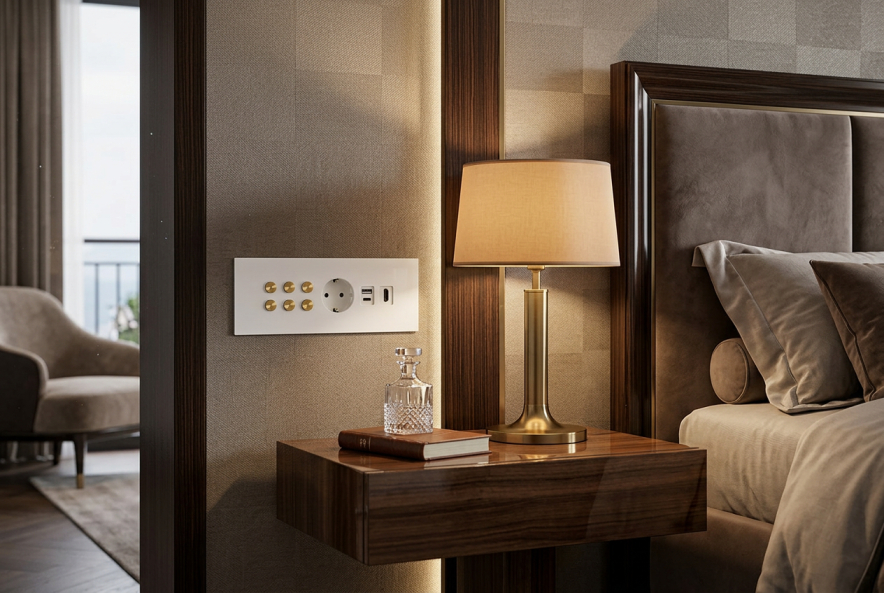
The Core Surface Switch is a fully KNX-certified modular smart switch series handcrafted from pure brass and anodized aluminum, combining Italian installation standard compatibility with complete KNX building automation functionality — controlling lighting, shading, climate, and audio from a single switch plate. It is the product that answers the question every luxury Indian homeowner eventually asks: why does the most visible hardware in every room still look like a plastic commodity item?
The Problem With Every Standard Smart Switch in India
Smart home adoption in India has grown significantly — but the wall switch has remained largely unchanged in its material reality. The dominant smart switches in the Indian market, regardless of brand, are plastic-bodied devices with glass or acrylic touch panels. They are functional. They are connected. But in a home where every other surface — the flooring, the cabinetry, the door handles, the sanitary fittings — has been specified in premium materials, a plastic switch plate is a visible and consistent compromise.
The Core Surface Switch was engineered specifically for this problem. It is not a functional device with decorative ambition — it is a luxury object with full KNX automation intelligence built inside it.
What is the Core Surface Switch?
The Core Surface Switch is Core Smart Home's modular KNX switch series — a wall-mounted control interface that combines pure brass or aluminum hardware construction with full KNX TP (Twisted Pair) bus integration. Compatible with the Italian installation standard — one of the most widely adopted modular electrical standards globally — the Surface Switch fits directly into standard modular frames, enabling switch and socket configurations to coexist within a single plate.
The Italian installation standard is relevant for Indian projects because it is the basis for several premium modular switch systems already in widespread use in luxury Indian interiors — making the Core Surface Switch dimensionally compatible with existing high-end frame systems.
Core Surface Switch — Materials and Craftsmanship
The defining characteristic of the Surface Switch series is its material integrity. Every component is produced from primary materials — not plastic with a metallic coating, but actual brass and actual aluminum, processed through artisanal techniques.
Pure Brass Variants
Each brass Surface Switch is formed from solid brass stock and refined through either satin brushing — achieving a consistent texture that reflects light evenly — or through aging and patination techniques that produce an organic, evolving surface character. Due to the artisanal nature of the aging process, no two patinated brass switches are identical — each carries subtle variations that are a mark of handcraft, not a manufacturing flaw.
Anodized Aluminum Variants
Aluminum Surface Switches undergo a multi-layer painting process — carefully selected color tones applied in sequence, then sealed with advanced protective coating. The result is a silky tactile surface that maintains its finish integrity across years of daily contact. Aluminum variants offer a broader color range than brass, spanning neutral tones, deep colors, and contemporary finishes.
The Surface Treatment Standard
| Material | Process | Texture | Characteristic |
|---|---|---|---|
| Brass — Satin | Mechanical brushing | Smooth directional grain | Consistent, refined |
| Brass — Aged | Coating/patination | Organic texture variation | Artisanal, unique |
| Aluminum — Painted | Multi-layer painting + seal | Silky smooth | Wide color range |
| Aluminum — Anodized | Electrochemical process | Satin effect | Durable, consistent |
KNX Functions — What the Core Surface Switch Controls
Despite its material luxury, the Core Surface Switch is a fully specified KNX sensor device programmed via ETS — the KNX Association's standard Engineering Tool Software. Every button function, LED behavior, and group address assignment is configurable to the specific requirements of each room and installation.
Lighting Control
Switching, dimming, and DALI control via assigned KNX group addresses. Single press for on/off, long press for dimming — or configured as scene activation buttons that trigger complete multi-device lighting states simultaneously.
Shading and Blind Control
Up/down/stop commands for motorized blind and shutter actuators. Slat angle control for venetian blinds. Configurable long-press for complete open/close and short-press for step adjustment.
Climate Control
Temperature setpoint adjustment, operating mode selection (Comfort/Standby/Economy/Protection), and direct HVAC commands — all from the same switch plate that controls the lighting and blinds in the same room.
Audio Control
Volume adjustment and source selection for KNX-integrated audio zones — making the Core Surface Switch the single control point for every environmental function in the room.
Scene Activation
Any button can be assigned as a scene recall key — activating a pre-programmed KNX scene that simultaneously controls lighting levels, blind positions, AC setpoints, and audio status across the room or the entire building.
Core Surface Switch vs Standard KNX Push Buttons
| Feature | Core Surface Switch | Standard KNX Push Button |
|---|---|---|
| Material | Pure brass / aluminum | Plastic with glass overlay |
| Manufacturing | Artisanal — hand-finished | Industrial — injection moulded |
| Frame compatibility | Italian installation standard | Brand-specific proprietary |
| Socket integration | Yes — within same frame | Rarely |
| Finish options | 12+ premium variants | 2–4 standard colors |
| Customization | Frame, module, finish, engraving | Color only |
| KNX functions | Full — lighting, shading, climate, audio | Full |
| ETS programming | Yes | Yes |
| RGB LED backlight | Yes — per button | Yes |
| Suitable for luxury interiors | Yes | Compromise |
Full Customization — Every Detail to Specification
What separates the Core Surface Switch from every other KNX push button is the degree of customization available at the product level — not as an afterthought, but as a core part of the specification process.
Frame size — Multiple frame configurations accommodate different module counts. A single-room control point might use a 3-module frame combining two KNX buttons and a socket. A master bedroom entry might use a 6-module frame with four scene buttons, a dimmer control, and a blind module — all within one plate.
Module configuration — KNX push button modules, socket modules, USB charging modules, and network modules can be combined within the same frame — replacing the multiple individual switch plates that would otherwise occupy the same wall space with a single, architecturally resolved panel.
Finish selection — Frame and button module finishes can be specified independently — a brushed brass frame with aged brass buttons, or an aluminum frame in a custom color with contrasting button modules.
CNC engraving — Button surfaces can be engraved with custom icons, text labels, or both — identifying the function of each button in the homeowner's preferred language and iconographic style. Engraved labels are permanent and precise, unlike adhesive icon labels that peel over time.
RGB LED backlight — Each button LED is independently programmable in ETS — color, intensity, and behavior (permanently on, status indication, blink on activation). Status LEDs confirm the state of the controlled device — if the lights are on, the relevant LED is lit; if off, it extinguishes.
Where Core Surface Switch Is Specified in Indian Projects
Our lighting control installations at Brightmatic specify the Core Surface Switch for luxury Indian residential projects where the design brief requires that every visible element — including electrical hardware — meets the material standard of the interior.
Master bedroom entry — A 4-module Surface Switch in aged brass combining scene buttons for Morning, Evening, Movie, and Night — each engraved with the scene name in the homeowner's preferred language.
Living room — A 6-module Surface Switch in satin aluminum combining four lighting scene buttons, one blind control module, and one USB charging module — consolidating five separate conventional switch plates into a single architecturally coherent element.
Home office — A 3-module Surface Switch integrating KNX lighting control with a network socket for desk connectivity — meeting both the smart home and working infrastructure requirements from a single wall plate.
- In a recent project at a penthouse in Sector 94, Noida — the interior designer specified brushed brass hardware throughout — door handles, towel rails, tap fittings, and cabinet pulls. We specified Core Surface Switch Series in satin brushed brass across all 22 control points. The result was the first time in the project that the electrical hardware matched the material language of everything around it.
Core Surface Switch and CoreOS Integration
The Core Surface Switch integrates natively with Core Smart Home's CoreOS platform running on the Eclipse Home Controller Touch Panel — the central hub of the Core KNX ecosystem.
This integration means every Surface Switch button assignment is reflected in the CoreOS visualization interface — the same scene triggered by the wall switch also appears in the touch panel and the Core Mobile App, maintaining perfect synchronization across all control points simultaneously.
For projects combining Surface Switches with Core Eclipse Thermostatic Push Buttons, both device types operate on the same KNX bus with the same ETS group address structure — a unified, coherent system behind the physical elegance of two complementary hardware families.
FAQ's
1. What is the Italian installation standard and why does it matter for Indian homes?
The Italian installation standard defines the physical dimensions and modular geometry of switch and socket components — frame sizes, module dimensions, and mounting specifications. It is widely used in premium European electrical and smart home products. For Indian luxury projects, its relevance is that several high-end modular switch frame systems already in use in India are dimensionally compatible — allowing Core Surface Switch modules to integrate into existing premium frames, or for complete Core Surface Switch plate assemblies to replace existing switch plates without wall modification.
2. Can the Core Surface Switch combine KNX buttons and power sockets in the same frame?
Yes — this is one of the Core Surface Switch's defining advantages over conventional KNX push buttons. Within a single Italian standard frame, KNX push button modules, power socket modules, USB charging modules, and data socket modules can be combined in any configuration. This consolidates multiple wall plates into a single, unified panel — reducing wall clutter and creating a cleaner architectural surface.
3. How are Core Surface Switch buttons programmed?
All Core Surface Switch KNX functions are programmed using ETS — the KNX Association's standard Engineering Tool Software used by certified KNX installers globally. Each button is assigned KNX group addresses for its target functions — switching, dimming, scene recall, blind control, or climate commands. LED colors and behaviors, button press/release functions, and long-press actions are all configured in ETS and loaded onto the device over the KNX bus. Our lighting control team handles all ETS programming and commissioning for Core KNX installations.
4. What is the difference between Core Surface Switch and Core Eclipse Thermostatic Push Button?
The Core Eclipse Thermostatic Push Button is an 86mm × 86mm device with five built-in environmental sensors — temperature, humidity, CO₂, proximity, and brightness — primarily designed as a room sensor and thermostat that also serves as a push button controller. The Core Surface Switch is a modular frame-based switch system without built-in sensors, designed specifically for aesthetic integration of multiple functions — including power sockets — within a single premium plate assembly. Both are KNX-certified and ETS-programmed, and both can coexist in the same installation serving different roles.
5. Are Core Surface Switch finishes consistent across different order batches?
For anodized aluminum and painted aluminum variants — yes, finish consistency is maintained across production batches. For aged brass variants — by design, subtle surface variations exist between individual pieces as a characteristic of the artisanal aging process. These variations are deliberate and considered a quality mark of handcrafted material processing. For projects requiring matched finishes across multiple plates in the same visual field, satin brushed brass or anodized aluminum variants provide the most consistent appearance.
Comments
No Comments