

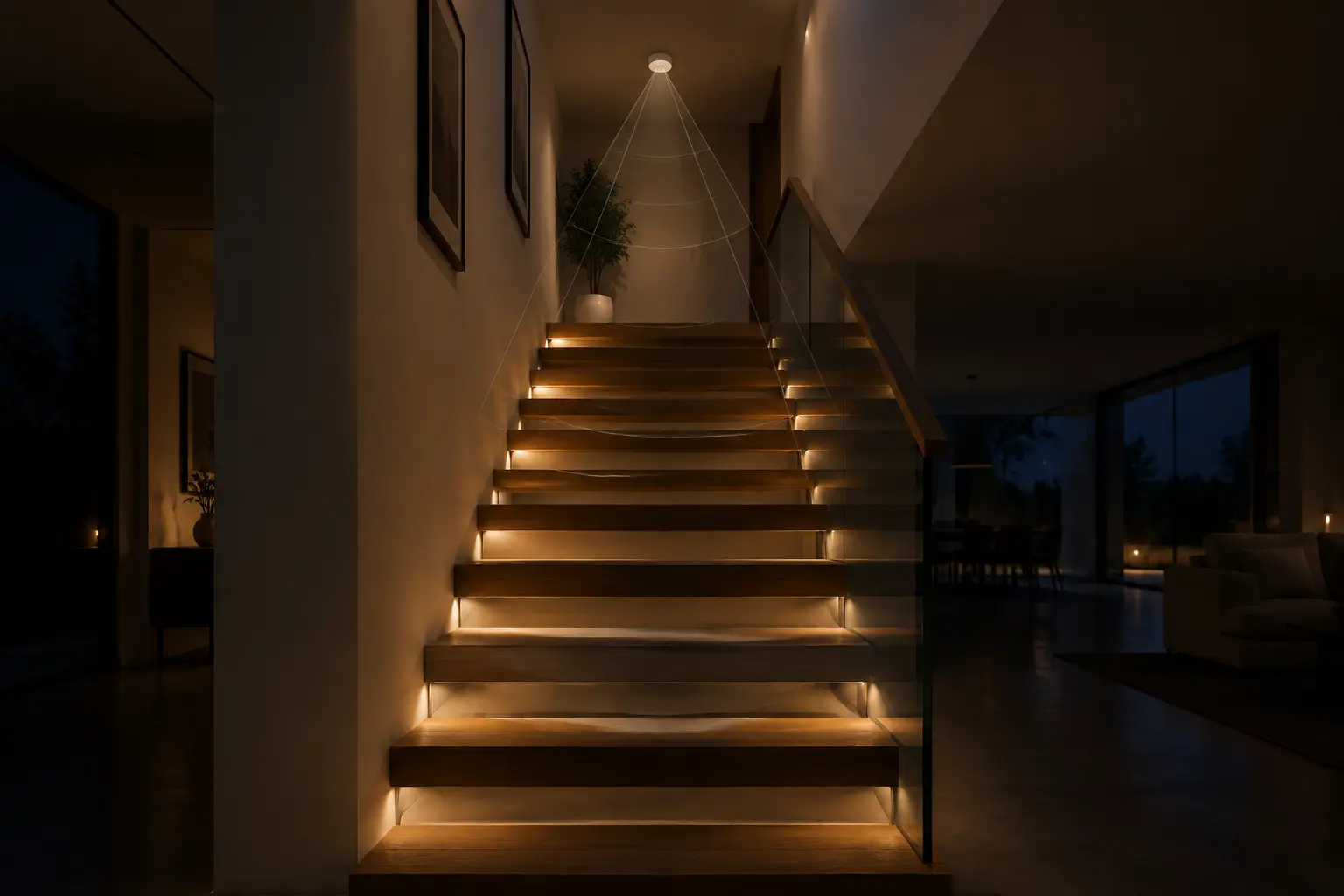
Lighting sensors switch or dim lights automatically based on movement, presence or daylight. The main types are PIR motion sensors, microwave sensors, presence detectors and daylight sensors. They save energy, add convenience and improve safety in staircases, bathrooms, corridors, offices and outdoor areas. Indicative costs range from Rs 500 to Rs 25,000+ per sensor.
You walk into a dark corridor carrying shopping bags. The lights come on before you reach for a switch. At 2 am, a soft path of light guides you to the kitchen without waking anyone.
That’s what a well-planned sensor does. A badly planned one switches off while you’re still in the shower. The difference is choosing the right type for the right space.
Who is this guide for?
- Homeowners planning smart lighting in a new home or renovation
- Villa owners wanting automatic lighting for staircases, outdoors and utility areas
- Office and commercial building owners looking to cut lighting energy
- Architects and electrical consultants specifying lighting controls
What is a lighting sensor?
A lighting sensor is a device that detects movement, presence or light level and automatically switches or dims lights in response.
It can work on its own, switching a single light circuit, or as part of a lighting control system like KNX or DALI, where it triggers scenes across a whole room or floor.
What are the main types of lighting sensors?
The four main types are PIR motion sensors, microwave sensors, presence detectors and daylight sensors.
1. PIR (passive infrared) motion sensors. These detect body heat moving across their field of view. They’re affordable and reliable for walking movement, which makes them ideal for corridors and staircases. They’re less sensitive to small movements, like someone sitting still.
2. Microwave sensors. These send out low-power signals and detect movement from the reflections. They’re more sensitive than PIR and can detect through thin materials like glass or partitions. That also means they can trigger from movement outside the intended area if not adjusted.
3. Presence detectors. These are high-sensitivity sensors designed to detect small movements like typing or reading. They keep lights on while people are still in the room, which makes them right for offices, bathrooms and study rooms. Many presence detectors also include a built-in light level sensor.
4. Daylight (light-level) sensors. These measure how much natural light is available and dim or switch artificial lights to match. This is often called daylight harvesting. It’s common in offices, lobbies and rooms with large windows.
| Sensor type | Detects | Sensitivity | Best for | Relative cost |
|---|---|---|---|---|
| PIR motion | Body heat in motion | Medium | Corridors, staircases, outdoors | Low |
| Microwave | Any movement (reflected signal) | High | Bathrooms, large or enclosed areas | Low–medium |
| Presence detector | Small movements | Very high | Offices, studies, meeting rooms | Medium–high |
| Daylight sensor | Natural light level | n/a | Offices, lobbies, window-side zones | Medium |
Occupancy vs vacancy: what’s the difference?
An occupancy sensor switches lights on and off automatically, while a vacancy sensor only switches them off, so you turn lights on manually.
Occupancy mode suits corridors and staircases. Vacancy mode suits bedrooms and living rooms, where you don’t always want lights to come on as you walk in, for example at night.
What are the benefits of lighting sensors?
Lighting sensors save energy, add convenience and improve safety, all without changing how people use a space.
- Energy savings. Lights switch off in empty rooms, and daylight sensors avoid lighting spaces that are already bright. Our guide on how ABB KNX saves electricity explains how this works in homes.
- Convenience. No searching for switches with full hands or in the dark.
- Safety. Staircases and pathways light up automatically, which is helpful for children and elderly family members.
- Security. Outdoor sensors light up entrances and boundaries when someone approaches. For the difference between sensor lighting and surveillance, see motion sensor vs CCTV.
- Compliance. India’s Energy Conservation Building Code, administered by BEE, includes provisions for automatic lighting controls in commercial buildings.
Where should lighting sensors be used?
Sensors work best in spaces people pass through or use briefly, and in commercial areas with long operating hours.
| Space | Recommended sensor | Why |
|---|---|---|
| Staircases | PIR or microwave | Safe, automatic light as people move. See our staircase lighting guide |
| Corridors & lobbies | PIR | Light only when someone is passing |
| Bathrooms | Microwave or presence | Stays on even when you’re still |
| Wardrobes & storage | Door or PIR sensor | Lights up as you open it |
| Study & home office | Presence + daylight | Stays on while working, saves energy by the window |
| Offices & meeting rooms | Presence + daylight | Major energy savings over long hours |
| Basements & parking | Microwave or PIR | Large areas used intermittently |
| Outdoor & driveway | Weatherproof PIR | Welcoming light and added security |
At Brightmatic, we usually start a sensor plan with staircases, bathrooms and outdoor areas, because that’s where homeowners feel the difference from the very first day.
How much do lighting sensors cost in India?
Lighting sensors indicatively cost Rs 500 to Rs 25,000 or more each, depending on type, quality and system integration.
Indicative estimates only, not actual quotes. Installation and programming are extra.
| Sensor | Indicative cost per unit |
|---|---|
| Basic PIR motion sensor | Rs 500 – 1,500 |
| Microwave sensor | Rs 800 – 2,500 |
| Ceiling presence detector (standalone) | Rs 2,000 – 6,000 |
| Outdoor weatherproof sensor | Rs 1,000 – 4,000 |
| KNX or DALI presence/daylight sensor | Rs 8,000 – 25,000+ |
A full home usually needs only 6–12 sensors in the right places, not one in every room.
Not sure where sensors make sense in your home? Share your floor plan →
Are lighting sensors worth it?
- Are they expensive? Standalone sensors are affordable. System-level KNX or DALI sensors cost more but control entire scenes.
- Are they annoying? Only when the wrong type or timeout is chosen. Correct placement and settings fix this.
- What can go wrong? Lights switching off on people, false triggers from pets or AC vents, and sensors that can’t be adjusted after installation.
What mistakes should you avoid?
- Using a PIR sensor in a bathroom, where it may switch off while you’re still
- Placing sensors near AC vents, heaters or direct sunlight
- Setting very short timeouts in rooms where people sit still
- Mounting PIR sensors behind glass, which blocks infrared detection
- Using occupancy mode in bedrooms, so lights switch on at night
- Adding sensors after the ceiling is closed, without planning wiring
A common myth: sensors are only for offices. In homes, they’re often the feature families appreciate most, especially on staircases and at night.
Expert recommendation from Brightmatic
For homes, we recommend PIR sensors for staircases and corridors, microwave or presence sensors for bathrooms, vacancy mode for bedrooms, and weatherproof PIR sensors outdoors. For offices, use presence detectors combined with daylight sensors, ideally integrated into DALI or KNX control. KNX presence detectors from brands like ABB can trigger full room scenes, not just a single light.
Plan sensor positions with your lighting layout, before the ceiling goes up. Crafting Brighter Lives.
Plan your sensor lighting with Brightmatic
Brightmatic designs and installs sensor-based and smart lighting for homes, villas, offices and commercial spaces in Noida, Delhi NCR & across India.
FAQ's
What is the difference between a motion sensor and a presence sensor?
A motion sensor detects larger movement like walking. A presence sensor detects small movements like typing, so it keeps lights on while people sit still.Which sensor is best for a bathroom?
A microwave or presence sensor, because it detects small movements and won’t switch lights off while you’re still.Do lighting sensors really save electricity?
Yes. Lights switch off in empty spaces and daylight sensors reduce artificial light when natural light is available. Savings depend on how the space is used.Can lighting sensors work with smart home systems?
Yes. Sensors can be integrated with KNX, DALI or other smart systems to trigger scenes across rooms.Can pets trigger motion sensors?
They can. Some sensors offer pet-friendly settings or adjustable sensitivity, and careful placement reduces false triggers.Can sensors be added to an existing home?
Yes. Wireless and wall-switch sensors can be retrofitted. Ceiling presence detectors are easiest to add during renovation.Still unsure which sensor suits each room? Talk to our lighting expert. We’ll plan it for free.
Comments
No Comments