

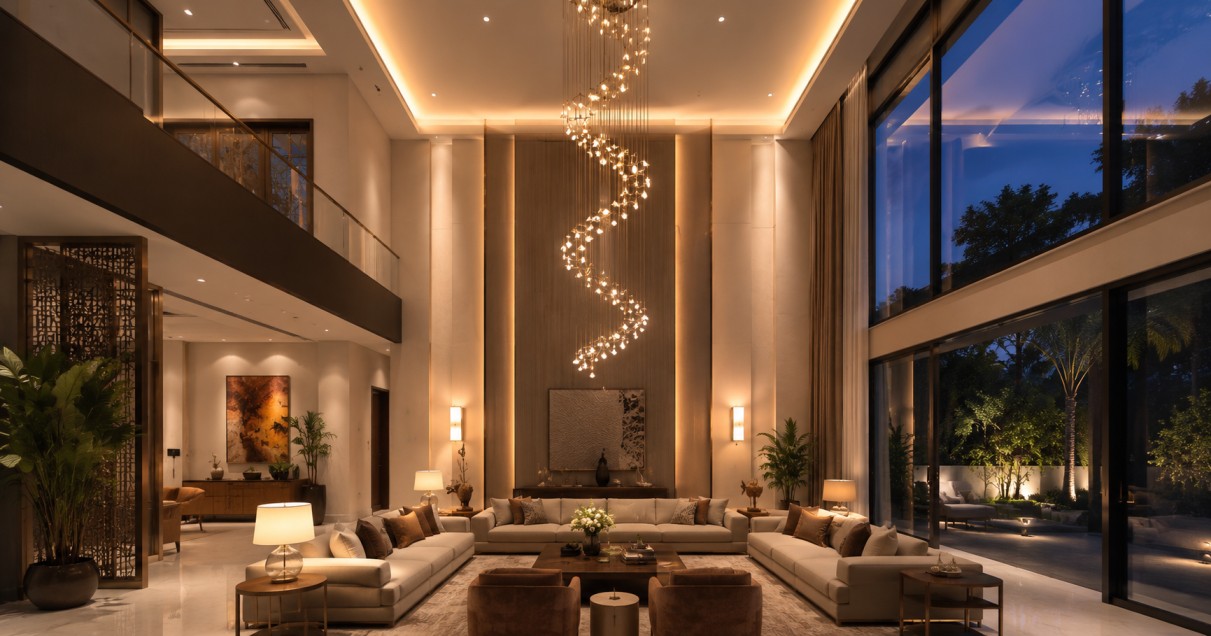
Double height ceilings need a layered lighting approach: a statement chandelier or pendant to fill the vertical volume, cove lighting to add a soft glow without harsh shadows, wall washing to light the tall walls evenly, and accent lighting at human level so the space feels warm rather than cavernous. The biggest mistake is relying on one high fixture — a double height space needs light at multiple heights, and every fixture must be planned for maintenance access from the start.
A double height ceiling is one of the most dramatic features a home can have — and one of the hardest to light well. Get it right and the space feels grand and inviting. Get it wrong and it feels like a dim, echoing hall with a lonely light hanging in the middle. This guide covers the ideas that actually work, the mistakes to avoid, and the practical detail nobody mentions until it's too late.
Who Is This Guide For?
Homeowners building or renovating a villa, penthouse, or home with a double height living room, foyer, or stairwell. Architects and interior designers planning lighting for tall-volume spaces in premium projects across Noida, Greater Noida, Gurgaon, and Delhi NCR. And anyone with a double height space that feels dark, flat, or awkward no matter how many lights they add.
Why Double Height Ceilings Are Hard to Light
A normal room is roughly 10 feet tall. A double height space is 18 to 20 feet or more. That single change breaks most of the usual lighting logic.
Light falls off with distance. A ceiling fixture 20 feet up delivers a fraction of the light at floor level that it would from a normal ceiling. Brightness that looks fine on paper arrives weak at the ground.
The volume is vertical, not horizontal. There's a huge empty middle zone between the ceiling and the furniture that most lighting completely ignores — which is exactly why these spaces feel cold and cavernous.
Scale is unforgiving. A fixture that looks generous in a showroom can look tiny and lost in a double height void. Proportion matters more here than anywhere else in the home.
The solution isn't more light from the top. It's light at multiple heights, layered deliberately.
Idea 1: A Statement Chandelier or Pendant
The centrepiece of most double height spaces is a large suspended fixture that fills the vertical volume — a chandelier, a linear cascade of pendants, or a sculptural cluster dropping down into the empty middle zone.
This isn't just decoration. A well-sized suspended fixture solves the "empty middle" problem by bringing visual weight and light down into the void, so the eye has something to rest on and the space feels occupied rather than hollow.
Getting the scale right: As a rough guide, the fixture should hang so its lowest point clears head height at the floor (or sits above a stairwell), while its overall size is proportioned to the volume, not the floor area. In a double height space, err larger — small fixtures disappear.
Cascading pendants work beautifully over stairwells and foyers, following the vertical line of the space. A single dramatic chandelier suits a formal double height living or dining volume.
Idea 2: Cove Lighting at the Upper Level
Cove lighting — concealed LED strips that wash light across the ceiling — adds a soft, even glow that fills a tall space without any visible source or harsh shadow.
In a double height room, cove lighting at the upper ceiling level does something no downlight can: it lights the ceiling plane itself, making the height feel intentional and luminous rather than dark and distant. It's the difference between a ceiling that disappears into shadow and one that glows gently as a feature.
Cove lighting can also run along the upper-level balcony edge or mezzanine that often overlooks a double height space, tying the two levels together. Our complete guide to cove lighting covers how to detail this properly — and it must be planned into the false ceiling before construction.
Idea 3: Wall Washing the Tall Walls
Wall washing places fixtures to graze light evenly down a tall wall, turning the large blank vertical surfaces of a double height space into a soft, luminous feature.
This is one of the most underused ideas in tall spaces, and one of the most effective. Double height walls are enormous — often two storeys of blank surface. Left dark, they make the room feel like a pit. Washed with light, they add brightness at every level and make the whole volume feel considered.
Wall washing works especially well on a feature wall, a textured stone surface, or a wall holding large artwork. The difference between wall washing and wall grazing matters here depending on the surface texture — our guide on wall washing vs wall grazing explains which to use where.
Idea 4: Bring Light Down to Human Level
The most common reason a double height space feels cold is that all the light lives up high. The fix is layering light at the level people actually occupy.
Floor lamps, table lamps, wall sconces at normal height, and lighting integrated into furniture all bring warmth down to where people sit and stand. This lower layer is what makes a grand space feel intimate rather than institutional.
A double height living room lit only from 20 feet up feels like a hotel lobby. The same room with lamps, sconces, and warm pools of light at seating level feels like a home. This is the core principle of layered lighting, and it matters more in tall spaces than anywhere else.
Idea 5: Light the Staircase and Mezzanine
Most double height spaces include a staircase or an overlooking balcony. These are lighting opportunities, not afterthoughts.
Staircase lighting — step lights, handrail LED, or a cascade of pendants following the stairs — adds safety and drama simultaneously. Mezzanine edge lighting defines the upper level and adds a glowing line at mid-height, filling the vertical gap between floor and ceiling light.
Idea 6: Use Daylight, Then Layer for Night
Double height spaces usually have tall windows or upper-level glazing that flood the space with daylight. The lighting design should complement this, not fight it.
The goal is a scheme that looks intentional both by day and after dark. This is where lighting control earns its place: a double height space benefits enormously from scenes that shift the balance of chandelier, cove, wall, and accent light for different times of day. At Brightmatic, we typically put double height spaces on a control system so a single tap moves from a bright daytime setting to a warm, layered evening scene.
The Detail Nobody Mentions: Maintenance Access
Here's the practical problem that ruins more double height lighting than any design mistake: how do you change a bulb or clean a fixture 20 feet in the air?
Every fixture in a double height space must be planned for maintenance access from the start. The options:
- Motorised chandelier lifts (winches): The fixture lowers on a concealed motor for cleaning and servicing. Essential for large chandeliers in tall voids.
- Long-life LED fixtures: Choosing fixtures rated for 50,000+ hours minimises how often access is needed.
- Accessible positioning: Wall washers and cove lighting positioned where scaffolding or a tall ladder can reach.
Skipping this planning means either a permanently dead bulb you can't reach, or the expense and disruption of scaffolding every time a fixture fails. This decision has to happen at the design stage — retrofitting a chandelier lift into a finished ceiling is far harder.
Double Height Lighting — Quick Reference
| Layer | Fixture | What It Solves |
|---|---|---|
| Statement | Chandelier / cascading pendants | Fills the empty vertical volume |
| Upper ambient | Cove lighting | Lights the ceiling, adds soft glow |
| Vertical surface | Wall washing | Lights tall blank walls evenly |
| Human level | Lamps, sconces, furniture light | Warmth and intimacy at floor level |
| Circulation | Stair & mezzanine lighting | Safety, drama, mid-height fill |
| Control | Scenes / automation | Day-to-night flexibility |
Common Double Height Lighting Mistakes
Relying on one high fixture: A single chandelier 20 feet up leaves the room dim at floor level and cold in feel. Tall spaces need layers at multiple heights.
Under-scaling the chandelier: A fixture sized for a normal room looks lost in a double height void. Go larger than feels natural.
Ignoring the walls: Enormous blank double height walls left dark make the whole space feel like a pit. Wash them with light.
Forgetting human-level light: All light up high makes a grand space feel like a lobby. Bring warmth down to seating level.
No maintenance plan: The most expensive mistake — a fixture you can't reach to service. Plan chandelier lifts or accessible positioning from the start.
Only lighting for night: Double height spaces have big windows. Design for how the space looks by day too, and use scenes to shift between them.
Expert Recommendation from Brightmatic
For the double height living rooms and foyers we handle across Delhi NCR, our standard approach is a four-layer scheme: a scaled statement fixture for the volume, cove lighting at the upper ceiling, wall washing on the tall surfaces, and warm accent light at human level — all on a control system for day-to-night scenes.
The insight worth passing on: clients almost always focus on the chandelier first, because it's the visible, exciting decision. But the chandelier alone is what makes these spaces feel cold. The layers people don't think about — the wall washing, the human-level warmth, the cove glow — are what actually make a double height room feel liveable. The chandelier gets the attention; the layering does the work.
And plan the maintenance access before anything else. It's the single detail that turns a beautiful double height scheme into a practical one. This is exactly the kind of thing best resolved when architectural lighting is designed alongside the build, not added after.
Planning Lighting for a Double Height Space?
A double height ceiling is a rare, dramatic feature — and it deserves lighting designed for its scale, not adapted from a normal room. The difference between grand and cavernous comes down to layering and planning.
Not sure how to light your tall space? Get a free consultation.
Planning a home in Noida or Delhi NCR? Contact Brightmatic for a personalised double height lighting consultation.
FAQ's
What is the best lighting for a double height ceiling?
A layered approach works best: a scaled statement chandelier or pendants to fill the vertical volume, cove lighting at the upper ceiling for soft glow, wall washing on the tall walls, and warm accent light at human level. Relying on a single high fixture is the most common mistake.How do you light a double height living room?
Combine four layers — a statement suspended fixture, cove lighting, wall washing on the tall walls, and lamps or sconces at seating level. This fills the empty vertical middle and brings warmth down to where people sit, so the space feels grand but not cold.What size chandelier for a double height ceiling?
Size it to the volume, not the floor area — in a double height space, err larger, as small fixtures look lost. The lowest point should clear head height at the floor or sit above a stairwell. A lighting designer can calculate the right scale for your specific space.How do you change a bulb in a double height ceiling?
Through planned maintenance access — usually a motorised chandelier lift that lowers the fixture, long-life LED fixtures that rarely need changing, or positioning that a tall ladder or scaffolding can reach. This must be planned at the design stage, not after.Why does my double height room feel cold and empty?
Almost always because all the light is up high, leaving the middle volume and floor level dark. Add wall washing on the tall walls and warm light at human level — lamps, sconces, furniture lighting — to fill the space and make it feel intimate.Do double height spaces need cove lighting?
Cove lighting is one of the most effective ideas for tall spaces because it lights the ceiling plane itself, making the height feel luminous and intentional rather than dark and distant. It should be planned into the false ceiling before construction.How much does double height ceiling lighting cost?
It varies widely based on the statement fixture, the number of layers, and whether a chandelier lift and control system are included. The chandelier alone can range from modest to several lakhs, and a full layered scheme with automation adds to that. Costs are best confirmed after a site assessment.
Comments
No Comments