

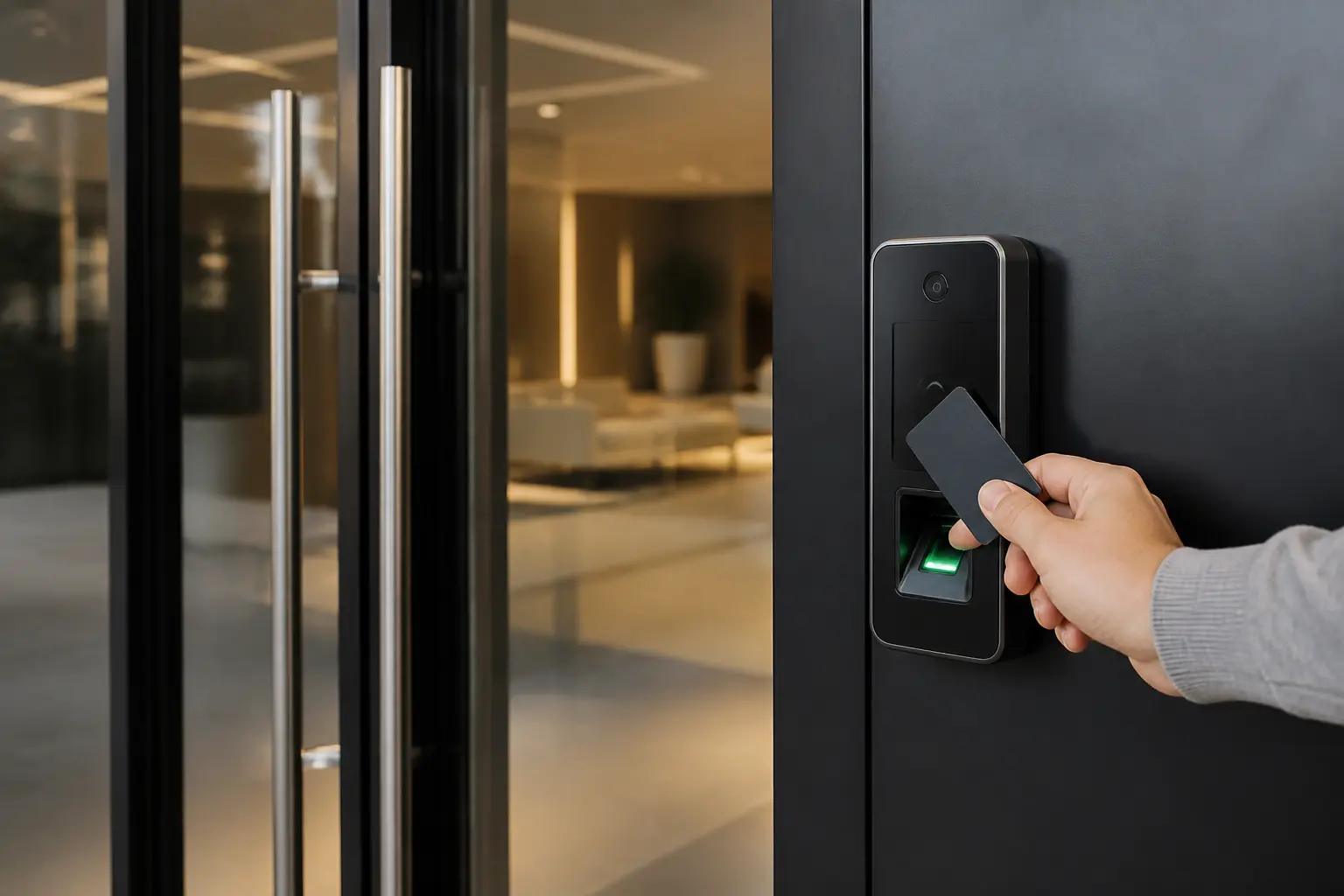
An access control system manages who can enter a building or space, and when — replacing traditional keys with credentials like fingerprints, cards, PINs, or mobile access. Instead of a simple lock, it's a system that controls multiple doors, tracks who entered and when, grants or revokes access instantly, and can restrict different people to different areas. Access control is used in homes, offices, housing societies, and hotels, and the right system depends on how many doors and users you have, the credentials you want, and whether you need logs, zones, and integration. Indicative cost in India starts from a few thousand rupees for a single door to significantly more for multi-door, multi-user commercial systems. This guide covers the types, uses, cost, and how to choose.
Keys get lost, copied, and can't tell you who came and went. An access control system solves all of this — controlling exactly who enters, where, and when. This guide explains how, and which system suits your needs.
Who Is This Guide For?
Homeowners, business owners, facility managers, and society/RWA committees in Noida, Greater Noida, Gurgaon, or Delhi NCR looking to control and secure entry to a home, office, building, or society. Architects and developers specifying access control for a project. And anyone wanting to understand access control systems, their cost, and how to choose.
What Is an Access Control System?
An access control system is a security setup that manages who is allowed to enter a space, and records their entry — using electronic credentials instead of physical keys. At its simplest, it's a reader at a door (for a fingerprint, card, or PIN) connected to a lock that opens only for authorised people.
But a full system does much more: it controls many doors, manages many users, keeps a log of every entry, lets you grant or revoke access instantly, and can restrict different people to different areas (zones). This is what makes it far more powerful than a lock — it's a complete system for managing entry, not just securing one door.
For a single home door, this overlaps with a smart door lock; for buildings with many doors and users, a dedicated access control system is needed.
How Do You Unlock — The Credential Types
Access control systems use one or more credential types to identify authorised people:
Biometric (fingerprint / face). The most secure and convenient — access tied to a person, nothing to carry or lose. Common in offices and premium homes.
RFID card / fob. Tap a card or fob to enter — familiar, easy to issue and revoke, ideal for offices, societies, and hotels where many people need access.
PIN code / keypad. Enter a numeric code — simple, no device needed, good for temporary or shared access.
Mobile access. Unlock via a smartphone app or Bluetooth — increasingly popular, with easy remote management.
Multi-factor. High-security areas may require two credentials (e.g. card + PIN) for extra protection.
The best systems support several credential types, letting you choose what suits each door and user group.
Access Control by Space Type
Different spaces have very different access control needs:
Homes. Securing the main door and gate, giving family keyless entry, and granting temporary access to guests or help — often integrated with the wider smart home security.
Offices. Controlling employee entry, restricting sensitive areas (server rooms, cabins), tracking attendance, and instantly revoking access when someone leaves. Access logs and zones are essential here.
Housing societies. Managing entry at gates and common areas for residents, staff, and visitors, with cards or app access for hundreds of users, and visitor management.
Hotels. Guest room access (often card or mobile-based) tied to check-in, plus staff access to service areas — a specialised form of access control.
Matching the system to the space — its scale, users, and security needs — is central to choosing well.
Key Features That Matter
Multi-door management. Controlling several doors from one system, each with its own access rules.
User management. Easily adding and removing users, and setting who can access what — crucial for offices and societies with changing people.
Access logs. A record of who entered which door and when — invaluable for security, investigations, and accountability.
Zones and time rules. Restricting people to certain areas, and certain times (e.g. staff only during working hours).
Instant revocation. Removing someone's access immediately — the moment an employee leaves or a card is lost — with no lock to change.
Integration. Tying access control into CCTV, alarms, and the wider security or building system for coordinated protection.
Reliability & backup. The system must work every time, with power backup so entry isn't compromised during outages.
What Does an Access Control System Cost?
These are indicative estimates for planning only, not quotes. Actual cost depends on the number of doors and users, credential types, features, and integration — confirmed after an assessment.
| Scope | What It Covers | Indicative Cost |
|---|---|---|
| Single door (home / small office) | One reader + lock, basic credentials | ₹5,000 – ₹25,000 |
| Multi-door office | Several doors, user management, logs | ₹25,000 – ₹1,50,000+ |
| Society / building | Gates, common areas, many users, visitor mgmt | Varies widely |
| Hotel | Room + staff access, PMS integration | Project-based |
Cost is driven most by the number of doors and users, the credential types (biometric costs more than basic), and the features (logs, zones, integration). For a single home door, it overlaps with smart-lock pricing; for commercial systems, it scales with doors and complexity. As with all security, reliability and proper design matter more than the cheapest quote.
How to Choose the Right Access Control System
- How many doors and users? This determines whether you need a simple lock or a full multi-door system.
- What credentials suit you? Biometric for security, cards for many users, mobile for convenience, PIN for simplicity.
- Do you need logs and zones? Essential for offices and societies; less so for a single home.
- Does it need to integrate? With CCTV, alarms, or your smart home for coordinated security.
- How important is remote management? For multiple sites or many users, app-based management matters.
- What about reliability and backup? Non-negotiable — the system must work every time, including power cuts.
Matching these to your specific space and needs — rather than buying a generic system — is how you choose the right one. A professional assessment ensures the system fits your doors, scale, and security requirements.
Why Use a Professional for Access Control
Correct system design. Sizing the system to your doors, users, and security needs — and planning zones, logs, and rules properly.
Proper installation. Readers, locks, wiring, and controllers installed correctly and securely, with power backup.
Integration. Tying access control into CCTV, alarms, and the wider system for coordinated security, rather than a standalone island.
Reliability. Ensuring the system works every time, with the backup and build quality that security demands.
Support. Access control needs ongoing management — adding users, adjusting rules — so local support matters.
Expert Recommendation from Brightmatic
For the access control we design across Delhi NCR — from homes to offices and societies — our approach starts with the questions that actually determine the right system: how many doors, how many users, and what do you need to control and know? From there we design the credentials, zones, logs, and integration to suit.
The insight worth passing on: people often think of access control as just a fancier lock. It isn't. Its real power is management and accountability — the ability to know exactly who entered where and when, to grant a contractor access to one area for one day, and to revoke a departed employee's access instantly without changing a single lock. A lost key is a security hole that costs money and worry to fix; a revoked credential is a non-event. That control is what access control delivers, and it's why it scales so well from a single home door to an entire building. Design it around who needs to go where — and the security, and the peace of mind, follow.
That's the thinking behind our security and access control approach — protection that's Crafting Brighter Lives.
Planning Access Control?
An access control system gives you something keys never can — complete control and a clear record of who enters your space, and the power to change it instantly. Whether for a home, office, society, or hotel, the right system is designed around who needs to go where.
Want to control and secure entry properly? Get a free consultation.
Securing a home, office, or society in Noida or Delhi NCR? Contact Brightmatic for a personalised access control consultation.
FAQ's
What is an access control system?
An access control system manages who can enter a building or space, and when, using electronic credentials like fingerprints, cards, PINs, or mobile access instead of keys. It can control multiple doors, track who entered and when, grant or revoke access instantly, and restrict people to certain areas. It's a complete system for managing entry, more powerful than a single lock.What are the types of access control systems?
Access control systems are categorised by credential type: biometric (fingerprint or face), RFID card or fob, PIN code, and mobile access, with high-security areas sometimes using multi-factor (two credentials). Systems range from single-door setups for homes to multi-door systems for offices, societies, and hotels, with user management, logs, and zones. The best support several credential types.How much does an access control system cost in India?
Indicatively, a single-door system starts around ₹5,000–25,000, a multi-door office system runs ₹25,000 to over ₹1,50,000, and society or hotel systems vary widely with scale. Cost depends on the number of doors and users, credential types (biometric costs more), and features like logs and integration. These are indicative estimates confirmed after an assessment.What is the difference between an access control system and a smart lock?
A smart lock secures a single door with keyless entry. An access control system is broader — it manages multiple doors and many users, keeps entry logs, controls zones and time rules, and allows instant access revocation across a building. For a single home door, a smart lock may suffice; for offices, societies, and multi-door needs, a full access control system is required.Which access control system is best for an office?
For an office, the best system controls multiple doors, manages employee access with easy adding and removing of users, keeps access logs, restricts sensitive areas with zones, and integrates with CCTV. Card or biometric credentials suit offices well, with the ability to instantly revoke access when someone leaves. The right choice depends on the number of doors, users, and security needs.
Comments
No Comments